The gap is measurable. In a 2023 McKinsey survey of 706 middle managers, only 20% strongly agreed that their organization equipped them to succeed as people managers. Most had never received formal training for the job they were promoted into.
This guide breaks down what middle managers actually need to learn, how to build a training program step-by-step, which delivery methods work best, and how to prove the investment paid off.
Key Takeaways
- Middle managers directly shape team performance, retention, and execution, making their training a top priority
- Generic courses fail; effective programs start with a tailored needs assessment
- Effective programs balance hard skills like budgeting with soft skills like communication and coaching
- Experiential, scenario-based learning beats passive classroom instruction for retention
- KPIs, 360-degree feedback, and retention data prove ROI and guide what to improve next
Why Middle Manager Training Deserves Priority
Middle managers are the connective glue between the C-suite and the frontline. They're usually the first people to translate a strategic goal into a real assignment, a deadline, or a difficult conversation. When that translation breaks down, strategy dies in the handoff.
Most middle managers get there through technical excellence, not leadership readiness. A top salesperson becomes a sales manager. A skilled engineer becomes an engineering lead. The skills that earned the promotion rarely overlap with the skills the new role demands.
This creates the classic "sink or swim" problem:
- Managers are promoted for individual output, not people-leadership ability
- Formal transition training is rare or nonexistent
- New managers learn management by trial and error, often at their team's expense
- Mistakes made in year one can shape a manager's habits for a decade
The stakes go beyond individual frustration. Well-designed leadership development correlates with stronger organizational performance. LinkedIn Learning's 2025 research found that companies with mature, broad career-development practices, including leadership training, reported greater confidence in their business outlook and stronger readiness for change. This kind of development functions as operational infrastructure, shaping outcomes rather than simply boosting morale.
The Cost of Neglecting Middle Management Development
Leaving this layer untrained creates a compounding cost across the organization.
- Manager burnout climbs. Gallup found that 35% of US managers reported feeling burned out very often or always in 2021, up from 28% the year before
- Turnover follows poor management. Gallup also reports that half of all employees have left a job specifically to get away from their manager at some point in their career
- Frontline engagement suffers. Managers account for a large share of the variance in team engagement scores, so an undertrained manager's struggles ripple across the entire team
- Strategic execution stalls. Without a manager who can translate vision into action, even the best executive strategy stops at the department door
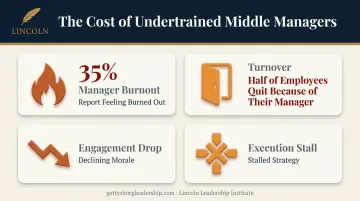
None of this is abstract. It shows up as missed deadlines, exit interviews citing "my manager," and strategic initiatives that quietly lose momentum three layers down from the leadership team that launched them.
Core Skills and Competencies Middle Managers Need
Every effective program should build a foundation across a defined set of competencies, not a scattershot list of leadership buzzwords. The essentials include:
- Communication — delivering clear direction and difficult feedback
- Delegation — assigning work without micromanaging or dropping it entirely
- Conflict management — resolving friction before it becomes dysfunction
- Decision-making under pressure — acting decisively with incomplete information
- Accountability — holding others to standards without damaging trust
- Strategic thinking — connecting daily tasks to broader company goals
Emotional intelligence deserves special attention. Studies on managerial effectiveness show that a leader's emotional intelligence predicts subordinate performance even after accounting for cognitive ability and personality traits, making it a measurable skill rather than a soft add-on.
Formal EQ assessments help pinpoint individual gaps rather than guessing at them. At Lincoln Leadership Institute, Dr. Jared Peatman is certified to administer the EQ-i 2.0 and EQ360 assessments, giving participants a data-backed starting point instead of a generic self-reflection exercise.
Building these competencies requires more than skill acquisition, though; the mindset shift matters just as much as the skill set. New managers must stop measuring their value by what they personally produce and start measuring it by what their team produces. That shift rarely happens on its own; it needs deliberate coaching, feedback, and practice over time.
The 5 C's of Middle Management
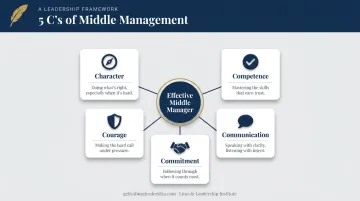
Many leadership programs frame core competencies around five pillars:
- Character — doing the right thing when no one is watching
- Competence — the technical and functional skill to do the job well
- Communication — clarity in both direction and listening
- Commitment — following through on decisions, even hard ones
- Courage — making unpopular calls and owning the outcome
These aren't independent traits. A manager can be highly competent but lack the courage to deliver hard feedback, or communicate well but lack the character to follow through when it's inconvenient. Strong middle managers develop all five together.
Balancing Hard Skills and Soft Skills
Technical fluency still matters. Budgeting, project management, and running a performance review are functional skills a manager has to execute correctly.
But technical skill without interpersonal skill produces a manager who hits deadlines while burning out their team. The strongest programs pair:
- Budgeting and resource planning with empathy in performance conversations
- Project management discipline with influence and coaching ability
- Data-driven decision-making with the emotional read to know when a decision needs more input first
Neither half works alone. A manager who can build a flawless project plan but can't rally a team around it will still miss the deadline.
How to Train Middle Managers: Building an Effective Program
A meta-analysis covering 335 independent samples of leadership training programs found four factors that predict whether training actually transfers back to the job. Those factors are needs analysis, practice opportunities, spaced sessions, and multiple delivery methods. Here's how to build a program around those principles.
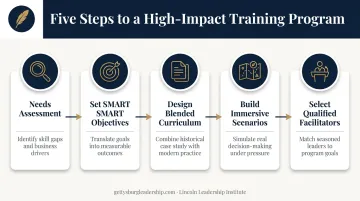
Step 1: Conduct a Training Needs Assessment
Before designing anything, find out what's actually broken. Use:
- Employee and manager surveys to surface perceived gaps
- Performance evaluation data to spot recurring weak points
- 360-degree feedback to compare self-perception against how others experience the manager
- One-on-one interviews to catch nuance that surveys miss
Skipping this step is how organizations end up buying a generic course that solves problems nobody has.
Step 2: Set Clear, Measurable Objectives
Vague goals like "improve leadership" don't hold anyone accountable. Apply the SMART framework instead: Specific, Measurable, Assignable, Realistic, Time-related.
Example objective: "Increase team engagement survey scores for participating managers by 10 percentage points within six months of program completion."
That's a target you can actually track and report on.
Step 3: Design a Progressive, Blended Curriculum
Start with foundational concepts (what good delegation or feedback actually looks like) before layering in advanced application like leading through a reorganization or a budget cut. Combine:
- Theory and frameworks
- Real case studies from within or outside the organization
- Interactive exercises that force decisions, not just discussion
Step 4: Build in Real-World and Immersive Scenarios
Role-play and case studies bridge the gap between theory and practice, but they have limits: participants often know it's "just an exercise."
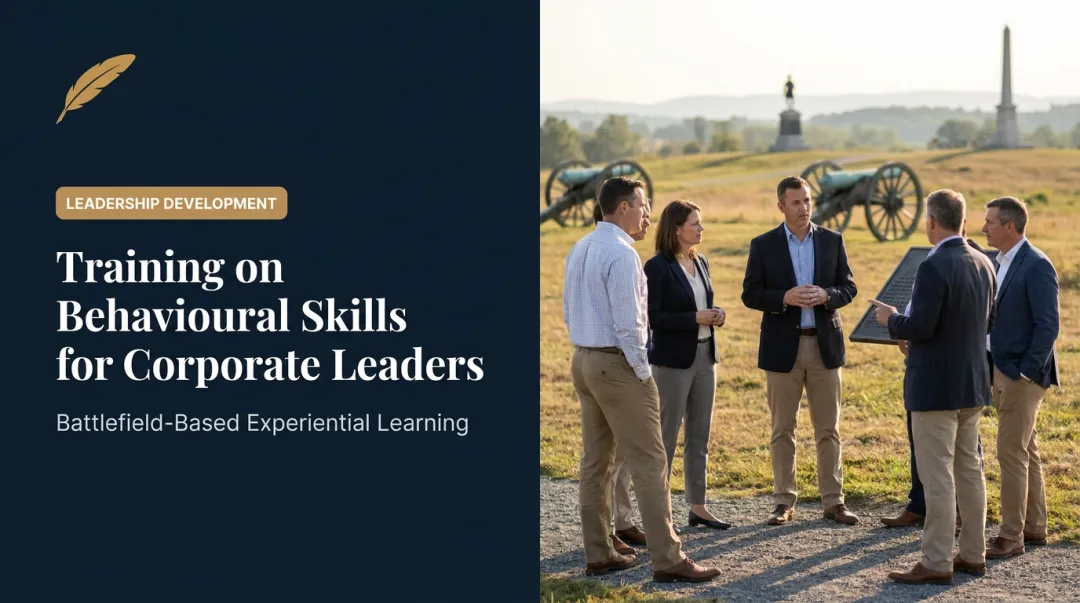
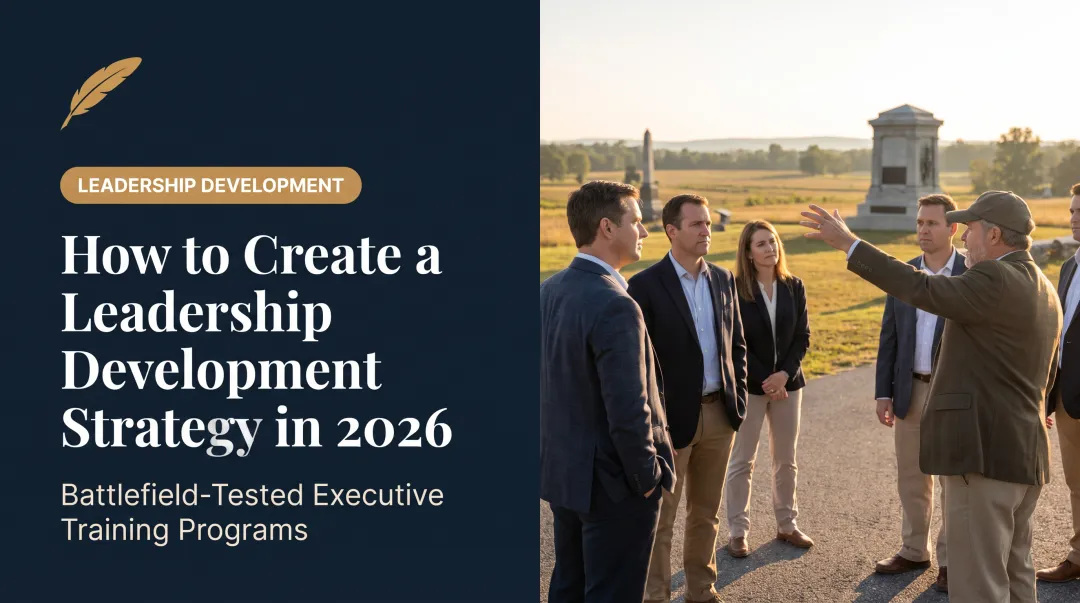
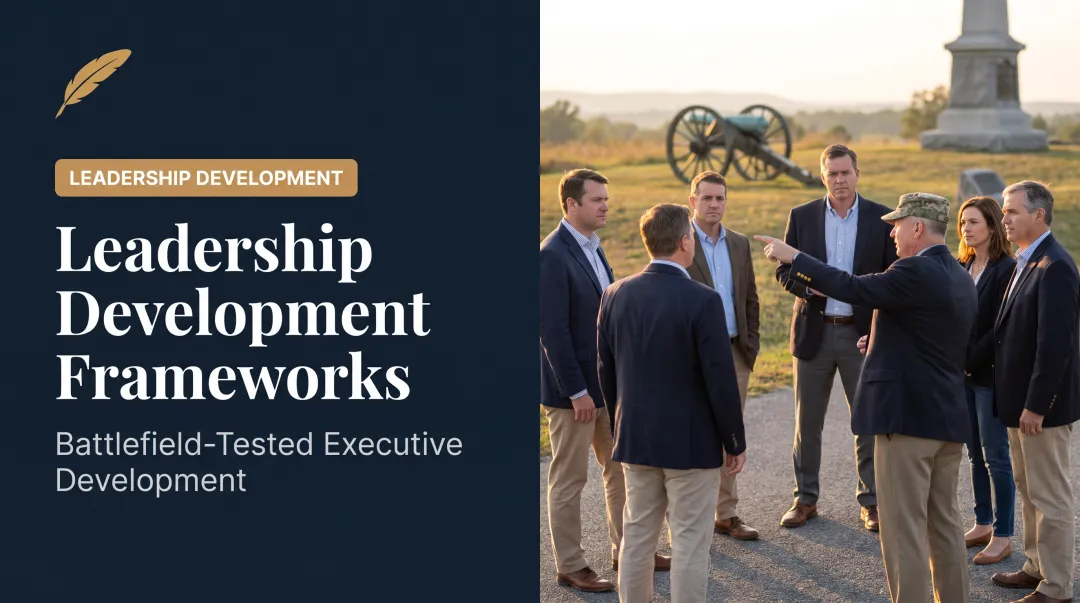
Immersive, high-stakes simulations remove that safety net. Lincoln Leadership Institute's battlefield programs put participants in the actual terrain where historic leaders made irreversible decisions with incomplete information.
At Gettysburg, groups work through the same command choices Union and Confederate officers faced. At Pearl Harbor, the scenario shifts to crisis response under sudden, catastrophic pressure.
This format works because the stakes feel real, even though the setting is historical. Participants report a different depth of engagement than they do sitting in a conference room reviewing a hypothetical case study.
Step 5: Select Qualified Facilitators
The facilitator makes or breaks the program. Look for:
- Real leadership or industry experience, not just theoretical credentials
- Credibility: someone participants will actually listen to
- Adaptability to adjust on the fly when a group needs something different
- Strong facilitation skills, since knowing the content and teaching it are different abilities entirely
Programs built around former military commanders, retired executives, and historians tend to land differently than ones led purely by academic instructors. The lived experience gives the lessons weight.
Choosing the Right Training Delivery Methods
No single format covers everything a middle manager needs. Each has a distinct strength:
| Delivery Method | Best For | Limitation |
|---|---|---|
| In-person/classroom | Deep engagement, group discussion | Harder to scale across locations |
| Virtual/online | Accessibility for distributed teams | Less immersive, easier to disengage |
| Coaching & mentoring | Individualized behavior change | Resource-intensive per manager |
| On-the-job training | Immediate application | Inconsistent without structure |
According to a 2017 meta-analysis on leadership training published in the Journal of Applied Psychology, face-to-face delivery was consistently a favorable factor in program outcomes. Programs using multiple delivery methods together also produced stronger results than any single format alone.
The practical takeaway: blend formats rather than picking one.
- Pair immersive, in-person experiences that build judgment and composure under real pressure
- Add flexible virtual sessions to extend reach and reinforce lessons afterward
- Layer in individual coaching for lasting behavior change
Lincoln Leadership Institute's Private Team Experience model reflects this — a fully customizable, on-site immersion for 8 to 20 participants from a single organization, often reinforced through virtual sessions and individual coaching.
Measuring the Effectiveness of Middle Manager Training
If you don't measure training, you can't tell whether it worked. Build measurement into the program from day one, not as an afterthought.
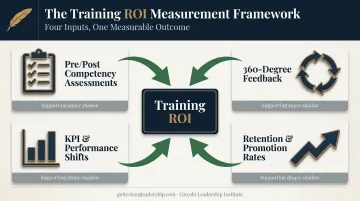
Pre- and post-training competency assessments give you a baseline and a comparison point. Use structured tools, such as validated assessments like EQ-i2.0, rather than relying on participant self-report alone.
360-degree feedback and engagement surveys reveal whether behavior actually changed on the team, not just whether the manager enjoyed the session.
Multisource feedback alone rarely moves the needle. Pair it with specific development goals and follow-through coaching, then track the data as action instead of a report card.
Track business-outcome metrics over time:
- KPI or performance shifts in the manager's team
- Retention rates for trained managers versus untrained peers
- Internal promotion rates among program participants
None of these numbers mean much in isolation. The value comes from comparing before and after, or comparing a trained group against a similar untrained group, over a defined period.
Frequently Asked Questions
How do you train middle managers?
Start with a needs assessment to uncover real skill gaps, then set specific, measurable objectives. Build a blended curriculum of theory, case studies, and hands-on practice, and track results continuously rather than treating training as a one-time event.
What skills do middle managers need?
The core categories are communication, delegation, conflict management, emotional intelligence, and strategic decision-making. Accountability and sound decision-making under pressure complete the list.
What are the 5 C's of management?
Character, Competence, Communication, Commitment, and Courage form a common framework for middle management effectiveness. Each pillar reinforces the others — competence without courage, for example, rarely produces a strong leader.
How long should a middle management training program last?
Effective programs are ongoing, not one-off events. Many organizations combine a short, intensive immersive session with continuous coaching and reinforcement over several months.
What is the most effective training method for middle managers?
Blended approaches outperform single-format programs. Combining immersive, experiential learning with ongoing coaching and flexible virtual touchpoints produces the strongest, most lasting behavior change.
How do you measure the ROI of middle manager training?
Track shifts in team KPIs, engagement scores, and retention or promotion rates for trained managers versus untrained peers. Pair this with pre- and post-training competency assessments to isolate the program's impact.