Real innovation development requires something different. It needs activities that build psychological safety, normalize creative risk-taking, and give teams a repeatable structure for generating ideas under pressure. Generic games create a short-term engagement bump, but they rarely change behavior once people are back at their desks facing a hard problem.
This guide covers the activities that build measurable innovation skills, how to match the right one to your team's specific gap, and how to prove it actually worked instead of just filling an afternoon.
TL;DR
- Innovation team building must build psychological safety, structured ideation skills, and comfort with risk—not just icebreakers.
- Crazy 8s, 6-3-5 Brainwriting, Innovation Constraints, Reverse Brainstorming, and decision simulations each target a distinct skill.
- Match each activity to your team's maturity level and a specific goal, not its "fun factor."
- Lasting results need debriefs, tracked metrics, and reinforcement through follow-up leadership development.
Overview of Innovation Team Building in Today's Workplace
Innovation-focused team building goes beyond morale-boosting games. These activities are designed to build creative confidence, get teams collaborating across functional lines, and encourage calculated risk-taking, skills that show up later in how a team actually approaches problems.
The research backs this up. A 2017 meta-analysis covering 136 independent samples and more than 22,000 people found that psychological safety correlates with team creativity at rho = .29 at the group level.
That's a meaningful, well-documented association, not a guarantee. It's still the strongest evidence available that teams who feel safe taking interpersonal risks generate more creative output.
That's the filter for everything below. The activities in this guide are ranked by how directly they build a measurable innovation skill, not by how many people laughed during the debrief.
Top Innovation Team Building Activities That Drive Real Results
Each activity below was selected because it targets one specific innovation outcome: idea volume, cross-team collaboration, comfort with failure, or decision-making under pressure. None of them are interchangeable.
Crazy 8s / Rapid Ideation Sprint
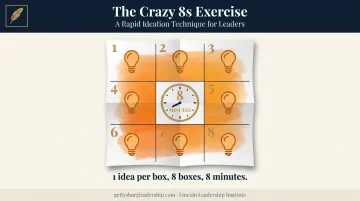
Crazy 8s comes from Google's Design Sprint methodology. Each participant folds a sheet of paper into eight sections and sketches eight distinct ideas in eight minutes, one per box. The pace is the point.
Google's own facilitation guidance says the goal is to move past everyone's first idea (usually the least original one) and "quiet the inner critic." The tight clock doesn't leave room for perfectionism to take over.
What makes it different: it's one of the fastest ways to generate raw idea volume for later refinement. You're not looking for a finished concept here, you're stockpiling raw material.
| Time & Group Size | 10-12 minutes; works individually or in groups of 4-8 |
| Primary Skill Built | Rapid ideation, reducing fear of "bad ideas" |
| Best Used For | Early-stage brainstorming on a specific problem or product challenge |
6-3-5 Brainwriting Method
This one is structured almost to the point of feeling rigid, and that's exactly why it works. Six participants each write three ideas in five minutes, then pass their sheet to the next person, who builds on those ideas. Repeat for six rounds.
The theoretical ceiling is 108 idea entries in 30 minutes. In practice, you get fewer truly unique concepts since people build on what's already there, but the volume still dwarfs a typical open discussion.
The mechanism here is called "production blocking." In a normal group brainstorm, one person talks while everyone else waits, forgets their point, or self-edits it into oblivion. Writing in parallel removes that bottleneck entirely.
- Every voice gets equal airtime since nobody has to compete to speak
- Quieter or lower-ranking team members contribute at the same volume as dominant personalities
- Mixing departments amplifies cross-functional thinking, since a marketing idea might get built on by an engineer three rounds later
| Time & Group Size | ~30 minutes; groups of 6 |
| Primary Skill Built | Collaborative idea-building and inclusive participation |
| Best Used For | Teams with dominant personalities or hierarchy that suppress open brainstorming |
Innovation Constraints Challenge
Take away the whiteboard software. Cap the budget at a fixed number. Give the team 20 minutes instead of two hours. That's the entire premise of a constraints challenge, and it mirrors real business conditions more honestly than an open-ended brainstorm ever will.
A 2022 meta-analysis of 111 studies found a modest, positive relationship between constraints and creative performance (r = .17). The effect isn't universal, though. Financial constraints showed a stronger positive association than time constraints, and the relationship depends heavily on how the constraint is designed.
The practical takeaway: constraints work best when they're tight enough to force new thinking but not so severe that they kill motivation. A team told to solve a problem with "no budget at all" often just gives up.
| Time & Group Size | 20-30 minutes; small teams of 3-5 |
| Primary Skill Built | Resourcefulness and adaptive problem-solving under real-world limits |
| Best Used For | Teams preparing to innovate within tight budgets, timelines, or regulatory constraints |
Reverse (Negative) Brainstorming
Instead of asking "how do we fix this," ask "how do we make this problem as bad as possible?" Teams brainstorm every way to worsen a situation, then flip each idea into its opposite to surface a solution.
The documented sequence is simple: reverse the question, generate ways to cause or worsen the problem, then reverse those ideas back into potential fixes. It's a well-established practitioner method for exposing hidden faults in a process or product that direct brainstorming tends to miss.
There's a psychological upside, too: criticizing a "how to fail" scenario feels a lot safer than critiquing someone's actual proposal in the room.
| Time & Group Size | 20-30 minutes; any group size |
| Primary Skill Built | Root-cause thinking and identifying blind spots |
| Best Used For | Teams stuck on a persistent, recurring problem |
Historical Decision-Point Simulation
This is the outlier on this list, and deliberately so. Instead of a structured brainstorming exercise, teams are placed at an actual historical turning point, given the incomplete information available to the real decision-makers at the time, and asked to make a call before learning what actually happened.
Lincoln Leadership Institute's Gettysburg Leadership Journey uses this exact approach. Participants work through moments like Pickett's Charge, where a breakdown in communication between General Longstreet and his commanders contributed to roughly 7,500 casualties in a single afternoon.
Guided by historians, licensed battlefield guides, and former military commanders, the exercise puts leaders in a position where they have to decide, defend that decision, and then confront the actual historical outcome.
Why does this build innovation courage rather than just historical trivia? Because most innovation failures aren't idea-generation failures. Teams already have plenty of ideas sitting in a shared drive somewhere. What they lack is the willingness to commit to one under uncertainty, which is precisely the muscle this format trains.
| Time & Group Size | Half-day to multi-day immersion; scalable to large cohorts |
| Primary Skill Built | Decisive action under pressure and values-based risk-taking |
| Best Used For | Leadership teams needing to build innovation courage, not just idea generation |
How to Choose the Right Activity for Your Team's Innovation Goals
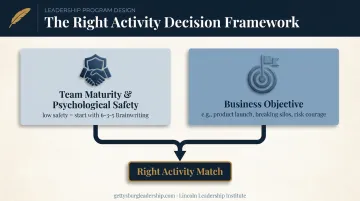
The most common mistake: picking an activity because it looks fun on a vendor's website, not because it addresses a real gap. A team that's already comfortable generating ideas doesn't need Crazy 8s. A team that hasn't built basic trust yet will struggle with an advanced ideation exercise, and it can backfire into forced participation and awkward silence.
Before booking anything, assess two things:
- Team maturity and psychological safety. If people are still hesitant to disagree with a manager in a meeting, start with a lower-stakes format like 6-3-5 Brainwriting before attempting something as intense as a decision-point simulation.
- A concrete business objective. Are you preparing for a product launch? Breaking down silos between engineering and sales? Building courage ahead of a risky strategic bet? The objective should drive the activity, not the reverse.
Group size and customization matter here too. Lincoln Leadership Institute structures its programs around this exact tradeoff:
| Format | Group Size | Best For |
|---|---|---|
| Private Team Experience | 8-20 participants, one organization | Custom case studies built around your specific challenge |
| Open Enrollment | 3-5 leaders, mixed companies | Broader perspective, no tailored content |
| Enterprise Partnership | Multi-year cohorts | Long-term innovation capability, not a one-off event |
Once you've matched the format to your objective, lock in your follow-up plan before the session even begins. Decide now what you'll measure and when, not after everyone's back at their desks.
Measuring Real Results: From Activity to Business Impact
An activity only proves its worth when it's tied to a measurable before/after shift. That could be idea volume in the next brainstorm, speed of decision-making on a live project, or a jump in psychological safety scores on your next engagement survey.
A 2017 systematic review and meta-analysis published in PLOS ONE covering 51 studies and 8,439 participants found that controlled, teamwork-training interventions produced a standardized mean difference of d = .919 for team performance. Passive, lecture-style instruction alone wasn't enough, the review found. The gains came from active, experiential formats, not slideshows.
To quantify shifts at the individual level, validated pre/post tools matter. Lincoln Leadership Institute's Dr. Jared Peatman is certified to administer the EQ-i2.0 and EQ360 Emotional Intelligence Assessments. These give organizations a way to measure changes in self-awareness and team dynamics before and after an experiential program, rather than relying on gut feel.
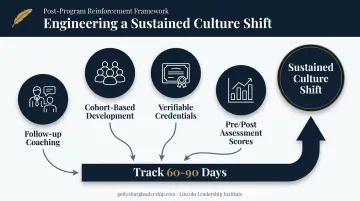
Assessment scores capture a moment, not a habit. A single session, however good, fades without reinforcement. That's why lasting programs pair the activity with:
- Follow-up coaching to keep new behaviors alive past week one
- Cohort-based development that revisits skills over multiple sessions
- Verifiable credentials, such as LLI's Leadership Excellence Certificate Program with Purdue University Global, that convert one experience into a LinkedIn-shareable credential
Track results for 60-90 days, not 60 minutes. That window is what separates a genuine culture shift from a short-term morale boost that evaporates by the next quarterly review.
Conclusion
Real innovation results come from matching an activity to a specific skill gap, whether that's idea volume, cross-team trust, or comfort with risk. Picking whatever looks the most novel on a slide deck won't get you there.
Pair any team-building activity with a measurement plan and genuine leadership follow-through, or the impact won't outlast the coffee served at the event.
If your team is ready for a deeper, evidence-based approach to innovation courage, Lincoln Leadership Institute's battlefield-based programs are worth a look. The Gettysburg Leadership Journey, for example, puts teams in exactly the kind of high-stakes, incomplete-information scenarios that build lasting innovation behavior.
Frequently Asked Questions
What are some creative team building activities?
Standout examples include Crazy 8s, Innovation Constraints Challenges, and historical decision-point simulations. What separates them from standard icebreakers is a specific target: idea volume, resourcefulness, or decisive risk-taking, not just group fun.
What are the 7 C's of innovation?
There's no single authoritative "7 C's" framework. One commonly used version includes Curiosity, Creativity, Collaboration, Communication, Commitment, Courage, and Culture, and structured team activities can reinforce each one directly.
How do you measure the ROI of team-building activities on innovation?
Use validated pre/post assessments like EQ-i2.0 (Lincoln Leadership Institute's faculty are certified administrators), and track concrete metrics such as idea volume, decision speed, or psychological safety survey scores before and after the activity.
How often should teams do innovation-focused team building?
Aim for a regular cadence, quarterly or ahead of major initiatives, rather than a single annual event. Innovation behaviors fade without reinforcement.
Can innovation team building activities work for remote or hybrid teams?
Brainwriting and constraint challenges adapt well virtually since written, parallel ideation often generates more ideas than in-person brainstorming. Immersive historical simulations typically require in-person attendance for full impact.
What makes experiential, immersive programs more effective than typical office team building?
High-stakes, real-world scenarios, whether historical or simulated, create deeper behavior change than low-stakes office games because participants must commit to a decision and face its consequences.