This isn't a hypothetical. For executives, hospital administrators, financial leaders, and government officials, moments like this happen more often than most job descriptions admit. Pressure isn't an occasional crisis anymore. It's a Tuesday.
The good news: how someone performs in that moment isn't fixed at birth. Performance under pressure is a trainable skill, and a growing number of organizations are building structured programs to develop it across their leadership pipeline.
This guide breaks down why people falter under stress, the specific skills that keep leaders composed, the training methods with real evidence behind them, and how experiential approaches, including battlefield-based leadership training, are producing measurable results for Fortune 1000 companies and government agencies.
Key Takeaways
- Performing well under pressure is built through deliberate practice, not an innate "clutch gene"
- Stress turns harmful when a situation feels like a threat; training can reframe it as a challenge
- Strongest programs combine skill mastery, simulated stress exposure, and structured debriefing
- Immersive environments accelerate readiness by recreating the ambiguity and stakes leaders face
Why Do Leaders Underperform Under Pressure? The Science Behind Choking
Pressure is any factor that raises the stakes of performing well: a deadline, an audience, a consequence for failure. How the brain interprets that pressure, more than the pressure itself, determines the outcome.
Challenge vs. Threat: The Split That Decides Performance
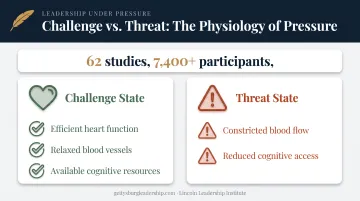
When someone perceives their resources as sufficient for the demand in front of them, their body enters what researchers call a challenge state. The heart pumps more efficiently, blood vessels relax, and cognitive resources stay available.
When perceived demand outweighs resources, the body shifts into a threat state, and performance suffers.
A 2025 meta-analysis spanning 62 studies and more than 7,400 participants confirmed that people in a challenge state consistently outperformed those in a threat state, though the size of that advantage varied by task and person. Appraisal isn't just a feeling. It's a measurable factor in how well someone performs.
What Stress Does to the Brain Under Load
Acute stress doesn't shut the brain off. It reallocates it. A 2016 meta-analysis found that acute stress meaningfully impairs working memory and cognitive flexibility—the exact mental functions leaders rely on to weigh options and pivot when a plan stops working.
Under load, that same response also:
- Narrows attention and crowds out peripheral information
- Pushes decisions toward gut-level heuristics instead of deliberate analysis
- Works fine for routine choices, but misfires in unfamiliar, high-stakes situations
There's No Universal "Optimal" Zone, But There Is a Trainable One
The Yerkes-Dodson concept suggests performance rises with arousal up to a point, then declines. That point shifts depending on task difficulty: simple tasks tolerate high arousal well, while complex tasks involving memory and divided attention degrade much sooner.
The real training goal isn't eliminating stress. It's widening the arousal zone in which someone can still think clearly and act decisively.
If composure under pressure has felt out of reach, the usual explanation is simpler: not enough realistic reps. That capacity is built through repeated, deliberate exposure—the focus of what follows.
Essential Skills You Need to Perform Well Under Pressure
Composure under pressure isn't one skill. It's a cluster of abilities that work together when the stakes rise.
- Decisive decision-making. Act on incomplete information before the window closes. Faculty like Admiral Scott Moore and Dave Cooper built careers on making the call when time and data are both limited.
- Emotional regulation. Use breathing and self-talk to keep arousal from hijacking judgment when pressure spikes.
- Situational awareness. Filter signal from noise so stress doesn't lock your attention on the loudest cue instead of the most important one.
- Clear communication under stress. Miscommunication often does more damage than the crisis itself. Faculty member Dennis Owens stresses clarity and credibility over polish when the stakes are high.
- Trust in training. Rehearse until instinct takes over and you stop overthinking every move. That confidence is earned only through repetition.
- Adaptability. Drop a failed plan without losing the team. Avoid "tactical fixation"—changing course mid-crisis is what separates good leaders from great ones.
None of these skills are exotic. What's rare is practicing them under real stress—not only reading about them in a slide deck.
Proven Methods to Train Performance Under Pressure
No single technique builds pressure tolerance on its own. The strongest programs layer several methods together and treat the process as ongoing practice, not a one-time event.
- Stress inoculation training (SIT). Built on a three-phase model—education, skill rehearsal, and applied practice under simulated stress—SIT has reduced performance anxiety across military, medical, and athletic fields for decades.
- Simulation and scenario-based practice. Introducing time pressure, fatigue, or ambiguity into training lets the brain and body acclimate before the real event.
- Mental rehearsal and visualization. Vividly imagining a high-pressure scenario activates brain regions used in real performance and reinforces the pathways live practice builds.
- Debriefing and reflection. A structured after-action review turns stress into a lasting lesson instead of a lingering scar—yet this is the step programs most often skip.
- Immersive, real-world experiential learning. Placing leaders in unfamiliar, high-stakes settings—such as historic battlefields—builds composure that transfers back to the boardroom. It is often the most effective method and the most underused, because it is harder to design than a lecture.
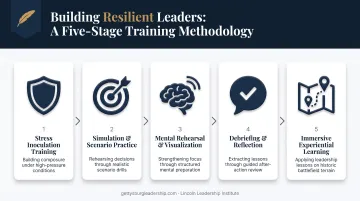
The common thread across all five methods: repeated exposure, skill mastery, and honest reflection afterward. Programs that lean on only one of these three tend to plateau quickly.
Inside Lincoln Leadership Institute's Battlefield-Based Approach
Most corporate leadership training happens in a hotel conference room. Lincoln Leadership Institute takes a different route entirely.
Learning Where History's Highest-Stakes Decisions Were Made
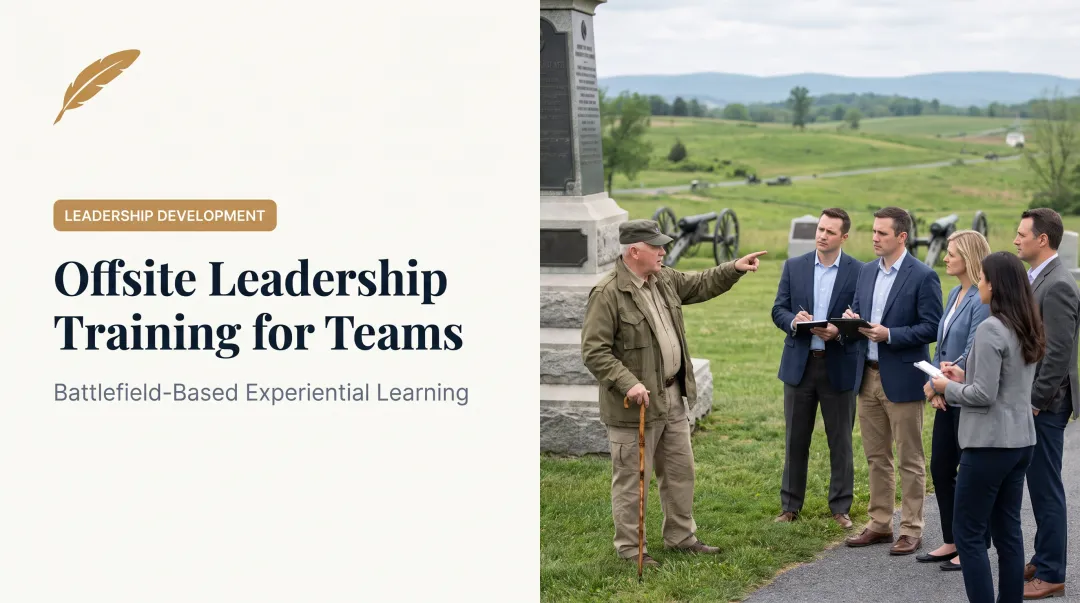
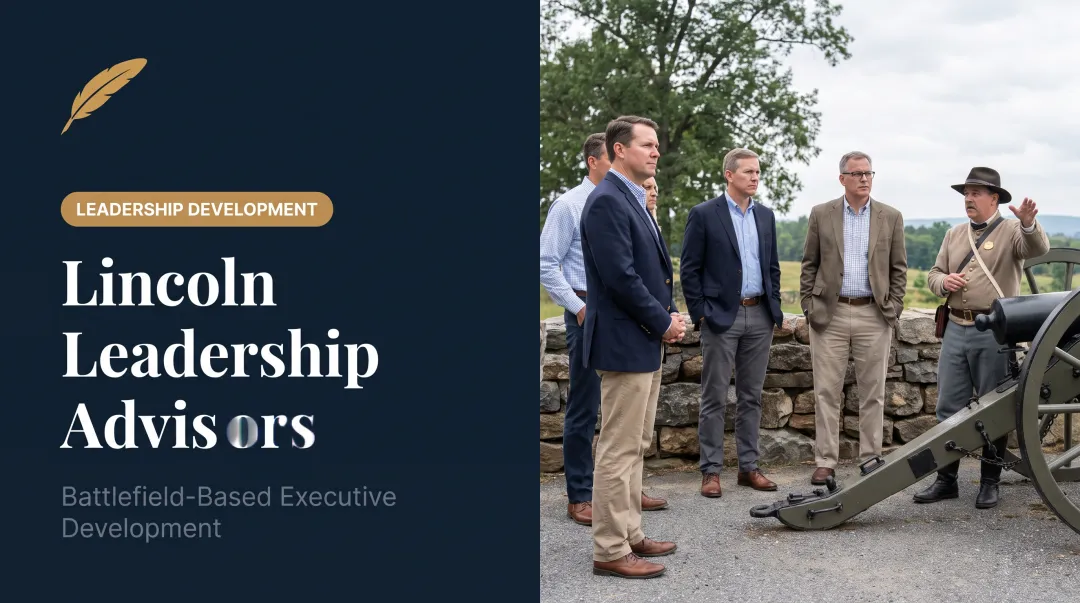
Rather than lecturing about pressure, LLI immerses leaders at the historic sites where consequential decisions had to be made in real time: Gettysburg, Normandy, Pearl Harbor, and the Alamo. Walking the ground where a commander had to decide—with incomplete information and no do-over—recreates the ambiguity leaders face in boardrooms and crisis rooms.
Faculty Who've Actually Been Under Fire
The credibility of this approach comes from who's teaching it:
- Admiral Scott Moore, a retired Navy Rear Admiral with 30+ years in Naval Special Warfare
- Dave Cooper, a U.S. Navy SEAL since 1988 and Command Master Chief
- Colonel (Ret.) Mark Erwin, former Chief of Staff of U.S. Army Special Operations Command
- Dennis Owens, an Emmy Award-winning political reporter with 15 Emmys and decades covering leaders under pressure
They translate decisions made on a battlefield or in front of a live camera into lessons corporate and government leaders can apply the same week they return to work.
Track Record and Credentials
LLI has delivered this work for more than 25 years. Proof points include:
- Over 40,000 leaders trained
- More than 25,000 Fortune 1000 and public-sector clients
- Organizations such as Pfizer, FedEx, GE, Milwaukee Tool, Huntington Bank, and the Department of Defense
- USA TODAY’s description of the training as “the most powerful performance training available”
Participants can also pursue LLI’s Leadership Excellence Certificate Program, delivered with Purdue University Global—an accredited credential that sits alongside the field experience.
Measurable Benefits for Individuals and Organizations
The value of pressure training shows up in two places: how individual leaders perform, and how the organization around them changes.
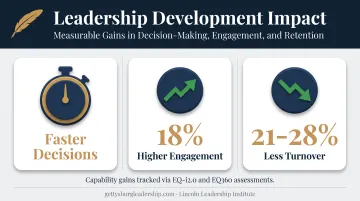
- Faster decisions under real-time constraints. Leaders who have practiced decision-making under simulated stress carry that skill into the boardroom, where the clock is just as unforgiving as on a battlefield.
- Stronger culture and retention. High-visibility development signals that the organization is serious about high-potential employees' growth. Gallup's research on manager development found trained managers' teams saw up to 18% higher engagement and 21% to 28% less turnover.
- Measurable leadership capability gains. Organizations pair training with pre- and post-program assessments. LLI's Dr. Jared Peatman is certified to administer the EQ-i2.0 and EQ360 assessments, so teams can track real change in composure and self-awareness.
Frequently Asked Questions
What skills do you need to work under pressure?
The core trainable skills are decisive decision-making, emotional regulation, situational awareness, clear communication, and adaptability. Each can be developed through deliberate practice rather than relying on natural temperament.
Why don't I perform well under pressure?
Underperformance usually comes from perceiving a situation as a threat rather than a challenge, often because you haven't rehearsed that specific type of stress before. More realistic practice, not more willpower, closes that gap.
What is performance under pressure training?
It's structured practice designed to build composure, decision-making, and communication skills using simulated or real high-stakes conditions. The goal is widening the range of stress a person can handle while still thinking clearly.
Can performing well under pressure really be trained, or is it a natural talent?
It's a learnable skill built through deliberate exposure and repeated practice. Even elite military and medical professionals develop this capacity through structured training.
How long does it take to see results from pressure training programs?
Measurable shifts in composure and decision-making can appear after just a few structured, immersive sessions. Sustained development, though, benefits from ongoing practice rather than a single event.
Which industries benefit most from performance under pressure training?
Corporate executives, healthcare providers, financial services professionals, defense leaders, and public sector officials all operate in high-stakes decision environments. That makes this training relevant across nearly every sector.