Here's the part most training programs miss: your team probably already knows what active listening looks like. They've heard the theory. What they lack is the habit.
Skills like clarity, feedback, and reading a room aren't built in a single workshop. They're built through repetition, the same way a sports team drills the same play until it becomes instinct.
This guide organizes communication team-building activities by the specific skill each one targets: icebreaking, trust and listening, problem-solving, and remote-friendly formats. We'll also cover how to facilitate them so the lessons actually stick.
Key Takeaways
- Communication activities build clarity, active listening, and trust: the foundation of high-performing teams
- Match the activity to your team's actual gap, not a random pick from a list
- Short, 10-15 minute exercises build habits better than one annual retreat
- The debrief matters as much as the activity itself
- Remote teams need adapted versions of classic exercises to stay engaged
Icebreaker Activities to Build Communication Skills
Icebreakers get dismissed as fluff. Done right, they're a low-stakes way to practice real communication skills before the stakes get higher.
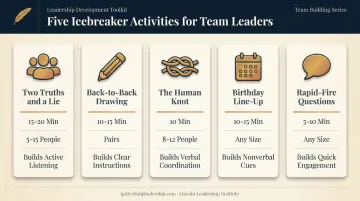
Two Truths and a Lie
Each person shares three statements about themselves, two true, one false, and the group guesses the lie. Works best with 5-15 people in 15-20 minutes.
This game sharpens active listening and nonverbal cue-reading. Players start noticing hesitation and tone shifts, skills that translate directly to spotting when a colleague is unsure in a meeting.
Back-to-Back Drawing
Pair up and sit back-to-back: one person describes an image while the other draws it without seeing it, ideally in 10-15 minutes.
The results expose vague language fast. "Draw a shape" fails. "Draw a circle, then a triangle on top" works. It's a quick lesson in precise, step-by-step instructions.
The Human Knot
Form a circle, grab two random hands across the circle, then untangle without letting go, ideally with 8-12 people in about 10 minutes. It forces real-time verbal coordination, since nobody can see the whole picture and the group must talk through every move.
Birthday Line-Up (No Talking Allowed)
Line up by birth month and day, silently, relying on gestures, finger counts, and eye contact, ideally in 10-15 minutes with any group size. It builds nonverbal communication skills that matter on loud warehouse floors or fast-paced trading desks, where talking isn't always an option.
Rapid-Fire Personal Questions
A quick round-robin of light personal questions, favorite vacation spot, worst meal ever eaten, that kind of thing. Runs 5-10 minutes regardless of group size, and works well for opening communication channels before a shift, a multi-location call, or a meeting that needs a warm-up.
Trust-Building & Active Listening Exercises
These activities go deeper than icebreakers. They put people in situations where miscommunication has an immediate, visible cost.
The Minefield (Blindfolded Obstacle Course)
One teammate is blindfolded and navigates an obstacle course using only a partner's verbal directions. Vague instructions ("go left a bit") lead to collisions. Precise ones ("three steps left, then stop") get people through clean.
It's one of the fastest ways to expose how much ambiguity costs in real-time direction-giving.
The Perfect Square
A blindfolded group holds a length of rope and tries to form a perfect square using only verbal coordination. No visual cues, no pointing. Someone has to take the lead on structure: corners, tension, spacing. The group has to agree on shared vocabulary to get there.
Telephone (Message Relay)
The classic: whisper a message down a line, then compare the last version to the original. It never survives intact.
This game illustrates something worth sitting with: information distorts without confirmation loops. Teams that build in a quick "here's what I heard" step lose far less in translation than teams that don't.
The Elephant in the Room
Anonymously collect one communication barrier from each person, then discuss the patterns as a group. When leadership goes first and shares its own barrier, it models the vulnerability that makes this exercise work instead of feel risky.
Shrinking Vessel
Confine the team to a taped-off area, then shrink it every few minutes. Space gets tight, and negotiation becomes necessary just to stay inside the lines.
Time and physical pressure change how teams communicate. Under deadline stress, teams typically exchange more messages, yet the quality of their decisions often drops as speed replaces clarity. Shrinking Vessel puts that same dynamic in front of your team, minus the real deadline.
Problem-Solving Communication Challenges
Once a team has the basics, problem-solving exercises test whether they can communicate under real cognitive load, not just social discomfort.
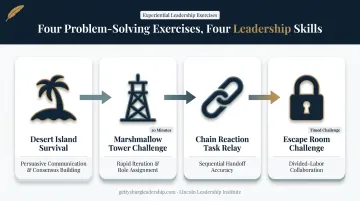
Desert Island Survival
Give the group a list of 20 survival items and ask them to narrow it to 5, then present their rationale. This forces persuasive communication, active listening to opposing views, and, eventually, consensus.
The Marshmallow/Spaghetti Tower Challenge
Build the tallest freestanding structure using spaghetti, tape, string, and one marshmallow, in 20 minutes. Time pressure forces rapid iteration and constant status updates. Teams that assign roles early consistently outperform teams that don't.
Chain Reaction Task Relay
Set up a sequence of dependent tasks where each action triggers the next, like a workplace handoff. One missed instruction early in the chain cascades into failure downstream, which makes an abstract point (communication gaps compound) impossible to ignore.
Escape Room or Team Puzzle Challenge
A timed, collaborative puzzle that requires dividing labor and negotiating under a clock. It's a bigger investment than a 15-minute icebreaker, so it works best for teams ready to go deeper.
There's real evidence behind it: a 2021 workplace study of 62 teams and 280 participants found self-reported belonging and morale rose sharply right after an escape room session. Both measures stayed above baseline a full month later. That's not proof of a productivity bump, but it's solid evidence that shared, high-pressure problem-solving builds real cohesion.
Virtual and Remote Team Communication Activities
Distance changes the math on communication. Buffer's 2023 State of Remote Work survey found 15% of remote workers cited collaboration and communication difficulties as a top struggle, and 30% said collaboration felt harder remotely than in person. These activities target that gap directly, and they work well as a lead-in to more structured formats like Lincoln Leadership Institute's virtual Lincoln Leadership Live sessions.
Decode the Emoji Message
Send a message built entirely from emoji and ask the team to interpret it. It's a fast, funny way to reinforce how much clarity matters in the asynchronous, text-heavy world of Slack and Teams, where tone and intent get lost easily.
Virtual Campfire or Story Sharing
An informal video call built around personal storytelling instead of an agenda. It builds rapport across time zones in a way status updates never will.
Rose, Thorn, Bud Check-In
Each person shares a win (rose), a challenge (thorn), and an opportunity (bud) in a structured round. It's low-pressure, repeatable, and gives distributed teams a communication habit that doesn't depend on hallway run-ins or shared office space.
Tips for Facilitating Effective Communication Team Building
Running the activity is the easy part. Making it stick takes intention.
- Match the activity to the actual gap. A team struggling with cross-shift handoffs needs Chain Reaction, not Two Truths and a Lie. Diagnose before you pick a game.
- Always debrief. Spend 5-10 minutes after every activity asking what worked, what broke down, and how it maps to daily work. Skip this step and the activity is just recess.
- Build in repetition. One workshop a year doesn't change behavior. A 15-minute exercise every week does.
For teams ready to move past one-off exercises, the stakes-and-repetition model gets more powerful when the scenario itself carries real weight.
At Lincoln Leadership Institute, immersive multi-day programs at Gettysburg use actual historical decision-making as a high-stakes case study leaders can't get in a conference room. One example: moments where unclear communication between commanders changed the outcome of a battle.
The lesson transfers because the stakes felt real, even if the battlefield is 160 years old.
Frequently Asked Questions
What are the 5 C's of communication skills?
The 5 C's, Clear, Concise, Concrete, Correct, and Complete, describe the core qualities of effective workplace communication. Each message should be easy to follow, free of clutter, specific, accurate, and give the reader everything they need to act.
What are the 7 C's of communication activities?
The 7 C's add Coherent and Courteous to the 5 C's above. Back-to-Back Drawing and Telephone build Clear and Concise skills, while The Elephant in the Room and Rose, Thorn, Bud grow trust-based courtesy.
What are 10 communication activities?
Two Truths and a Lie, Back-to-Back Drawing, The Human Knot, Birthday Line-Up, The Minefield, The Perfect Square, Telephone, Desert Island Survival, the Marshmallow Tower Challenge, and Escape Room challenges cover icebreaking through advanced problem-solving.
What is the best team-building activity to improve communication in the workplace?
It depends on the gap. The Minefield or Perfect Square work best for listening; Desert Island Survival builds persuasion. Consistency across weeks matters more than any single activity you choose.
How often should teams practice communication-building activities?
Short weekly icebreakers plus one deeper trust or problem-solving exercise a month builds lasting habit change. A single annual retreat rarely moves the needle on its own.
Can these activities work for remote or hybrid teams?
Yes. Video calls handle Decode the Emoji Message, Virtual Campfire, and Rose, Thorn, Bud well, and most in-person exercises have workable digital or asynchronous adaptations.