Many organizations run the same trust falls and scavenger hunts with their highest-potential leaders that they'd run with a summer intern class — then wonder why nothing changes back at the office. The problem isn't a lack of effort. It's a mismatch between the activity and the competency gap it's supposed to close.
This article breaks down 15 leadership team building activities, grouped by the specific skill each one builds: trust and communication, strategic problem-solving, and immersive experiential challenges. You'll also find guidance on choosing the right activity for your team's size and seniority level, plus the mistakes that turn a promising exercise into a forgettable afternoon.
Key Takeaways
- Leadership team building activities target specific competencies — trust, communication, strategic decision-making — instead of generic bonding
- Fifteen activities fall into three categories: trust & communication, strategic problem-solving, and immersive experiential challenges
- Match each activity to team size, seniority, and the leadership gap you need to close
- Structured debriefs that tie the activity to real workplace behavior make the learning stick
What Are Leadership Team Building Activities (and Why They Matter)
What Are Leadership Team Building Activities?
Leadership team building activities are exercises built specifically for people who are already leading, or about to be. Rather than icebreakers designed to help coworkers remember each other's names, these exercises strengthen trust, communication, and decision-making under pressure.
The difference matters:
- A junior-level activity might ask employees to solve a puzzle together
- A leadership version asks the same group to negotiate scarce resources, deliver bad news, or decide with incomplete information — because that's the actual job
Leaders also carry an extra burden in these exercises: they're practicing delegation and accountability while modeling behavior their own teams will absorb. How a VP handles a simulated crisis in a training room often previews how they'll handle a real one three months later.
Why They Matter for Modern Organizations
Without deliberate leadership-focused team building, predictable problems show up: executives operate in silos, unresolved trust issues fester between department heads, and communication breakdowns at the top cascade down through every layer of the org chart.
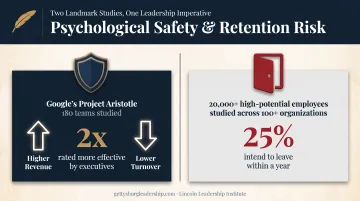
Google's Project Aristotle studied 180 teams and tested dozens of variables to find out what separated high performers from everyone else. The clear winner was psychological safety.
Teams with strong psychological safety were rated effective twice as often by executives, generated more revenue, and were less likely to leave. If that dynamic matters for regular project teams, it matters even more for the leadership team setting the tone for everyone else.
There's also a retention angle worth naming directly:
- Research covering more than 20,000 high-potential employees across 100-plus organizations found that a quarter of top performers intended to leave within a year, according to Corporate Leadership Council data reported in Harvard Business Review
- Investing in deliberate leadership development sends a signal: this organization is serious about growing you, not just extracting output from you
For high-potential leaders, that signal often decides whether they stay and grow — or start looking elsewhere.
15 Leadership Team Building Activities to Strengthen Your Executive Team
These 15 activities split into three categories based on the primary skill each one builds:
- Trust and communication exercises repair relationships between leaders
- Strategic problem-solving activities test planning and decision-making under constraints
- Immersive historical challenges push leaders into unfamiliar territory where old habits stop working
Match the category to your team's real gap, not the activity that photographs best.
Trust & Communication-Building Activities for Leaders
1. Leadership Blind Trust Walk One leader is blindfolded and guided by a peer through a simple obstacle course using only verbal direction. It mirrors the trust required when delegating a high-stakes decision to someone else's judgment.
2. Active Listening Debrief Circles Leaders pair up. One shares a current challenge while the other listens without interrupting, then reflects back what they heard before responding. It builds the kind of empathetic listening leadership teams often skip.
3. Turning Point Storytelling Each leader shares a defining professional failure and the lesson it taught them. Vulnerability-based trust builds faster through shared setbacks than through shared wins.
4. Crisis Communication Role-Play Leaders respond in real time to a simulated media or stakeholder crisis, practicing quick, composed messaging and team coordination before a real crisis forces the issue.
5. 360-Degree Feedback Circle Each leader receives structured peer feedback: one strength, one growth area. Keeping the format tight prevents it from becoming a venting session and reinforces the accountability leaders expect from everyone else.
Strategic Problem-Solving & Decision-Making Activities
6. War Room Strategy Simulation Teams get a time-boxed, realistic business scenario and must build and present a strategic response. It reveals planning discipline fast: who structures an approach versus who just reacts.
7. Resource Allocation Under Pressure Leaders negotiate and prioritize limited resources across competing team priorities, mirroring the budget and staffing trade-offs they make every quarter. Watch who defends their turf and who thinks about the whole organization.
8. The Marshmallow Challenge for Executives Using spaghetti, tape, and one marshmallow, teams race to build the tallest freestanding structure in 18 minutes. Tom Wujec's TED research found business teams often over-plan and run out of time once the marshmallow goes on top. It exposes the gap between over-planning and rapid prototyping better than any slide deck could.
9. Reverse Engineering Exercise Teams briefly view a completed structure or process, then rebuild it from memory. It sharpens observation, delegation, and how well information transfers from the people who saw it to the people who didn't.
10. Scenario-Based Contingency Planning Leaders get an unfolding scenario with incomplete information, make a call, then receive new information that forces them to adapt. It's a direct rehearsal for how real decisions actually unfold — messy and subject to change.
Immersive Historical & Experiential Leadership Challenges
11. Historic Battlefield Leadership Immersion (offered by Gettysburg Leadership) Multi-day programs at Gettysburg, Normandy, and Pearl Harbor place teams where historic leaders made high-stakes decisions. At Gettysburg Leadership, faculty include a retired Navy Rear Admiral, a Navy SEAL, licensed battlefield guides, and Ph.D. historians who turn each site into frameworks teams apply back at work.
12. Decision-Point Historical Reenactment Teams stand at a documented historical decision point and decide as the actual leader did, using only the information available at the time. Then they compare their choice to what really happened — a gap that's usually more instructive than getting the "right" answer.
13. Legacy Leadership Interviews Each leader interviews a mentor, retired executive, or veteran about a defining leadership moment, then shares the lesson with the team. It's a low-cost way to import decades of judgment into a single afternoon.
14. Outdoor Leadership Challenge Course A physical obstacle or ropes-style course with rotating leadership roles tests how each person leads when they're tired, rushed, and being watched — conditions that reveal more than a calm boardroom ever will.
15. Values-Based Reflection Walk A guided walk through a meaningful site, structured around reflection questions tied to the team's stated leadership values. It's quieter than the rest of this list, but for teams that need space to think, that's the point.
How to Choose the Right Leadership Team Building Activities for Your Team
The right activity depends on your team's specific leadership gap, not what looks impressive on a vendor's brochure. Consider these factors before you book anything:
- Leadership level and seniority — emerging leaders benefit from different exercises than a C-suite team weighing a merger
- The competency gap being addressed — trust, communication, decision-making, or strategic thinking; pick the activity built for that gap, not the trendiest one
- Team size — a 5-person team needs individual attention that a 20-person cohort can't give
- Time and budget — a single afternoon solves a different problem than a multi-day immersion
- Facilitation needs — some exercises work fine DIY; others need a trained facilitator or expert-led program
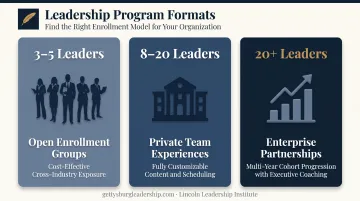
Company size and structure also shape which delivery format makes sense. Gettysburg Leadership, for example, builds its own program tiers around this exact logic:
| Format | Group Size | Best For |
|---|---|---|
| Open Enrollment Groups | 3–5 leaders | Cost-effective, cross-industry cohort exposure |
| Private Team Experiences | 8–20 leaders | Fully customizable content and scheduling for one organization |
| Enterprise Partnerships | 20+ leaders | Multi-year, cohort-based progression with executive coaching |
Use a similar lens with any vendor: match group size and depth of customization to what your leadership team actually needs, not the package that's easiest to sell.
Common Mistakes to Avoid When Planning Leadership Team Building Activities
Even well-intentioned programs fall flat when planners skip a few basics:
- Treating leadership team building like junior-staff icebreakers: misses the deeper trust and strategic stakes senior teams actually navigate
- Skipping the structured debrief: lessons never connect to real workplace decisions, so nothing changes back at the desk
- Choosing an activity for novelty over the real competency gap: a trendy escape room won't fix a delegation problem
- Treating team building as a one-time event: one-off sessions rarely change habits the way spaced practice does
A structured debrief is what separates "we did a fun thing" from "here's what we're changing on Monday."
Conclusion
Whichever activities you choose, the same rule applies: match the exercise to the specific competency gap on your leadership team, not the format that photographs well for a company newsletter. Trust needs different work than strategic decision-making, and both look different again from the composure under pressure that only immersive, high-stakes environments can teach.
The 15 activities above range from a 15-minute active listening exercise to a multi-day battlefield immersion, so time and budget shouldn't be why your leadership team skips this work.
For teams ready for a fully facilitated, historically grounded immersion, Gettysburg Leadership's programs at Gettysburg, Normandy, and Pearl Harbor are built for that high-stakes work. Organizations like Pfizer, FedEx, GE, and the Department of Defense have already put their leadership teams through these battlefield programs.
Frequently Asked Questions
What are the best team building activities for a small group?
Small leadership groups of 3–8 people get the most value from intimate trust and communication exercises such as active listening circles, turning-point storytelling, and blind trust walks. Everyone gets real airtime.
How often should leadership teams do team building activities?
A quarterly cadence of shorter exercises paired with one deeper annual immersion works well for most leadership teams, keeping skills fresh without overloading the calendar.
What's the difference between regular team building and leadership team building?
Regular team building builds morale and rapport. Leadership team building targets delegation, accountability, and the high-stakes decision-making specific to people in charge.
How long should a leadership team building activity be?
Duration ranges from 15-minute icebreakers to multi-day immersive programs, depending on the depth of the leadership goal you're addressing.
Can leadership team building activities be done virtually?
Communication and trust-focused exercises adapt well to virtual formats. Immersive or experiential challenges built around a physical location are most effective in person.
What outcomes should leadership team building activities produce?
Effective activities should produce measurable shifts in trust, communication clarity, and decision-making speed back at work, tracked through debriefs and follow-up check-ins.