Introduction
You got promoted because you were the best. Best regional sales director, best plant manager, best CFO in the room. Then you stepped into a broader role, and suddenly the instincts that made you excellent started working against you.
This is the leadership paradox nobody warns you about: functional excellence and enterprise leadership are not the same skill set. Many leaders struggle here because they're still optimizing for their old scorecard.
An enterprise leadership mindset means asking what the whole organization needs before asking what your team needs. It's a learnable capability, not a personality trait some people are simply born with.
This article breaks down what enterprise thinking actually looks like, why the shift is so hard, the core mindsets and skills involved, and a practical roadmap for building it.
Key Takeaways
- Enterprise leaders ask "What does the organization need?" before "What does my team need?"
- Functional thinking isn't a character flaw—it's the result of years rewarded for department-level wins.
- Enterprise thinking grows through cross-functional exposure, self-awareness, and high-pressure practice—not another framework.
- Immersive, historically grounded learning accelerates the shift by simulating real cross-functional stakes.
What Is an Enterprise Leadership Mindset?
An enterprise leadership mindset means leading as a champion of the whole organization first, and your specific business unit second. It's a horizontal orientation, one that weighs functions, geographies, and business units simultaneously instead of optimizing a single vertical lane.
This is rarer than most executives assume. Korn Ferry's research found that only 14% of executives show genuine Enterprise Leader qualities. Everyone else, by default, leads functionally, even at senior levels.
That gap matters. It's the difference between a leader who defends their department's budget and one who flags a problem in their own numbers because it will help another team downstream.
Enterprise Leadership vs. Functional Leadership
Functional leaders optimize their department's KPIs. Enterprise leaders weigh trade-offs across the entire business, and sometimes deprioritize their own team's project for a bigger, less convenient win.
Here's what that looks like in practice:
| Behavior | Functional Leader | Enterprise Leader |
|---|---|---|
| Budget issue | Manages within their own line item | Flags how it affects operations elsewhere |
| Competing priorities | Defends their team's timeline | Pauses their initiative for a higher-priority need |
| Decision-making | Charts a path for their department | Connects issues across organizational boundaries |
A finance leader who quietly absorbs a budget shortfall instead of surfacing it because "it's not operations' problem" is thinking functionally. One who raises it immediately, knowing it will slow their own quarter, is thinking like an enterprise leader.
The Business Acumen Foundation
That kind of trade-off judgment rests on three fundamentals:
- Strategic understanding — knowing where the organization is headed and why
- Market and customer orientation — seeing decisions through the lens of the end customer, not just internal metrics
- Financial literacy — understanding how decisions ripple across the P&L, not just your own budget line
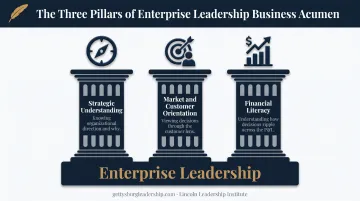
SHRM research on applied business acumen links this fluency to how senior leaders drive strategy and serve customers across the full organizational mission, not just their own function.
But acumen alone doesn't create an enterprise leader. Without an identity shift, all that knowledge stays conceptual. You can understand every function's constraints on paper and still default to protecting your own turf when it counts.
Why the Shift to Enterprise Thinking Is So Hard
If enterprise thinking were simple, more than 14% of executives would already be doing it. Three forces keep leaders stuck in functional mode.
Status quo bias and loss aversion. Leaders repeat the playbook that got them promoted, because it worked. Behavioral research shows people weigh losses more heavily than equivalent gains—so deprioritizing your own team's goals feels like a loss, even when the organization benefits.
Identity lag. Many leaders still see themselves as functional experts long after their title changes. The real promotion is not the new box on the org chart. It is the identity shift from "I run this department" to "I steward this organization." Most leaders never make that internal move.
Measurement misalignment. Organizations say they want enterprise thinkers, then keep paying bonuses on departmental metrics. McKinsey documented a company where customer needs were not even part of functional targets—reinforcing the siloed behavior leadership claimed to oppose. After cross-functional teams and end-to-end accountability were introduced, first-time-right delivery rose from 65% to over 80%, and early help requests dropped by a third.
That result didn't come from a mindset workshop. It came from changing what the organization actually measured and rewarded.
The Essential Mindsets and Skills of Enterprise Leaders
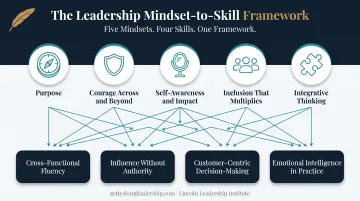
Enterprise thinking is built on a handful of interconnected mindsets:
- Purpose — understanding why the organization exists, beyond its mission statement
- Courage across and beyond — addressing unpopular problems even outside your own lane
- Self-awareness and impact — knowing your strengths, blind spots, and how you affect others
- Inclusion that multiplies — bringing different voices in early enough to change the outcome
- Integrative thinking — seeing an issue in its full, messy context, not a simplified version
Four practical skills turn these mindsets into daily behavior:
- Cross-functional fluency — understanding another department's language, constraints, and pressures well enough to ask a useful question, not just a polite one
- Influence without authority — building buy-in through trust and collaboration when you lack the positional power to force a decision
- Customer-centric decision-making — using "what creates more value for the customer" as the tie-breaker when departments disagree
- Emotional intelligence in practice — recognizing the motivations and blind spots that protect an old functional identity, then adjusting how you show up
Formal tools help make that last skill measurable. Assessments such as EQ-i 2.0 and EQ360 give leaders an objective read on emotional intelligence. At Lincoln Leadership Institute, faculty including Dr. Jared Peatman are certified to administer these assessments within leadership development engagements.
How to Develop an Enterprise Leadership Mindset: A Practical Roadmap
Frameworks help you understand enterprise thinking. Practice is what actually builds it.
- Get exposure to other business functions. Learn how other departments operate—their pressures, incentives, and internal culture—rather than assuming your function's priorities apply everywhere.
- Take on real cross-functional problems. Volunteer for initiatives requiring genuine collaboration toward a shared outcome, not just committee attendance.
- Build self-awareness through structured feedback. Use a coach, peer group, or formal assessment to surface blind spots you cannot see alone.
- Practice the strategic pause. Before major decisions, ask who else is affected, what organizational trade-offs exist, and which of your assumptions may be limiting the view.
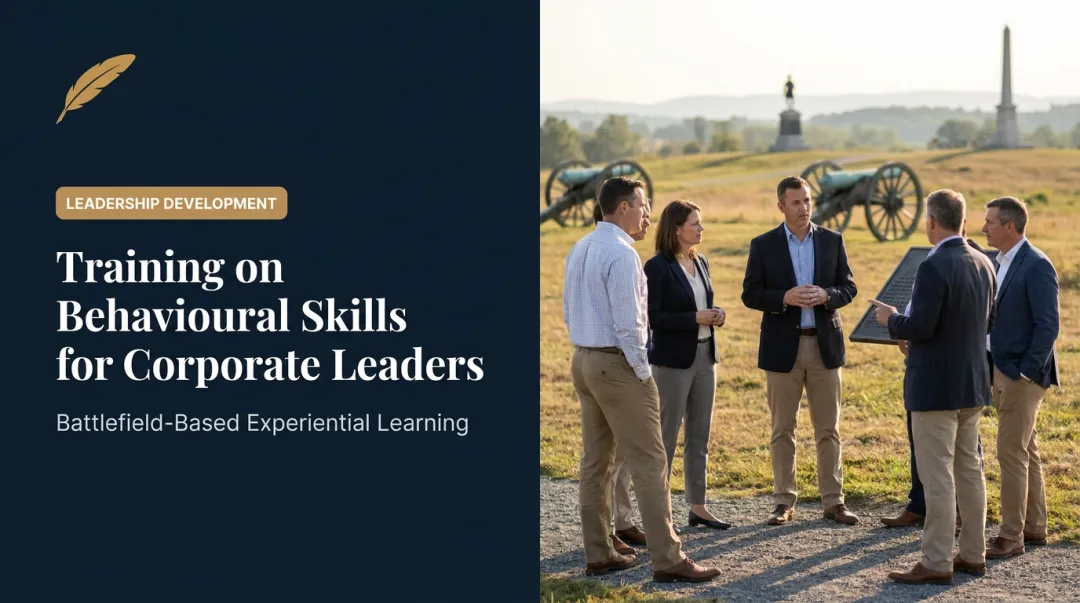
- Seek immersive, high-pressure learning experiences. Classroom learning rarely forces the identity shift enterprise thinking requires. You need real ambiguity and incomplete information—the kind of pressure built into immersive programs such as Lincoln Leadership Institute's 2.5-day Gettysburg Leadership Journey.
- Align stakeholders before changing course. When an enterprise-serving decision disrupts your team's timeline, explain the why clearly. Trust erodes fast when people feel blindsided.
None of these steps work in isolation. Exposure without self-awareness just gives you more data to ignore, and self-awareness without pressure-tested practice stays theoretical.
Learning Enterprise Leadership from History's Greatest Decisions
Historical immersion accelerates enterprise thinking because the tension is identical. Commanders facing incomplete information and enormous stakes had to weigh unit-level interests against the larger campaign, exactly the trade-off modern leaders face between their department and their organization.
Consider General George Meade at Gettysburg on July 4, 1863. His army's effective infantry had dropped from roughly 78,000 to 51,000 men, and he faced a genuine enterprise-level question:
- Hold position
- Attack
- Retreat toward supply lines
- Pursue Robert E. Lee's retreating army
Meade convened a council of war, weighing the whole-army implications of each option rather than defaulting to his own corps' preference. He chose caution and rest, then pursued with cavalry and the Sixth Corps once conditions changed.
The lesson sits above tactics. Meade had to think past his own command structure under conditions no PowerPoint deck can replicate.
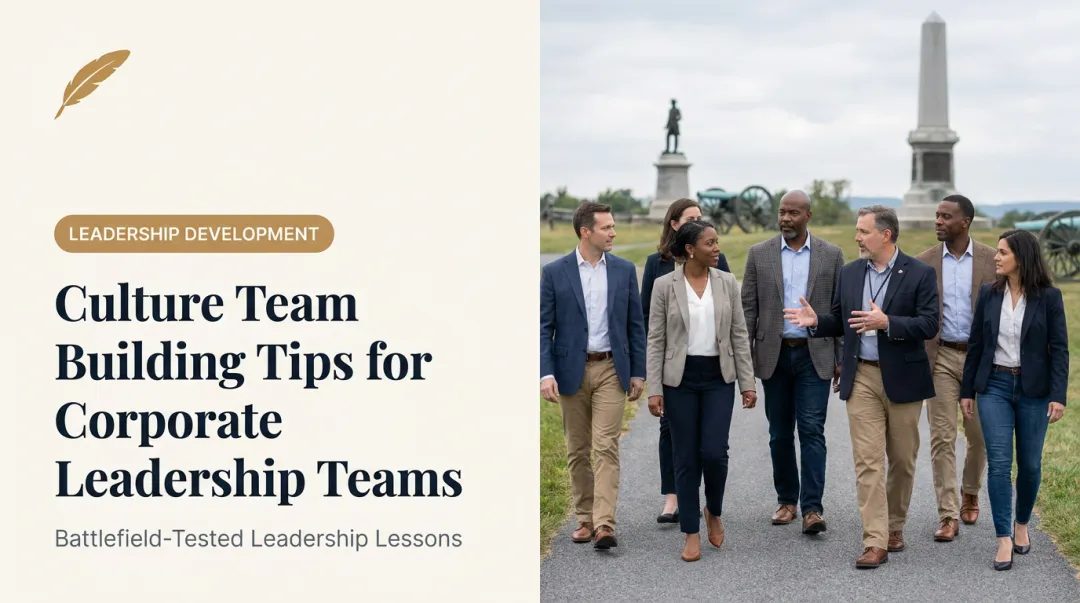
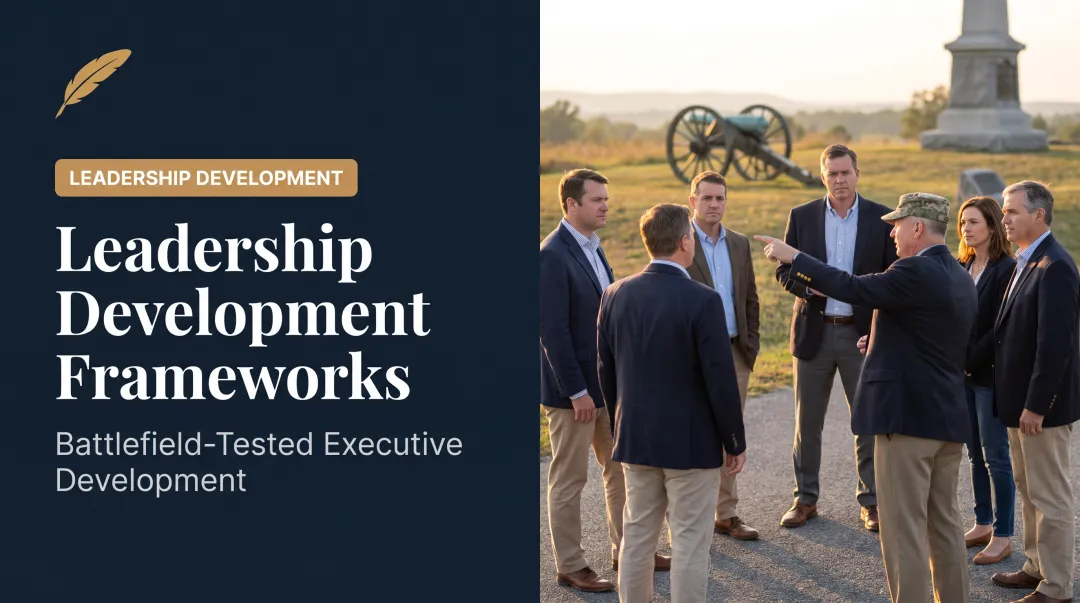
Lincoln Leadership Institute builds programs around this tension. Immersive experiences at Gettysburg, Normandy, Pearl Harbor, and the Alamo put leaders in real decision-making scenarios, guided by faculty that includes retired generals, admirals, and Navy SEALs.

When you're standing on the ground where a commander had to make an enterprise-level call with incomplete information, the abstraction disappears. You feel the weight of the trade-off, not just read about it.
Frequently Asked Questions
What are the C's of leadership development?
Common "C" frameworks emphasize traits like competence, commitment, and character as core, equally weighted pillars of leadership. These support enterprise leadership by building the credibility and consistency needed to influence across departmental lines.
What mindsets should I develop for enterprise leadership?
Build purpose, courage beyond your own lane, self-awareness of impact, inclusion that multiplies perspectives, and integrative thinking. Together, they shift your default orientation from departmental to organization-wide.
What core skills are essential for developing an enterprise leadership mindset?
Cross-functional fluency, influence without authority, customer-centric decision-making, and emotional intelligence are the four practical skills that turn enterprise mindsets into daily behavior.
What is the difference between enterprise leadership and executive leadership?
Executive leadership typically means overseeing a department with vertical authority and department-specific targets. Enterprise leadership is horizontal and ecosystem-wide, defined by mindset and cross-boundary impact rather than title alone.
How long does it take to develop an enterprise leadership mindset?
Developing an enterprise leadership mindset is an ongoing identity shift. Sustained coaching, cross-functional exposure, and immersive experiential programs accelerate progress far more than occasional workshops.
Can enterprise leadership be taught, or is it innate?
It's learnable. Deliberate practice, honest feedback, and real or simulated high-stakes decision-making build enterprise thinking over time, regardless of a leader's starting personality type.