Introduction
Every negotiation reveals a style, whether you notice it or not. A vendor contract, a standoff between department heads, a Civil War general accepting a surrender: each moment follows an underlying pattern of behavior.
Most people default to one or two familiar styles without realizing it. That habit produces deadlocks, lopsided concessions, and working relationships that erode quietly over time.
Leaders often treat negotiation as instinct instead of a deliberate choice. This article breaks down the five core negotiation styles, when each one works, and how decisive leaders—including figures whose choices shaped the Civil War—shifted between them under pressure.
Key Takeaways
- Five recognized styles exist: competing, accommodating, avoiding, compromising, and collaborating
- No single style wins universally — stakes, relationship value, and time pressure determine the right fit
- Most negotiators unconsciously lean on just one to three preferred styles
- Collaborating builds the most durable value but demands more time, trust, and skill than the rest
What Are Negotiation Styles?
Negotiation styles are consistent patterns of behavior people fall into when their interests diverge from someone else's. They're not personality types; they're choices. Effective negotiators learn to switch between them deliberately.
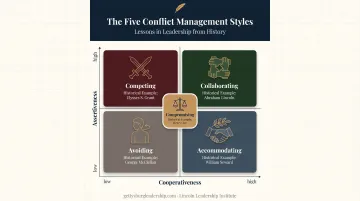
The framework comes from the Thomas-Kilmann Conflict Mode Instrument (TKI), developed by Kenneth Thomas and Ralph Kilmann and first published by Xicom in 1974. It measures behavior along two dimensions:
- Assertiveness — how strongly you pursue your own interests
- Cooperativeness — how much you help the other side get what it needs
| Style | Assertiveness | Cooperativeness |
|---|---|---|
| Competing | High | Low |
| Accommodating | Low | High |
| Avoiding | Low | Low |
| Compromising | Moderate | Moderate |
| Collaborating | High | High |
TKI research notes that everyone can use all five modes. Nobody is locked into a single style. Treat them as a toolkit: the skill is knowing which mode the moment calls for.
Why Negotiation Styles Matter for Leaders
Negotiation skill isn't a soft skill reserved for procurement teams. It shapes deal terms, budget allocations, hiring offers, vendor contracts, and how internal conflicts get resolved, or don't.
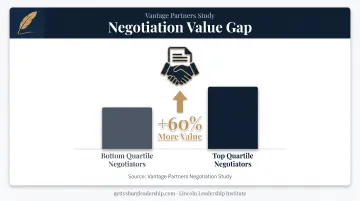
The gap between skilled and unskilled negotiators is larger than most leaders assume. A 2026 Vantage Partners study of more than 400 market leaders found that negotiators in the top quartile secured roughly 60% more value than those in the bottom quartile. Same deals, same market conditions: wildly different outcomes based on approach alone.
Without style-awareness, a few predictable problems show up:
- Deadlocks between two equally competitive parties who won't budge
- One-sided concessions that quietly drain value from a deal
- Resentment that surfaces months later and damages the relationship
This is the terrain Lincoln Leadership Institute has spent more than 25 years exploring. Decisive, values-based decision-making under pressure—the same instinct battlefield commanders used with incomplete information—is a learnable skill.
That belief shapes the High-Impact Negotiations Workshop, which pairs interactive exercises from historic negotiations with modern practice in communication, conflict resolution, and collaborative problem-solving.
The 5 Negotiation Styles
Negotiation style isn't one-size-fits-all. Each of the five styles balances assertiveness against cooperativeness differently. Skilled negotiators, including many of history's sharpest leaders, learn to move between them rather than defaulting to whichever one feels most comfortable.
Competing (I Win – You Lose)
Competing is high-assertive, low-cooperative behavior focused on claiming value for yourself. It works through power, position, urgency, or firm demands rather than dialogue.
- Best suited for: one-off transactions, time-critical decisions, or situations requiring non-negotiable compliance
- Strengths: fast results, clarity of position, strong defense against being exploited
- Trade-offs: risks deadlock against equally competitive counterparts; can permanently damage relationships
Historical example: In February 1862, Confederate General Simon Buckner asked Ulysses S. Grant for surrender terms at Fort Donelson. Grant's reply left no room for negotiation: only "unconditional and immediate surrender" would be accepted. Buckner surrendered.
The exchange is a textbook case of high assertiveness with zero cooperative signaling. It works when the stakes demand total clarity, but it is not a style built for ongoing partnerships.
Accommodating (I Lose – You Win)
Accommodating flips the equation: low assertiveness, high cooperativeness. You concede gracefully, share information generously, and prioritize the relationship over the immediate win.
- Best suited for: repairing a damaged relationship, situations where you're at fault, or when you hold a weak negotiating position
- Strengths: builds goodwill and trust quickly
- Trade-offs: overused, it signals weakness and invites exploitation by competitive counterparts
Historical example: Abraham Lincoln worried that emancipating enslaved people in the loyal border states could push Maryland, Kentucky, or Missouri toward secession. His final Emancipation Proclamation deliberately left slavery untouched in those states to preserve their allegiance to the Union.
The move was not pure generosity; Lincoln also leaned on his wartime authority. Still, the calculated concession protected a coalition he could not afford to lose.
Avoiding (I Lose – You Lose)
Avoiding is low-assertive, low-cooperative behavior that sidesteps the conflict altogether. Nobody's interests get actively pursued; the issue gets delayed instead.
- Best suited for: trivial issues, situations needing a cooling-off period, or moments when you're simply unprepared
- Strengths: prevents rash decisions, buys time to gather information
- Trade-offs: unresolved issues resurface with more tension, and silence often gets filled with the other side's worst assumptions
Historical example: Lincoln drafted the preliminary Emancipation Proclamation in July 1862 but held it back. Secretary of State William Seward warned that issuing it without a recent Union victory would look like desperation, not strength. Lincoln agreed and waited. Only after Lee's retreat from Antietam did he issue it, in September 1862.
The pause was not indecision. It was a deliberate delay until conditions favored decisive action.
Compromising (Split the Difference)
Compromising blends moderate assertiveness with moderate cooperativeness, aiming for a quicker middle-ground settlement rather than expanding what's on the table.
- Best suited for: time-pressured decisions between trusted parties where "good enough" is genuinely acceptable
- Strengths: fast, feels equitable, reduces strain on the relationship
- Trade-offs: leaves value on the table and rewards whoever opens with the more extreme position
Historical example: Henry Clay's Compromise of 1850 traded California's admission as a free state against a stronger fugitive-slave law and the possibility of western slavery through popular sovereignty. The U.S. Senate's own account credits the package with staving off civil war for another decade, but only by extending slavery's life.
It remains a clear illustration of what compromising actually costs: short-term stability bought at the price of a deeper, unresolved problem.
Collaborating (I Win – You Win)
Collaborating combines high assertiveness with high cooperativeness. Instead of dividing a fixed pie, both sides work to expand it through joint problem-solving and transparent information-sharing.
- Best suited for: high-stakes deals, long-term partnerships, or complex problems that need creative solutions
- Strengths: creates the most durable value and trust of any style
- Trade-offs: time- and resource-intensive; falls apart if the other party won't reciprocate in good faith
Historical example: Lincoln's cabinet famously included former nomination rivals William Seward, Salmon Chase, and Edward Bates, along with former Democrats brought in to build broader support. Rather than surrounding himself with agreement, Lincoln institutionalized disagreement inside his own government.
It was a structural bet that competing viewpoints, managed well, would produce better outcomes than an echo chamber. It did not guarantee harmony in every cabinet meeting, but it kept the Union's sharpest minds pointed at the same goal.
How to Choose the Right Negotiation Style
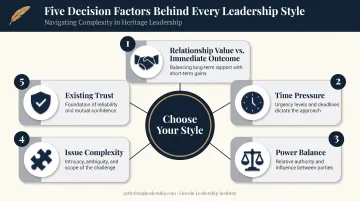
The right style depends on the situation — not on personal preference or habit. Before you walk into any negotiation, weigh these factors:
- Relationship value versus immediate outcome — is this a one-time transaction or a partnership you need next year?
- Time pressure — does the decision need to happen now, or is there room to think?
- Power balance — do you hold leverage, or does the other side?
- Issue complexity — are there creative trade-offs available, or is this a fixed pie?
- Existing trust — have you and this counterpart negotiated well together before?
Common mistakes worth avoiding:
- Defaulting to the same style regardless of context
- Mistaking compromise for genuine collaboration
- Ignoring the counterpart's style and failing to adapt
- Waiting too long to shift from collaborating to competing when it's time to claim value
Reading a situation correctly and adjusting in real time is not something you learn from a slide deck. Lincoln Leadership Institute builds that instinct in immersive, battlefield-based programs where leaders face incomplete information, competing priorities, and real time pressure. Situational flexibility is earned through practice, not theory.
Frequently Asked Questions
What are the main styles of negotiation?
The five styles are competing, accommodating, avoiding, compromising, and collaborating. They come from the Thomas-Kilmann Conflict Mode Instrument, which measures assertiveness against cooperativeness.
What are the main negotiation techniques?
Core techniques include preparing your BATNA (best alternative to a negotiated agreement), active listening, anchoring with an initial offer, and asking questions that surface shared interests. These are tactics, not styles — they support whichever style you choose.
What are the five C's of negotiation?
There's no single standardized version of this list. One negotiation firm has published Communication, Collaboration, Compromise, Calm, and Change as ways to avoid a breakdown, but it's not a universally recognized framework.
Which negotiation style is most effective in business?
Collaborating tends to build the most durable value for long-term business relationships, since both sides' core needs get met. That said, the "best" style still depends on the stakes, timeline, and relationship in front of you.
Can you use more than one negotiation style in a single negotiation?
Yes. Skilled negotiators often shift styles across different issues within the same deal — collaborating on shared priorities, then competing on a specific term that matters most.
How do I find out my own negotiation style?
Reflect on past negotiations for patterns, ask colleagues for honest feedback, or take a formal assessment like the Thomas-Kilmann instrument. Most people are surprised how narrow their default range actually is.