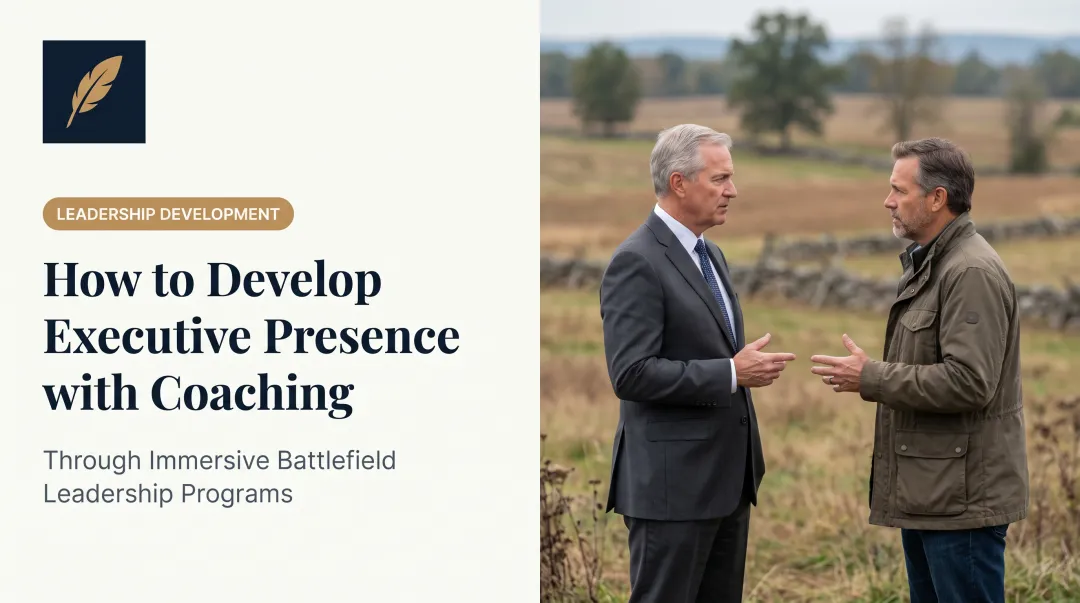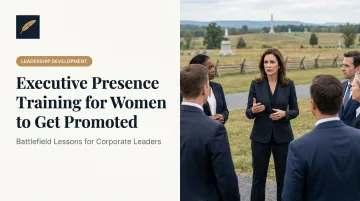
This scenario repeats across banking floors, hospital systems, and tech campuses every promotion cycle. Executive presence sounds like a personality trait some people are born with and others aren't. It isn't. It's a set of observable, learnable behaviors, and senior executives say it accounts for 26% of what determines who gets the next promotion, according to Coqual's Executive Presence research.
For women, building and being credited for that presence comes with extra friction: structural barriers, perception bias, and a "double bind" that generic advice rarely addresses. This guide breaks down what executive presence really means, the framework behind it, why the path looks different for women, and how immersive, high-pressure training can close the gap.
Key Takeaways
- Executive presence is a learnable skill built from communication, composure under pressure, and demonstrated credibility, not an innate trait
- Senior leaders say presence drives 26% of promotion decisions, per Coqual research
- Women often face a double bind: directness gets labeled aggressive, while warmth gets dismissed as weak
- Structured feedback and immersive, high-pressure practice build presence faster than passive learning alone
What Is Executive Presence, and Why Does It Matter for Promotion?
Executive presence is the ability to project confidence, authority, and composure in a way that earns trust from teams, peers, and the senior leaders who control access to opportunity. Charisma helps, but the real signal is readiness: does this person look ready to carry more weight?
That signal travels even when you're not in the room. Presence functions as a proxy for judgment. It shapes how a leader gets discussed during succession planning meetings, calibration sessions, and hallway conversations she'll never actually hear.
A Coqual study of senior executives found that 67% named gravitas as the core signal of leadership potential, 28% pointed to communication, and only 5% cited appearance.
Strong results get you in the conversation. They rarely get you the promotion on their own. Once someone clears the performance bar, the deciding question shifts to presence: does this person look ready for the next room?
Why This Looks Different for Women
Traditional models of executive presence were built around male-coded behaviors: assertiveness, risk-taking, dominance in a meeting. When a man displays these traits, he reads as ready. When a woman displays the identical behaviors, she often comes across differently.
This is the double bind, and it shows up in familiar patterns:
- Direct feedback delivery gets read as harsh instead of clear
- Confident self-promotion gets read as arrogant instead of competent
- A warm, collaborative style gets read as nice but not quite leadership material
Catalyst's research on the double-bind dilemma documents this pattern across industries, along with a higher competence threshold women must clear before they're seen as leadership-ready. Generic presence coaching, built around one template, rarely accounts for this gap.
The 5 C's of Executive Presence
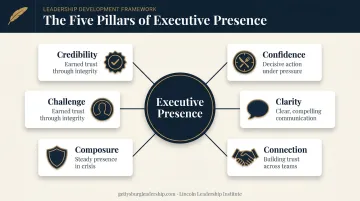
Executive presence used to get boiled down to three things: gravitas, communication, and appearance. That model is dated and incomplete. A more practical framework for self-assessment is the 5 C's: confidence, clarity, connection, composure, and credibility.
Confidence
Confidence is self-assured decision-making without arrogance. It shows up less in tone and more in structure: leading with your conclusion before your context. Instead of walking a room through five data points before naming your recommendation, state the recommendation first, then back it up.
This structure matters even more for women, since hedging before a conclusion often reads as uncertainty rather than humility.
Clarity
Clarity is the ability to distill complexity into direction. It means cutting filler words, qualifiers, and over-explaining. Phrases like "I just think maybe we could possibly" bury the point. Say what you mean, once, and stop talking.
Connection
Connection is the ability to build trust and relatability across teams and stakeholders. It matters more for women navigating the double bind, because connection is often what allows directness to read as strong rather than cold. Leaders who invest in real relationships earn more benefit of the doubt when they make a hard call.
Composure
Composure is staying calm, measured, and in control during high-stakes moments: a product launch that stalls, a board question you didn't prep for, a team in crisis. Of the five C's, it's the most directly trainable through simulation.
You can't fake calm under real pressure. You build it by practicing under pressure, repeatedly, until your reactions catch up with your training.
Credibility
Credibility is consistency between words and actions over time. It's the track record piece, but track record alone isn't enough. Visibility matters just as much: the people making promotion decisions need to actually know what you've delivered. Competence without visibility is invisible.
This gap hits women hardest, since the same double bind can make real achievements go unnoticed by decision-makers.
Why Women Face Unique Barriers to Building Executive Presence
The barriers here aren't only perceptual. They're structural, and they compound.
Double bind, revisited. Identical behaviors get read differently depending on who's doing them. A decisive man is "strong." A decisive woman is "difficult." That leaves less room for error and more energy spent managing perception instead of doing the job.
Sponsorship gap. Mentorship isn't the same as sponsorship. A mentor gives advice; a sponsor uses political capital to advocate for you in rooms you're not in. McKinsey and LeanIn's 2025 Women in the Workplace research found only 31% of entry-level women have a sponsor, compared with 45% of entry-level men. The gap persists at every level up through vice president.
The same report found sponsored men were promoted at twice the rate of unsponsored men, while sponsored women saw a smaller lift of 1.7 times.
The disparity starts even earlier, in what's often called the "broken rung":
- For every 100 men promoted from entry level to manager in 2025, only 93 women made the same jump
- Just 74 women of color reached that level in the same period
- Fewer women even reach the point where presence conversations start
Shrinking structural support. Flexible schedules and formal leadership programs have scaled back at some organizations. Nearly one in five companies pulled back remote or hybrid flexibility in 2025. Two in five entry-level women reported zero promotion prep, stretch assignments, or leadership training in the prior two years, a gap that disproportionately affects women carrying caregiving loads outside work.
The 360-degree feedback lesson. When feedback from bosses, peers, and direct reports gets averaged into one number, it can bury important patterns. Splitting scores by rater group, instead of blending them, separates a real skill gap from a narrow organizational template that penalizes certain communication styles.
If peers rate your judgment highly but one manager consistently flags "presence," that's worth investigating, not absorbing at face value.
Proven Strategies for Developing Executive Presence
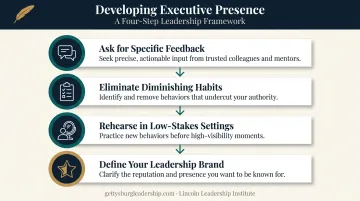
Generic advice to "be more confident" doesn't hold up under real feedback. These four moves do.
Ask for specific, actionable feedback. Skip "work on your presence." Request input from three or four stakeholders immediately after a key meeting: what landed, what didn't, what to do differently next time. Immediate, multi-source feedback beats one annual review comment.
Eliminate presence-diminishing habits. Record yourself in a real meeting or rehearsal and review it. Watch for:
- Softening language ("I just wanted to," "sort of," "maybe")
- Raising your inflection until statements sound like questions
- Over-apologizing before making a point
- Closing off your body language: arms crossed, shoulders slumped, shrinking into the chair
Rehearse deliberately, in low-stakes settings first. Study two or three leaders you admire, specifically how they open meetings or handle interruptions. Practice the exact behavior out loud in a smaller setting before trying it in the boardroom.
Define your leadership brand. Get clear on your values and strengths before you try to "perform" presence. Presence that doesn't match who you are reads as fake, while presence built on real strengths holds up under scrutiny.
These strategies work. But composure, the C that's hardest to fake, is also the hardest to build from a worksheet.
How Experiential, High-Pressure Training Accelerates Executive Presence
Composure, decisiveness, and gravitas rarely develop from a slide deck. They get forged under actual pressure, real or simulated, which is why immersive leadership experiences tend to produce faster, more durable shifts than lecture-based training.
This is the model behind the Lincoln Leadership Institute's programs. Instead of a conference room, leaders work through decision-making, communication, and composure challenges on the actual ground where history's highest-stakes leadership calls were made: Gettysburg, Normandy, Pearl Harbor, and the Alamo.
Faculty include a retired Army general, a retired Navy Rear Admiral, and a Navy SEAL who has served since 1988. They guide participants through scenarios that demand a decision now, with incomplete information and real consequences on the line.
For a woman being developed for promotion, the typical starting point is the 2.5-day Gettysburg Leadership Journey.
It's built around scenarios that sharpen decision-making in rapidly changing conditions, communicating clearly under pressure, and aligning a team when priorities collide. That's the skill set that separates "strong performer" from "promotion-ready" in most calibration conversations.
Two Elements That Add Rigor Beyond a Motivational Offsite
- Objective data on how presence lands. Dr. Jared Peatman, LLI's Director of Curriculum, delivers EQ-i 2.0 and EQ360 assessments that reveal the gap between intent and perception, critical since identical behavior often reads differently across genders.
- A credential that reinforces credibility. Participants can complete the Leadership Excellence Certificate Program with Purdue University Global, earning a digital badge verifiable on LinkedIn — a visible signal that the development is real, not self-reported.
Both elements apply no matter how a woman enters the program. Organizations can send an individual through an Open Enrollment cohort alongside peers from other industries. Or they can build a Private Team Experience for a group of rising women leaders, with content customized to their specific challenges. Either path builds presence under real pressure, not assumed from a personality test.

There's a second-order benefit here: when an organization sponsors a high-potential woman for a visible program like this, it signals investment ahead of the promotion decision itself. That signal circulates the same way presence does, in rooms she isn't in.
Frequently Asked Questions
What are the 5 C's of executive presence?
Confidence, clarity, connection, composure, and credibility are five interrelated capabilities that combine to project executive presence. Confidence drives decision-making, clarity sharpens communication, and composure and credibility hold it together under scrutiny.
What is executive presence training for women leaders?
It's structured coaching or experiential development that strengthens confident communication, composure under pressure, and credibility. Programs account for the double bind and bias that shape how women's presence gets perceived.
How long does it take to develop executive presence?
Initial shifts, like cutting filler language or leading with conclusions, can show up within weeks of targeted feedback and practice. Durable, promotion-level presence typically takes several months of consistent application.
Can introverted women develop strong executive presence?
Yes. Executive presence isn't about extroversion or volume. Quieter leaders often build it through preparation, clarity, and composed decisiveness, qualities that read as authority regardless of how much room you take up in a meeting.
Does executive presence really affect promotion decisions?
Senior executives report that executive presence accounts for 26% of what determines the next promotion, according to Coqual's research. That figure comes from one research program, but it's the most consistently cited benchmark in the field.
What's the difference between executive presence and confidence?
Confidence is one internal component. Executive presence is the broader, externally observable combination of confidence, clarity, connection, composure, and credibility, how all of it reads to the people deciding your next move.