Introduction
You've seen it before: a team full of smart, capable people who somehow can't hit a deadline together. Individually, they're strong performers. Collectively, they're stuck.
This isn't a talent problem. It's a motivation problem.
Global employee engagement sat at just 20% in 2025, and Gallup estimates that low engagement costs the world economy roughly $10 trillion, or 9% of global GDP, in lost productivity (Gallup, 2026).
Add hybrid schedules, economic uncertainty, and lingering burnout, and keeping a team emotionally invested in shared goals has never been harder.
This article breaks down the psychology behind team motivation, gives you tactics you can use this week, and shows how immersive, history-based leadership experiences build real cohesion faster than any slide deck.
Key Takeaways
- Blend intrinsic drivers (purpose, autonomy) with extrinsic ones (pay, recognition)—leaders need both
- Trust, clear goals, and consistent recognition are your three most reliable levers for sustained motivation
- Change and uncertainty demand more transparency, not less
- Shared, high-stakes experiences build team cohesion faster than traditional classroom training
What Is Team Motivation? Intrinsic vs. Extrinsic Drivers
Team motivation isn't the sum of individual motivation. It's the collective alignment of energy, commitment, and effort toward a shared goal. You can have five highly motivated individuals who still function as a dysfunctional team because nobody's pulling in the same direction.
The Two Engines Driving Your Team
Psychologists distinguish between two motivational sources:
- Intrinsic motivation — doing work because it's inherently satisfying, driven by purpose, mastery, and autonomy
- Extrinsic motivation — doing work to earn a separate reward, like a bonus, promotion, or formal recognition
Self-determination theory identifies three psychological needs behind lasting motivation: autonomy, competence, and relatedness. Autonomy here means feeling volitional about your work, not working alone or unsupervised.
Both types matter. But intrinsic motivation tends to sustain effort longer, especially once the novelty of a bonus wears off. A leader who relies only on pay and perks will always be chasing the next incentive to keep energy up.
Why This Actually Matters to the Business
The link between engagement and business performance isn't theoretical. Gallup's 11th Q12 meta-analysis, spanning 183,806 work units and over 3.3 million employees, found that teams in the top quartile of engagement outperformed bottom-quartile teams by 23% in profitability and 18% in sales productivity, with 21% lower turnover in high-turnover organizations (Gallup, 2024).
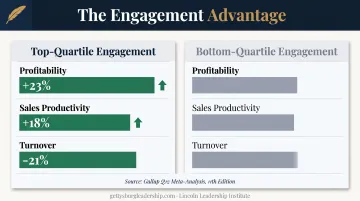
Those gaps show up directly on the P&L.
Proven Strategies to Motivate Your Team
Motivation comes from several levers working at once. Here's where to focus first.
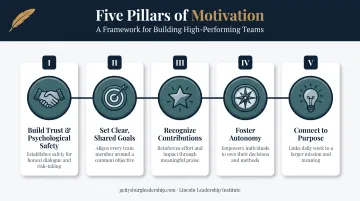
Build Trust and Psychological Safety
Teams rarely quit loudly. They disengage quietly, holding back ideas and concerns because they fear judgment.
Google's Project Aristotle studied 180 teams with more than 35 statistical models. Psychological safety (the shared belief that it's safe to take interpersonal risks) was the strongest predictor of team effectiveness, ranking above dependability, clarity, and even meaning (Google re:Work, 2015).
Leaders build this by modeling vulnerability first. A simple, repeatable tactic:
- Open meetings with a 60-second check-in asking, "What's one thing slowing you down right now?"
- Respond without judgment, even to messy or half-formed concerns
- Follow up privately on anything raised: silence after vulnerability kills future honesty
Set Clear, Shared Goals
Ambiguity is one of the fastest ways to kill motivation. If people aren't sure what "done" looks like, they default to minimum effort or, worse, freeze.
The original SMART framework (Specific, Measurable, Assignable, Realistic, Time-related) still holds up decades later. What matters more than the acronym is the discipline behind it: every goal needs a clear owner and a deadline.
Connect individual tasks to the bigger objective explicitly. A developer fixing a bug should know it's tied to a client renewal, not just a ticket number.
Recognize and Celebrate Contributions
Generic praise ("great job, team") fades fast. Specific, individualized recognition sticks because it tells people exactly what behavior to repeat.
Try this low-cost habit: dedicate five minutes at the start of your weekly meeting to have one team member publicly recognize a peer's specific contribution from the past week. Rotate who gives it. Recognition spreads horizontally, not just top-down.
Foster Autonomy and Ownership
Micromanagement signals distrust, and distrust kills motivation faster than almost anything else on this list.
Delegated ownership does the opposite. Assign a team member to lead a specific initiative or represent the team in a cross-departmental meeting. Give them the authority to make real decisions, not just carry messages back and forth. Confidence grows from being trusted with something real.
Connect Work to a Larger Purpose
Purpose is the intrinsic driver leaders most often skip, and the one that sustains effort longest when it's real.
Make it tangible:
- Share customer stories that show the direct outcome of the team's work
- Report outcome data regularly, not just at year-end reviews
- Explain how a specific project affects the company's broader mission, not in abstract terms but with real numbers or names
Sustaining Team Motivation Through Change and Uncertainty
Change disrupts routines, and disrupted routines breed resistance. During transitions, motivation depends far more on transparency than reassurance. False confidence erodes trust the moment reality catches up with the messaging.
Three practices keep motivation intact when the ground is shifting:
- Ask open-ended questions before proposing solutions. "What concerns you most about this shift?" surfaces resistance early, while it is still manageable.
- Break large initiatives into milestones every few weeks. Visible progress sustains momentum; a distant finish line drains it.
- Put frequent, direct updates in the hands of immediate supervisors, not only executive memos. People trust the person who manages their day-to-day work more than a company-wide email.
The Leader's Role: Why Leading by Example Matters
Teams mirror their leader's energy far more than they respond to motivational speeches or incentive programs. If a leader shows up disengaged, the team notices before any survey does.
Three behaviors separate leaders who motivate teamwork from those who only talk about it:
- Listen more than you talk so people know their input was considered, not just collected
- Admit uncertainty and own mistakes instead of projecting false confidence
- Stay genuinely calm under pressure; teams spot performed composure immediately
Only real composure and accountability build lasting motivation.
This is also where organizations often stall. It's easy to tell leaders to "lead by example." It's much harder to build that muscle without real pressure to test it.
Building Battle-Tested Teams: The Lincoln Leadership Institute Approach
Motivating a team long-term takes more than a one-off workshop. Real cohesion gets forged through shared, high-stakes experiences: not slides about trust, but situations that actually require it.
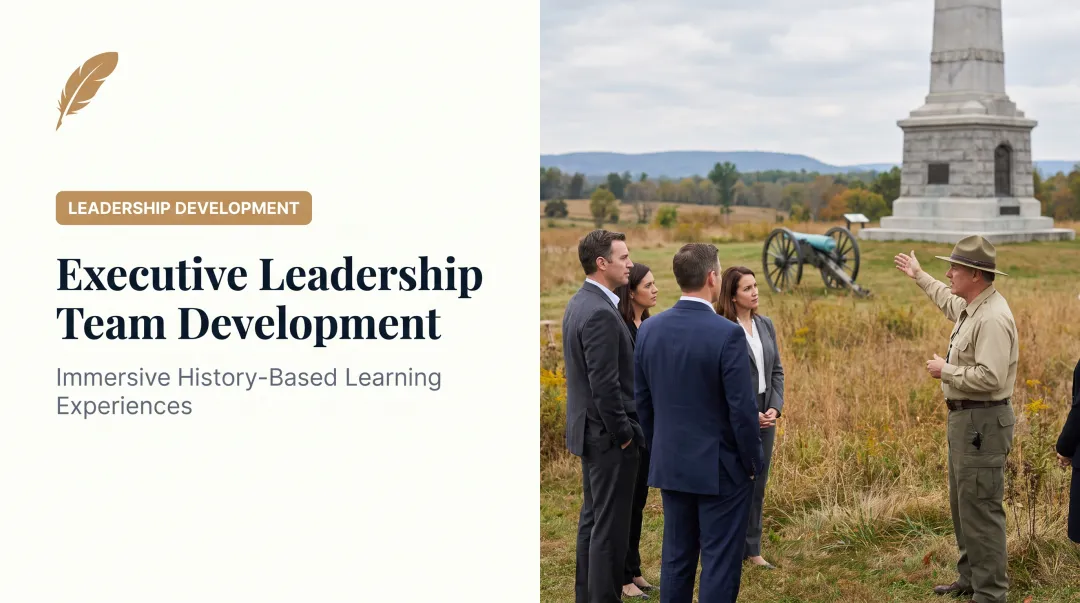
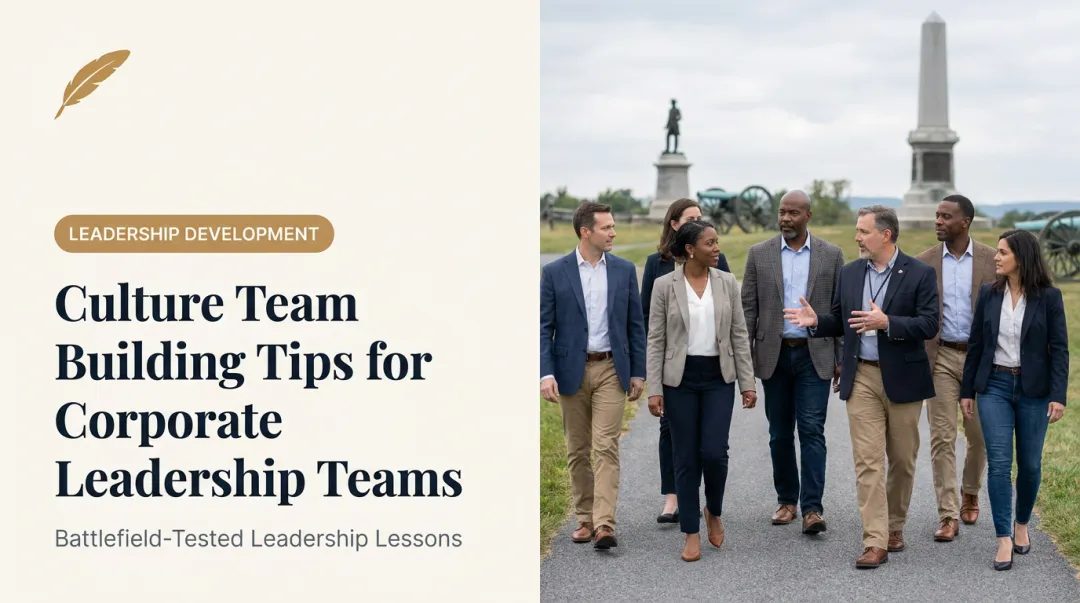
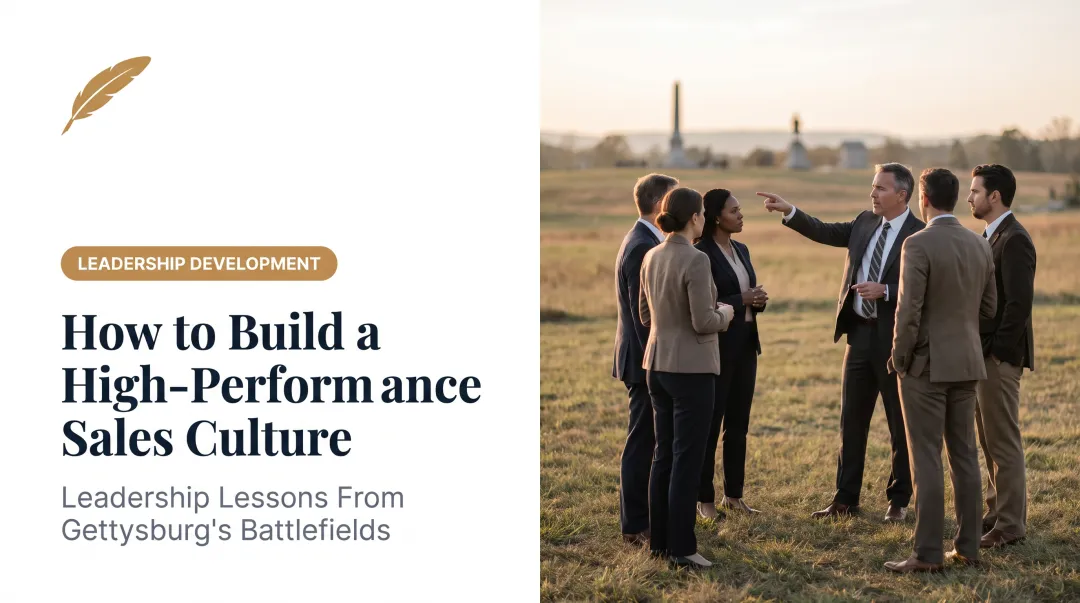
This is the premise behind Lincoln Leadership Institute's approach. Rather than a conference room, teams train on the actual ground where history's highest-stakes decisions were made: Gettysburg, Normandy, Pearl Harbor, and the Alamo. Participants work through scenario-based challenges that demand the same trust, clear communication, and decisiveness they'll need back at the office. Here, the consequences feel real enough to change behavior.
Faculty depth is part of what makes the experience stick. LLI programs are led by:
- Retired Navy SEALs
- A retired Rear Admiral
- An Army Colonel and former Chief of Staff of US Army Special Operations Command
- Ph.D. historians who turn battlefield decisions into Monday-morning frameworks
For teams looking to build this into a longer development path, LLI offers three formats:
| Model | Group Size | Customization | Duration |
|---|---|---|---|
| Open Enrollment | 3–5 per organization | Standard curriculum | ~2.5 days |
| Private Team Experience | 8–20 participants | 100% customizable | 3 days |
| Enterprise Partnership | 20+ (cohort-based) | Fully strategic, multi-year | Multi-year |
LLI also partners with Purdue University Global on a Leadership Excellence Certificate Program. Director of Curriculum Dr. Jared Peatman is certified to administer EQ-i2.0 and EQ360 Emotional Intelligence Assessments, which help teams see why certain dynamics keep repeating.
Over 25 years, LLI has worked with more than 40,000 leaders and 25,000+ Fortune 1000 and public sector clients, including Pfizer, FedEx, GE, and the Department of Defense. Pfizer described the experience as one that "reshaped our culture, repurposed our mission and driven outstanding performance results."

That kind of investment sends a clear message: the team matters enough for the organization to put real resources behind its growth. That signal builds loyalty that outlasts the program itself.
Frequently Asked Questions
How do you motivate teamwork?
Build trust first, then set clear goals people can rally around. Layer in consistent, specific recognition and connect the work to something bigger than the task list. These four levers, applied consistently, outperform any single incentive program.
What are the core teamwork skills?
Communication, active listening, collaboration, conflict resolution, accountability, adaptability, and trust-building all show up repeatedly across teamwork research. No single official list exists, but these consistently appear as the foundation.
What are the "5 C's" of motivation?
There's no single, universally recognized "5 C's" framework in academic psychology. Some practitioners use Clarity, Challenge, Connection, Contribution, and Celebration as a working model, but treat it as a helpful mnemonic rather than settled science.
What's the difference between intrinsic and extrinsic motivation?
Intrinsic motivation comes from within: purpose, mastery, and autonomy drive the behavior itself. Extrinsic motivation depends on an outside reward, like pay, bonuses, or formal recognition.
How do you keep a team motivated during change?
Prioritize transparency over reassurance, and involve the team in decisions before announcing solutions. Breaking large changes into smaller milestones also prevents the fatigue that kills motivation mid-transition.
What role does a leader play in team motivation?
Leaders set the emotional tone a team mirrors. Modeling honesty, listening more than talking, and admitting uncertainty build far more durable trust than polished confidence or incentive programs alone.