Most corporate leadership training doesn't come close to replicating that kind of pressure. Sanitized case studies and abstract frameworks are easy to forget, mostly because nothing was ever actually at stake. History works differently: real people, real consequences, real outcomes you can study.
This article looks at what history's defining moments teach modern leaders, profiles the figures behind them, introduces a practical framework for measuring leadership readiness, and shows how these lessons can be experienced firsthand instead of just read about.
Key Takeaways
- History packs years of consequence into high-stakes moments, so its lessons stick harder than a typical case study
- Decisiveness, adaptability, conviction, and clear communication recur across military, political, and civil leadership
- The 7 C's framework lets leaders self-assess against traits history has already stress-tested
- Standing where decisions were made builds retention lecture-based training rarely matches
Why History Is a Powerful Classroom for Leadership
Business case studies are usually hypothetical: "what would you do if..." History removes the hypothesis. The decisions already happened. The consequences already played out. Nothing can be undone, and that permanence is exactly what makes the lessons stick.
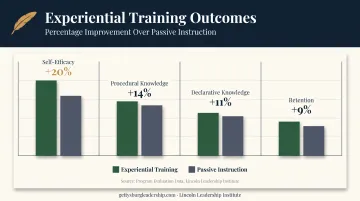
Research backs this up. A peer-reviewed meta-analysis by Sitzmann found that simulation-based, experiential training produced measurably better results than passive instruction. Compared with standard instructional groups, experiential training delivered:
- 20% higher self-efficacy
- 14% higher procedural knowledge
- 11% higher declarative knowledge
- 9% higher retention
Studying history for leadership insight isn't new. Scholars built entire theories, like Thomas Carlyle's 1840 Great Man theory, by examining commanders and statesmen who led through crisis.
Trait research since then, including Stogdill's 1948 survey and later Big Five meta-analyses, has confirmed that specific characteristics correlate with effective leadership. No single formula guarantees it, but the pattern is consistent.
What makes historical moments so instructive comes down to three things:
- Real stakes — outcomes were permanent, not hypothetical
- Complete narrative arcs — the decision, the reasoning, and the consequence are all documented
- No corporate noise — no committees, no approval chains, just a leader and a decision that had to be made now
That last point matters most. Strip away modern bureaucracy and what's left is the raw decision-making process—the part that clarifies what actually matters under pressure.
Core Leadership Lessons from History's Defining Moments
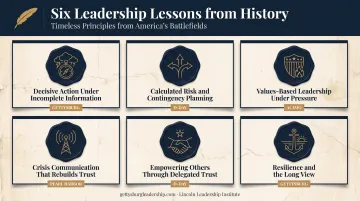
Four battlefields. Six lessons. Each one still applies directly to how leaders operate today.
Decisive Action Under Incomplete Information
Lincoln didn't have polling data or a communications team when he decided to reframe the Civil War's purpose at Gettysburg. He had a divided nation, a war going worse than promised, and no guarantee that emancipation as a unifying cause would hold. He acted anyway, delivering a 272-word address that redefined what the war was for.
The modern parallel: leaders often have to decide before all the data arrives. Waiting for certainty usually costs more than an imperfect call made early.
Calculated Risk and Contingency Planning
D-Day was originally set for June 5, 1944. Chief meteorologist James Stagg's forecast showed the weather worsening, so Eisenhower postponed the invasion 24 hours, then approved it based on a narrow predicted break in the storm.
Planners had spent nearly a year preparing contingencies for tides, moon phases, and troop movement. Eisenhower personally drafted a note accepting full responsibility if the invasion failed. The strongest calls pair bold timing with that kind of backup planning.
Values-Based Leadership Under Extreme Pressure
The 13-day siege at the Alamo ended March 6, 1836, with defenders vastly outnumbered and no reinforcements arriving in time. William Travis, James Bowie, and roughly 189 others chose to stay regardless, holding their position because the mission mattered more to them than the odds did.
Clarity of purpose can carry a team through situations where the outlook is genuinely grim. Conviction means knowing exactly why the mission matters enough to hold the line, even when the odds look poor.
Crisis Communication That Rebuilds Trust
After Japan attacked Pearl Harbor on December 7, 1941, President Roosevelt had less than a day to steady a shaken nation before addressing Congress. He personally revised his own draft, swapping clinical phrasing like "world history" for the far more resonant "infamy," and "simultaneously" for "suddenly." Small edits, enormous impact on how the message landed.
A few things carried over into how organizations recover from crisis today:
- Leaders who communicate plainly and quickly rebuild trust faster than those waiting for perfect information
- The messenger matters as much as the message; credibility built over time is what makes a crisis briefing land
- Word choice shapes emotion—specific, human language lands harder than careful corporate phrasing
Empowering Others Through Delegated Trust
Modern special operations units run on commander's intent: leaders define the mission and the desired outcome, then trust subordinate teams to execute independently based on real-time judgment. Faculty like Admiral Scott Moore and Command Master Chief Dave Cooper, who each spent more than 30 years in Naval Special Warfare, teach this model from firsthand experience rather than theory.
Micromanaging kills the speed and initiative teams need under pressure. Define the outcome, then get out of the way.
Resilience and the Long View
Every one of these campaigns absorbed setbacks along the way. The Union lost battle after battle before Gettysburg. The Allies took devastating losses on Omaha Beach. Pearl Harbor itself was a catastrophic defeat before it became a turning point. None of these leaders treated a single loss as final.
Separating a short-term setback from the long-term mission is what allows a team to recover instead of collapsing.
Legendary Leaders Throughout History and What They Teach Us
Abraham Lincoln
Lincoln's leadership rested as much on humility and moral clarity as it did on political skill. His Gettysburg Address, delivered November 19, 1863, took barely two minutes to speak but reframed the entire purpose of the Civil War in fewer than 300 words.
That mix of brevity, conviction, and moral clarity is the model Lincoln Leadership Institute draws on when teaching leaders how to steer through crisis with clear values—not the name alone, but the method.
Dwight D. Eisenhower and the Normandy Generals
As Supreme Allied Commander, Eisenhower had to weld American, British, and Canadian forces—each with its own command culture and political pressure—into one invasion force. Launching D-Day on a narrow weather window remains a clear case of calculated risk paired with contingency planning.
Lesson: Align competing stakeholders early, then decide with incomplete information and a backup plan ready.
Sun Tzu
Sun Tzu's The Art of War argues that the height of strategic skill is winning without direct conflict, breaking an opponent's resistance through preparation and positioning rather than brute force. That idea still maps to competitive strategy today.
Lesson: Win through preparation and positioning. The best leaders often avoid unnecessary fights altogether.
Winston Churchill
Churchill's wartime speeches, including "We Shall Fight on the Beaches" and "Their Finest Hour," delivered in June 1940, didn't just report facts. They gave a frightened public the language for its own resolve. For Churchill, communication wasn't a supporting skill—it was the leadership itself.
Lesson: In a crisis, the words you choose can steady a team as much as the plan you publish.
Beyond the Battlefield
Leadership isn't confined to war rooms. Mahatma Gandhi and Nelson Mandela led through civil resistance and moral conviction rather than formal command—proof that influence can outrun hierarchy when the cause is clear.
Across eras, the same traits show up again and again:
- Integrity when the easy path would compromise the mission
- Resilience after setbacks that would stall most teams
- A vision people can hold onto when the outcome is still uncertain
Those patterns are why history remains one of the sharpest classrooms for leaders who have to decide, align, and communicate under pressure.
The 7 C's of Leadership: A Timeless Framework
The 7 C's give leaders a simple lens for self-assessment. Each pillar maps to a historical moment where the trait was tested under real pressure.
| Pillar | What It Means | Historical Example |
|---|---|---|
| Character | Moral and ethical grounding behind every decision | Lincoln preserving the Union while ending slavery |
| Courage | Acting despite personal risk or fear | Travis and the defenders holding the Alamo |
| Communication | Clarity and conviction in how a message lands | Churchill's wartime speeches |
| Commitment | Staying anchored to the mission when it gets hard | Eisenhower owning full responsibility for D-Day |
| Competence | Technical and tactical skill to execute the mission | D-Day forces executing Eisenhower's commander's intent |
| Credibility | Trust earned through consistency, not title | FDR's steady tone after Pearl Harbor |
| Collaboration | Coordinating across differences toward one goal | Eisenhower unifying Allied command |
Every pillar was proven by leaders who faced real consequences. Use the list as a quick self-assessment: rank yourself on each C, then focus development on the one or two traits that are weakest right now.
Bringing History's Leadership Lessons to Life
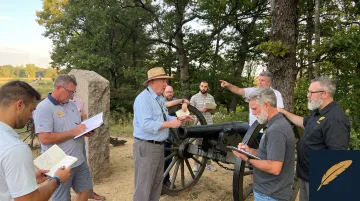
Reading about Gettysburg or Normandy teaches concepts. Standing on the actual ground where those decisions were made teaches something else entirely.
A meta-analysis of 335 independent leadership-training samples by Lacerenza and colleagues found that practice, feedback, spaced sessions, on-site location, and instructor-led delivery were among the strongest moderators of training effectiveness—stronger than lecture-based formats alone.
Lincoln Leadership Institute, based in Gettysburg and known regionally as Gettysburg Leadership, built its entire model around that idea more than 25 years ago. Its programs run directly on the ground where history happened:
- Gettysburg Leadership Journey — a 2.5-day immersive experience covering decisive leadership and crisis communication
- Normandy D-Day Leadership Experience — an international program on strategic leadership and alliance-building
- Pearl Harbor Leadership Experience — a three-day program on crisis leadership and rapid decision-making
- Alamo Leadership Summit and Experience — one-day and multi-day formats built on courage and resilience
Faculty includes historians, licensed battlefield guides, retired generals and admirals, Navy SEALs, and Emmy-winning journalists like Dennis Owens, who brings 30 years of broadcast experience to crisis communication instruction.
The Institute has served more than 25,000 Fortune 1000 and public sector clients and has transformed over 40,000 leaders to date.
For leaders who want academic credentialing alongside the experience, the Institute's partnership with Purdue University Global offers a Leadership Excellence Certificate Program that pairs formal recognition with the immersive learning.
Frequently Asked Questions
Who are the greatest leaders in history?
"Greatest" is always debated, but Lincoln, Churchill, Eisenhower, Gandhi, and Sun Tzu come up again and again across political, military, and civic life. Decisiveness, clear communication, and integrity are what still travel across eras.
What are the 7 C's of leadership?
Character, Courage, Communication, Commitment, Competence, Credibility, and Collaboration. Together they form a practical framework for assessing where a leader is strong and where they need to grow.
What can businesses learn from military leadership?
Mission clarity, delegated trust through commander's intent, and composure under pressure. Special operations units in particular show how empowering people to act independently often outperforms tight control.
How is leadership different today than in the past?
Leadership has shifted from strict command-and-control models toward collaborative, values-driven, and adaptive styles. Core traits like courage and clear communication, however, have stayed constant.
Can leadership be taught, or are leaders born?
Both. Disposition plays a role, but structured training and coaching reliably raise leadership skill. Leaders are built through deliberate practice, feedback, and real responsibility—not talent alone.
What makes Gettysburg a good place to learn about leadership?
Gettysburg concentrated high-stakes Civil War decisions—on the field and in Lincoln's address weeks later. Leaders can stand in that ground and study command, communication, and moral courage where the choices actually unfolded.