In that kind of environment, "purpose" has stopped being a soft HR talking point. It's become one of the clearer predictors of whether leaders can keep teams engaged, focused, and resilient.
Here's the problem: most leaders say purpose matters, but few can define it in a way that shapes actual decisions. It stays trapped in mission statements and onboarding decks instead of showing up in daily behavior.
This article breaks down why purpose-driven leadership produces measurable results, not just inspiration, and how leaders can build it deliberately.
Key Takeaways
- Leading with purpose means tying daily decisions to a clear "why," not just repeating a mission statement
- Purpose-driven leaders drive stronger engagement, steadier decisions under pressure, and clearer team alignment
- Without purpose, teams default to compliance, reactive firefighting, and cultural fragmentation
- Purpose is a practice built through reflection and repetition over time, not a one-time exercise
What Is Leading with Purpose
Leading with purpose means grounding your decisions and behavior in a clear sense of "why": a set of core values and a mission bigger than the next deadline or quarterly number. That clarity turns task management into leading people toward something that matters.
Purpose operates on two levels:
- Personal leadership purpose: an individual's own "why" statement, the internal compass that guides how they lead
- Organizational purpose: the shared mission a leader connects their team to, giving daily work a larger meaning
Purpose is clarity and conviction under pressure. Consider Abraham Lincoln's Gettysburg Address, delivered on November 19, 1863, at the dedication of the Soldiers' National Cemetery.
In just 272 words, Lincoln redefined a divided nation's purpose during its darkest hour, calling for a "new birth of freedom" and reaffirming a government "of the people, by the people, for the people." That's the model: a leader distilling conviction into words that move people to act, even under existential pressure.
Modern leadership purpose works the same way, just at a smaller scale and on a daily basis.
Key Advantages of Leading with Purpose
The advantages below aren't abstract inspiration. They're outcomes HR and executive teams already track through engagement surveys, retention data, and performance reviews.
Increases Employee Engagement and Retention
Purpose-driven leaders help people see personal meaning in their work, which increases discretionary effort and loyalty. This isn't a nice-to-have; it directly affects who stays and who leaves.
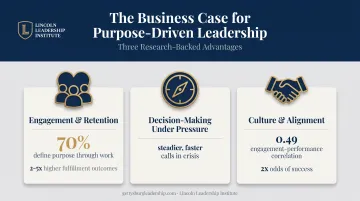
McKinsey's research on workplace purpose found that 70% of employees say their sense of purpose is largely defined by work, and 63% want more opportunities to find purpose in day-to-day tasks.
Employees who felt fulfilled in their purpose at work reported outcomes 2x to 5x higher than unfulfilled peers: productivity, resilience, and likelihood of staying. Workers given room to connect personal purpose to the organization's mission were nearly 3x more likely to report that fulfillment.
Where this matters most:
- High-turnover industries fighting to retain talent
- Recruiting and keeping Gen Z and Millennial employees
- Periods of restructuring or organizational change
Improves Decision-Making Under Pressure and Uncertainty
A clear sense of purpose acts as an internal compass. When leaders face ambiguous, high-stakes situations, that compass keeps them grounded instead of reactive.
Core values become the anchor when leaders face steep trade-offs and no clear playbook—an AI disruption, an economic shock, or a sudden crisis. Battlefield history tells the same story: commanders who grasped the larger purpose of the mission made faster, steadier calls than those chasing short-term wins. That is the same pressure leaders study in immersive battlefield programs, where purpose under fire separates decisive action from reactive thrash.
Metrics affected:
- Decision speed and quality
- Crisis response effectiveness
- Consistency of judgment under stress
It shows up most in rapid change, restructuring, and high-uncertainty environments where the old playbook no longer applies.
Builds Unified Culture and Team Alignment
Shared purpose shifts a team's mindset from "me" to "we." That shift is what builds trust and gets cross-functional teams pulling in the same direction instead of protecting their own turf.
Gallup's Q12 meta-analysis, covering more than 3.3 million employees across 90 countries, found engagement correlates with performance at 0.49, with top-half engaged units carrying more than twice the odds of success of bottom-half units. Mission and purpose are core components of that engagement measure.
This matters most during:
- Mergers and post-acquisition integration
- Rapid scaling, when culture can fragment fast
- Leading distributed or cross-generational teams
What Happens When Purpose Is Missing
When purpose disappears, employees comply instead of commit. They follow instructions without the discretionary effort or resilience that gets teams through setbacks.
The consequences compound over time:
- Disengagement and quiet quitting — people show up but stop investing beyond the minimum
- Reactive firefighting — leaders lose the steadiness purpose provides and start managing crisis to crisis
- Fragmented culture and silos — without a shared "why," teams optimize for their own goals instead of the collective mission
- Leadership that doesn't scale — influence stays trapped with one founder or executive instead of spreading through the organization
The longer purpose stays absent, the harder it becomes to rebuild trust. What starts as mild disengagement calcifies into a culture that resists change, even when leadership finally tries to fix it.
How to Lead with Purpose in Practice
Purpose isn't something you declare once in a town hall. It's built through daily repetition and the example you set when it counts.
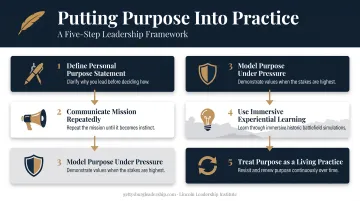
Define a personal leadership purpose statement. Write a short, values-based "why" — something like "help others achieve success as they define it." This becomes the filter for daily decisions, not a framed quote nobody revisits.
Communicate the organizational mission repeatedly. Purpose fades into the background fast without reinforcement. Bring it into performance reviews, team meetings, and everyday conversations, not just annual kickoffs.
Model purpose through action, especially under pressure. Credibility comes from demonstrating values-based decisions in the moments that are hardest, not from stating values when things are calm.
Use immersive, experiential learning to make it stick. Reading about purpose and living it are different experiences. At the Lincoln Leadership Institute, leaders study how Lincoln crystallized national purpose on the Gettysburg battlefield, then apply those lessons through practical team frameworks. One Pfizer participant said the experience "reshaped our culture, repurposed our mission and driven outstanding performance results."
Treat purpose as a living practice. Revisit and refine your personal and organizational purpose statements as your role, team, and circumstances evolve. What guided you five years ago may not fit the challenges you face today.
Conclusion
Leading with purpose is what separates leaders who simply manage tasks from those who build lasting commitment and performance. It shows up in engagement scores, decision quality, and how well teams hold together under pressure.
Practiced consistently, purpose compounds—building a culture that strengthens over time instead of one that needs constant repair.
For leaders ready to build this capability, Gettysburg Leadership's immersive battlefield experiences turn purpose-driven leadership from theory into practice you can apply the moment you return to work.
Frequently Asked Questions
What does "leading with purpose" mean?
It means grounding your leadership decisions and daily behavior in a clear "why": a set of values and mission bigger than immediate tasks or metrics. It shapes how you decide, not just what you say.
Why is purpose important in leadership?
Purpose drives higher engagement, steadier decision-making under pressure, and stronger team alignment. All three translate into measurable business outcomes like retention and performance.
What are 5 qualities of a good leader?
Integrity, self-awareness, communication, empathy, and decisiveness top most lists. Purpose underpins each one, giving leaders a consistent reference point for how they show up.
What are the 7 C's of leadership?
One established framework includes Consciousness of Self, Congruence, Commitment, Collaboration, Common Purpose, Controversy with Civility, and Citizenship. It treats leadership as a purposeful, values-based, collaborative process.
What are the five P's of leadership?
Common versions include Purpose, People, Process, Performance, and Pride or Passion. Purpose typically sits at the foundation, shaping the other four.
How do I find my own leadership purpose?
Reflect on your core values, the challenges that shaped you, and what genuinely motivates your actions. Distill that into a short, memorable statement you can return to when decisions get hard.