In 2026, that exchange looks different than it did even three years ago. AI drafting tools sit on executives' desktops. Hybrid teams expect leaders to show up on camera, not just in email. A single leaked memo can move a stock price before lunch.
This article breaks down the trends reshaping how executives speak, write, and present this year, the forces driving them, and what they mean for organizations investing in leadership development, including the kind of high-pressure, experiential training that builds these skills faster than a slide deck ever could.
Key Takeaways
- AI can draft executive messages, but human review still decides whether audiences trust them
- Trust between leaders and employees hinges more on transparency than curated positivity
- Emotional intelligence is now measured, coached, and expected—not left to instinct
- Video and multichannel formats are overtaking single-format memos
- Crisis-ready, real-time response is now a baseline executive skill
Key Trends Shaping Executive Communication in 2026
Trend 1: AI-Augmented, Human-Verified Communication
Executives now use AI to draft speeches, summarize earnings data, and personalize employee messages before a town hall. A communications team might feed quarterly numbers into an AI tool to generate first-draft talking points, then have the CEO revise for tone and specificity before an earnings call.
That human pass matters more than most leaders realize. A 2025 study surveying 1,100 working professionals found that only 40% to 52% rated a supervisor's AI-assisted message as sincere when AI involvement was high, compared with 83% for messages with low AI assistance, according to research published in the International Journal of Business Communication.
Employees noticed the polish. They doubted whether the manager actually cared.
Organizations getting this right typically:
- Use AI to synthesize data into rough talking points, not finished remarks
- Route every leadership message through a human editor who adds specific, personal detail
- Reserve emotionally charged topics—layoffs, crises, culture shifts—for fully human-drafted communication
Skip that last step, and leaders risk sounding polished and hollow at the exact moment employees need something real.
Trend 2: Radical Transparency as the New Trust Currency
Employees no longer reward curated positivity. They reward leaders who share the messy, unfinished truth, including bad news.
Only 21% of U.S. employees strongly agree they trust organizational leadership, according to Gallup. But when employees strongly agree that leaders communicate clearly, inspire confidence in the future, and actively lead change, 95% report full trust in leadership, per Gallup's 2023 workplace research. Transparency isn't a soft nicety here. It's the mechanism that produces trust.
Intel CEO Pat Gelsinger offered a real example in September 2024, telling employees directly that the company still needed to hit a $10 billion savings target, was pausing projects in Germany and Poland, and was more than halfway through cutting roughly 15,000 positions. No corporate euphemism, no burying the number in a footnote.
This kind of directness carries risk. It's also the only kind that still works.
Trend 3: Emotional Intelligence as a Core Executive Skill
EQ used to be a personality trait executives either had or didn't. It's now a measurable, trainable competency with standardized assessments behind it.
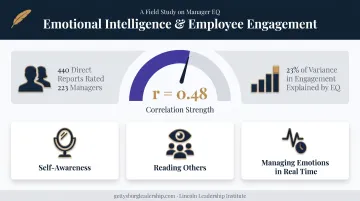
A field study of 440 direct reports rating 223 managers found that manager emotional intelligence correlated with total employee engagement at r = 0.48, accounting for 23% of the variance in engagement scores. The strongest link involved managing others' emotions, not just your own.
Tools like the EQ-i 2.0 and EQ 360 assessments give leaders structured feedback on where their communication style creates friction—blind spots most executives can't see on their own.
At Lincoln Leadership Institute, Director of Curriculum Dr. Jared Peatman is certified to administer both assessments. He helps executive clients pinpoint gaps such as under-reading a room's emotional temperature during a high-stakes announcement, before those gaps show up in engagement scores.
EQ development typically covers:
- Self-awareness, catching your own reactions before they leak into tone
- Reading others, picking up unspoken concern on a call or in a room
- Managing emotions in real time, staying composed when a question catches you off guard
Trend 4: Video-First, Multichannel Storytelling
The all-staff email is losing ground to the recorded video message. When a reorganization or layoff hits, employees increasingly expect to see the executive's face, not just read their words.
A leader announcing a difficult restructuring on video, rather than through a written memo, conveys something text can't: tone, pause, visible discomfort with the decision. That register of empathy is hard to fake on camera and hard to hide.
Most organizations now support major announcements with a mix of:
- Recorded video addresses for significant change or milestones
- Internal podcasts or fireside chats for ongoing strategy updates
- Short-form clips for frequent, low-friction touchpoints between big announcements
Single-format communication isn't disappearing, but relying on it alone for consequential news is increasingly the exception.
Trend 5: Crisis-Ready, Real-Time Communication Under Scrutiny
Social media and 24-hour news cycles compress an executive's response window from days to hours. A poorly worded first statement now gets amplified before a company can issue a correction.
United Airlines learned this in April 2017. After a passenger was forcibly removed from an overbooked flight, CEO Oscar Munoz initially described the incident as an effort to "re-accommodate" passengers and called the passenger "disruptive and belligerent."
The backlash was immediate. United Continental Holdings dropped more than 4% intraday, temporarily wiping out nearly $1 billion in market value, according to The Guardian's coverage of the incident. Shares closed down 2.8%, about $600 million below the prior close, even after a follow-up apology.
That kind of exposure is why demand for crisis-specific training has grown. At Lincoln Leadership Institute, faculty such as Dennis Owens—a 15-time Emmy Award-winning former political reporter who teaches crisis and media communication strategy—help leaders practice hard questions under pressure, instead of discovering their instincts live on camera.
What's Driving These Executive Communication Trends
Four forces are converging to raise the bar for every executive communicator, and none of them are slowing down.
- Technology advances: Generative AI and sentiment-analysis tools let communications teams draft and test executive messages faster, but that speed cuts both ways. Audiences now expect faster responses too.
- Workforce expectations: Younger, hybrid employees expect frequent, two-way dialogue with leadership, not quarterly town halls.
- Media and public scrutiny: A leaked memo or out-of-context clip can reach a national audience within hours.
- Competitive talent dynamics: Visible investment in leadership communication skills signals to high-potential employees that development is real, not a line in a handbook.
Recent global trust research shows that much of the public holds real grievance toward institutions and expects CEOs to speak up when company decisions directly affect customers, employees, or communities. Executives can no longer stay quiet and expect goodwill to hold on its own.
How These Trends Are Impacting Organizations
These shifts are changing how organizations budget, staff, and train for leadership communication.
Operational Impact
More companies now build dedicated executive communication capacity—speechwriters, internal video producers, and multichannel content leads—rather than leaving it to whoever has time between board meetings.
What used to be one memo drafted by an assistant is now a coordinated output:
- A video script
- A follow-up email
- An internal FAQ
- Clips for LinkedIn
Business Impact
Boards and investors increasingly treat executive communication quality as a reputation and valuation issue, not a soft skill. The United Airlines episode above shows how quickly a mishandled statement can move a stock price in hours. That's why more boards now ask about a CEO's public communication readiness alongside financial oversight, rather than treating it as an afterthought.
Workforce Impact
Demand for leadership development programs, coaching, and formal assessments like EQ-i 2.0 and EQ 360 has grown as companies try to build communication skills deliberately at the senior and high-potential levels.
Fortune 1000 companies and government agencies—including Pfizer, FedEx, GE, and the U.S. Treasury—have turned to structured, experiential programs such as those Lincoln Leadership Institute runs at Gettysburg and other historic sites. Lecture-based training alone hasn't closed the gap.
Put a leader in a live, high-pressure scenario with incomplete information and ask them to decide what to communicate and when. That surfaces instincts a slide deck never will.
Future Signals for Executive Communication Beyond 2026
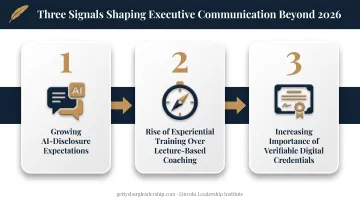
These trends won't stay static. Here are three early indicators worth watching over the next one to three years:
- AI-disclosure expectations will grow. Audiences will increasingly want to know when a leadership message was AI-assisted, echoing disclosure norms that emerged around sponsored content.
- Experiential training will keep gaining ground on lecture-based coaching. Immersive formats—including battlefield-based leadership simulations like those used at Lincoln Leadership Institute—let executives practice high-stakes communication decisions in real time instead of discussing them in the abstract.
- Verifiable digital credentials will matter more to boards. LinkedIn-verified certificates and badges—such as university-partnered credentials—will give boards a fast way to confirm a leader has built real communication and decision-making skills, not just attended a workshop.
Conclusion
AI adoption, radical transparency, emotional intelligence, multichannel storytelling, and crisis-readiness point to one shift: executive communication has become a measurable, trainable discipline instead of a personality trait some leaders happen to have.
Leaders who adapt early build stronger trust, higher retention, and better organizational performance than those still relying on quarterly memos and hoping for the best.
For organizations ready to build these skills directly, experiential leadership programs offer something a workshop can't: real pressure. Lincoln Leadership Institute runs its programs at historic sites like Gettysburg, where communication, decision-making, and character face the same stakes history's leaders once did—not a whiteboard simulation.
Frequently Asked Questions
What does "executive communication" mean?
Executive communication is the strategic, business-aligned communication senior leaders use to convey vision, decisions, and results to employees, investors, and the public. It differs from routine workplace communication in scope, stakes, and audience size.
How can I get better at executive communication?
Structured practice, feedback-driven coaching, and formal assessments like EQ-i 2.0 build self-awareness quickly. Experiential leadership programs that simulate high-pressure decisions tend to produce faster, more lasting improvement than lecture-based training alone.
What are some examples of effective executive communication?
Examples include transparent town halls that address bad news directly, CEOs who explain layoffs without corporate euphemism, and recorded video addresses that convey empathy during major change.
What are the core qualities of executive presence?
Most frameworks cite clarity, confidence, credibility, composure, and character. What matters more than the label is staying clear and steady under pressure.
How is executive communication different from everyday workplace communication?
Executive communication carries higher stakes, reaches broader and more diverse audiences, and demands more brevity and strategic framing. A miscommunication at the executive level can move markets; one between coworkers rarely does.
How is executive communication training typically delivered?
Formats range from one-on-one coaching and workshops to immersive, experiential programs that place leaders in real-world, high-pressure simulations. The latter builds instincts that lecture-based formats alone struggle to replicate.