
Introduction
Ask a room full of leaders to rate their own accountability, and most will hand themselves a solid grade. Ask their teams the same question, and the room gets quiet.
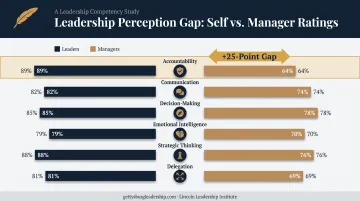
Gallup's 2026 workforce study found that accountability ranks dead last among seven core leadership competencies, according to both leaders and the managers who report to them. Only 30% of managers rated their leaders as outstanding at creating accountability.
The fallout is predictable: fuzzy expectations, stalled performance, and teams that quietly disengage because nobody's answering for outcomes.
This article breaks down what accountability actually means, walks through the 5 C's framework for building it, and explains why decision-making under real pressure—not another slide deck—is what finally makes it stick.
Key Takeaways
- Accountability means owning outcomes, not just checking off tasks, and answering for wins and losses alike
- Gallup research confirms accountability is the leadership competency both leaders and teams rate weakest
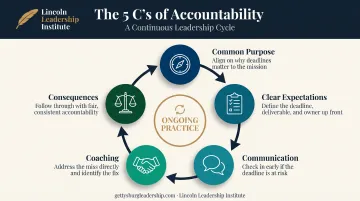
- The 5 C's (Common Purpose, Clear Expectations, Communication, Coaching, Consequences) give accountability structure
- Self, peer, and authoritative accountability each strengthen a healthy culture in different ways
- Immersive, high-stakes learning builds accountability faster than lecture-based training
What Does Accountability in Leadership Mean?
People use "responsibility" and "accountability" interchangeably. They shouldn't.
Responsibility is ownership of a task before the work happens: you're assigned the project, the budget, the deadline. Accountability is what happens after: answering for the result, whether it's a win or a miss. A leader can hand off responsibility. Accountability, they keep.
That distinction shows up in one simple habit. Strong leaders say "we" when a project succeeds and "I" when it fails. That wording tells the team the leader owns the outcome instead of distancing from it.
Forward-Focused, Not Punitive
Real accountability isn't about assigning blame after the fact. It's about correcting course and learning faster next time. Leaders who treat every miss as a search for a scapegoat train their teams to hide problems instead of surfacing them.
It Has to Start at the Top
Accountability can't cascade downward if it doesn't originate at the executive level. When a VP dodges ownership of a missed target, entry-level employees learn that dodging is the norm.
Here's the uncomfortable part: leaders consistently overestimate their own performance here. Gallup found manager ratings trailed leader self-ratings by more than 20 points on six of seven competencies—and accountability showed the widest gap of all. Leaders think they're doing better than their teams say they are.
Why Accountability Matters: The Business Case for Leaders
Skip accountability, and the cost shows up on the balance sheet, not just in morale surveys.
Gallup's data makes the engagement gap stark: employees whose leaders excel at creating accountability are 51% engaged, compared to just 17% when leaders fall short. That's a threefold difference driven almost entirely by one competency.
Clear expectations paired with genuine accountability also drive output quality. When people know exactly what's expected and know someone will follow up, they stop guessing and start executing.
The Trust Connection
Accountability and psychological safety reinforce each other. Harvard Business School researcher Amy Edmondson notes that psychological safety requires candor without fear of retribution.
People need to feel safe admitting mistakes before anyone can hold them accountable for fixing them. Punish every misstep, and people stop reporting them at all.
The organizational costs of weak accountability show up fast:
- Lower morale as high performers watch underperformers go unaddressed
- Higher voluntary turnover, with leadership and manager roles costing roughly 200% of salary to replace
- Wasted hours on rework, miscommunication, and unproductive friction
Closing this gap isn't a one-off training day. It takes deliberate, ongoing leadership development that builds lasting habits, not a shared vocabulary alone.
The 5 C's of Leadership Accountability
Building real accountability takes more than telling people to "own it." A practical framework helps—here's one built around five connected principles.
At a glance:
- Common Purpose — shared meaning behind the work
- Clear Expectations — specific, measurable standards
- Communication & Alignment — regular two-way dialogue
- Coaching & Collaboration — growth over blame
- Consequences — consistent recognition and correction
Common Purpose
Accountability without meaning is just compliance. Teams who understand why their work matters hold themselves to a higher bar than teams chasing an arbitrary metric. Gallup's own engagement research includes a telling question: does your job feel important to the company's mission? When the answer is yes, accountability follows naturally.
Clear Expectations
Vague goals produce vague results. Leaders need to define specific, measurable standards—not "improve customer service," but "resolve tickets within 24 hours." Gallup has found that roughly half of workers don't actually know what's expected of them, which makes accountability nearly impossible to enforce fairly.
Communication & Alignment
Accountability breaks down without regular, two-way dialogue. Gallup found that employees who received meaningful feedback in the past week were far more likely to be fully engaged, with frequent feedback linked to substantially higher motivation than annual reviews alone. Silence between check-ins is where accountability quietly dies.
Coaching & Collaboration
Accountability shouldn't feel like a threat. Framed as coaching, it becomes growth instead of punishment. A leader who says "let's figure out what went wrong and fix it together" builds a different culture than one who says "explain yourself."
Consequences
Standards only mean something if they're enforced consistently—for good performance and for poor performance alike. That means real recognition when someone delivers, and fair, corrective action when someone doesn't. Threats and blame tend to make people hide errors; consistent, predictable consequences make people report them.
Putting it together: Say a team misses a major deadline. A leader grounded in the 5 C's works the full loop:
- Common Purpose — reconnects the team to why the deadline mattered
- Clear Expectations — reviews what was expected versus what was delivered
- Communication — holds an honest conversation about where things broke down
- Coaching — works alongside the team to close the gap next time
- Consequences — follows through with corrective steps or recognition based on effort and outcome
Types of Accountability and How to Put Them Into Practice
Accountability takes three forms. Knowing which one fits the moment helps you pull the right lever.
Self-Accountability
This is internal ownership: no one has to check in because the person holds themselves to the standard. It is the most sustainable form, and it grows when leaders hand over real authority instead of micromanaging every step.
Put it into practice by:
- Giving people decision rights that match their responsibilities
- Defining clear outcomes, then stepping back on the “how”
- Asking “What do you recommend?” before offering your own fix
Peer Accountability
Colleagues holding each other responsible strengthens culture in ways top-down mandates never will. Teams that confront problems promptly and respectfully outperform teams that let issues slide. Left without structure, though, peer pressure can turn inconsistent or even toxic.
Put it into practice by:
- Setting shared norms for how the team raises missed commitments
- Making progress visible so peers can spot gaps early
- Coaching respectful challenge instead of silence or blame
Authoritative Accountability
Sometimes a leader has to step in directly: new hires still learning expectations, or resistant employees who have not bought in yet. Use this as a temporary bridge, not a permanent strategy, and always pair it with follow-up.
Put it into practice by:
- Naming the standard, the gap, and the next concrete action
- Setting a clear check-in date before the conversation ends
- Shifting toward peer or self-accountability as soon as capability allows
Whichever type is in play, consistent follow-up is what makes it stick. Weekly check-ins, tight feedback loops, and honest debriefs turn one hard conversation into an ongoing habit.
Timeless Lessons in Accountability from History
Some of the clearest accountability lessons come from high-stakes moments with incomplete information.
After the Battle of Gettysburg, Abraham Lincoln praised General George Meade for the victory, then drafted a sharply worded letter faulting him for not pursuing Robert E. Lee's retreating army fast enough. Lincoln never sent that letter.
He still held Meade accountable for the outcome, but he revised his judgment once he had more context. That is accountability without recklessness: demand results, and stay willing to revisit the verdict.
Military tradition has built this idea into daily practice. The chain of command makes every officer accountable for what their unit does or fails to do. The after-action review (AAR) turns each mission into a lesson instead of a blame session. It asks three questions:
- What should have happened?
- What actually happened?
- How do we improve next time?
Lincoln Leadership Institute puts the same logic on the ground. Its 2.5-day Gettysburg battlefield program places leaders in scenarios with incomplete information and real consequences, much as Lincoln and his generals had to decide. Faculty with chain-of-command experience, including retired military leaders who lived AAR culture firsthand, help participants map those historical choices to accountability gaps back at the office.

Leaders who want to formalize that growth can pursue the Institute's Leadership Excellence Certificate Program, developed with Purdue University Global.
Frequently Asked Questions
What does accountability in leadership mean?
Accountability means owning outcomes and results, not just completing assigned tasks. It applies equally to successes and failures—leaders answer for both.
What are the 5 C's of leadership accountability?
Common Purpose, Clear Expectations, Communication, Coaching, and Consequences. Together, they turn accountability into a structured practice rather than a vague expectation.
How is accountability different from responsibility?
Responsibility is ownership of a task before the work happens. Accountability is answering for the outcome afterward—regardless of how the task was assigned.
Why do so many leaders struggle with holding others accountable?
Most leaders avoid the discomfort of difficult conversations and often set expectations too vaguely to enforce. Without specifics, there's nothing concrete to hold anyone to.
What is an example of accountability in leadership?
A leader publicly owns a missed team goal, explains what went wrong, and outlines the specific corrective steps the team will take—rather than deflecting blame onto individuals.
How can leaders hold teams accountable without micromanaging?
Set clear, measurable expectations upfront, then follow up through coaching conversations instead of constant oversight. Regular check-ins replace the need to watch every move.