That's a lot of money chasing a crowded market. With hundreds of leadership providers competing for corporate budgets, HR and L&D leaders often struggle to tell proven, outcome-driven programs apart from generic corporate training dressed up in new branding.
This guide breaks down the Fortune 500 management training programs worth knowing, how large enterprises evaluate them, and the trends reshaping leadership development right now.
Key Takeaways
- Fortune 500 companies blend experiential, university, and skills-based training providers.
- Program selection hinges on faculty credibility and documented client outcomes, not brand name alone.
- Options range from battlefield leadership training to case-method executive education.
- The 70-20-10 model increasingly guides leadership development budget allocation.
Overview of Management Training in the Fortune 500 Landscape
Management training programs are structured, often multi-day or multi-module experiences built to strengthen decision-making, communication, and strategic leadership skills in current and emerging managers. They differ from one-off workshops in that they're designed around measurable competency gaps, not general professional development.
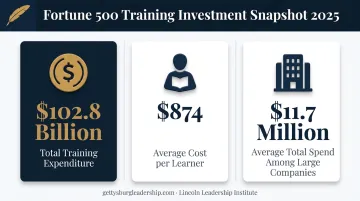
That specificity requires real investment. Total U.S. training expenditure hit $102.8 billion in 2025, spanning corporations and institutions with 100+ employees, per Training Industry's annual survey. Large enterprises alone spend millions annually on succession planning and frontline management pipelines, while also funding dedicated tracks for high-potential leaders.
The providers below have earned recognition across Fortune 1000 and public sector organizations for a mix of reliability and faculty expertise, with programs that show measurable behavior change. Each takes a distinct approach, so the right fit depends on your organization's specific leadership gaps.
Top Fortune 500 Management Training Programs Worth Knowing
Selection criteria for this list centered on reputation among large enterprises, faculty credentials, proven methodology, and evidence of measurable behavior change, not marketing claims.
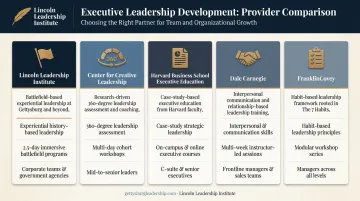
Lincoln Leadership Institute (Gettysburg Leadership)
For more than 25 years, Lincoln Leadership Institute has pioneered experiential leadership development at historic battlefield sites, including Gettysburg, Normandy, Pearl Harbor, and the Alamo. Its faculty roster includes retired generals, Navy SEALs, Emmy-winning journalists, and Ph.D. historians who connect historical decision-making to modern leadership challenges. The Institute's Leadership Excellence Certificate Program, delivered in partnership with Purdue University Global, adds an accredited, verifiable digital credential to the experience.
| Category | Details |
|---|---|
| Program Format | Multi-day immersive battlefield experiences, one-day summits, private team cohorts, and the virtual Lincoln Leadership Live format |
| Notable Credential | Purdue University Global-backed Leadership Excellence Certificate with a verifiable digital badge |
| Client Base | 25,000+ Fortune 1000 and public sector clients, including FedEx, GE, Pfizer, and the Department of Defense |
Center for Creative Leadership (CCL)
CCL is a long-standing, research-based nonprofit leadership institute known for grounding its programs in 360-degree assessments and academic rigor rather than trend-driven content. Its flagship Leadership Development Program (LDP) targets mid-level leaders and directors through a five-day intensive nested inside a five-month development journey. For senior executives, Leadership at the Peak runs a similar five-day, in-person format within a six-month arc.
| Category | Details |
|---|---|
| Program Focus | Research-backed leadership assessments and competency-building coursework |
| Delivery Format | In-person and live-online options, depending on program |
| Best Suited For | Mid-level leaders and directors (LDP); C-suite and senior executives (Leadership at the Peak) |
Harvard Business School Executive Education
HBS Executive Education extends the school's case-method teaching into short-format programs for senior leaders and general managers. Brand prestige and access to HBS faculty are the obvious draw, but the pricing reflects that positioning.
The Advanced Management Program runs three modules over three months for senior executives and carries a $95,000 fee for its 2026 session, according to HBS Executive Education's comprehensive leadership programs page. Its General Management Program, aimed at functional and divisional leaders, spans four modules over four months at $81,000.
| Category | Details |
|---|---|
| Program Focus | Strategic decision-making and general management through case-method learning |
| Format & Duration | Blended campus and virtual modules over 3–4 months |
| Investment Level | Approximately $81,000–$95,000 for comprehensive programs |
Dale Carnegie Training
Dale Carnegie has spent over a century building communication and interpersonal skills training, and its franchise-based delivery network makes it one of the most widely accessible options for foundational manager training. A notable enterprise example: industrial supplier Walter AG ran a competence and leadership project spanning 266 training sessions, 104 trainers, and 28 countries through Dale Carnegie's managed learning services.
| Category | Details |
|---|---|
| Program Focus | Communication, interpersonal skills, and people-management fundamentals |
| Delivery Format | In-person, live online, and hybrid "learn from anywhere" formats |
| Best Suited For | First-time managers and frontline supervisors needing foundational skills |
FranklinCovey
FranklinCovey built its reputation on "The 7 Habits of Highly Effective People" and has since scaled that framework into a broader leadership consultancy model. Its content-licensing structure lets organizations certify internal facilitators rather than relying solely on outside trainers. Healthcare system AdventHealth used FranklinCovey's leadership development approach and reported a 50% reduction in leadership turnover, with leader-effectiveness scores climbing from 81 to 87.
| Category | Details |
|---|---|
| Program Focus | Execution, personal effectiveness habits, and trust-based leadership |
| Delivery Format | Live in-person, live online, on-demand, and train-the-trainer licensing |
| Best Suited For | Organizations seeking scalable, culture-wide leadership frameworks |
How Fortune 500 Companies Choose the Right Management Training Program
The most common mistake HR leaders make? Picking a program because everyone's heard of it, not because it addresses a specific leadership gap backed by verified outcome data. Brand recognition doesn't guarantee fit.
Instead, mature L&D teams evaluate providers against a consistent set of factors:
- Facilitator credibility: Do instructors bring real operational or academic authority, not just presentation skills?
- Documented client outcomes: Has the provider shown measurable results with organizations of comparable size or industry?
- Customization ability: Can the content flex to your organization's actual challenges, or is it a fixed curriculum?
- Post-program reinforcement: Is there coaching, follow-up resources, or a structured path to sustain behavior change after the event ends?
Format matters here too. Scenario-based and experiential formats consistently outperform lecture-only training on engagement and retention. According to ATD research, 98% of surveyed organizations now use some form of scenario-based learning, and 72% report better knowledge retention and application as a result.
Emerging Trends Shaping Fortune 500 Leadership Development
The 70-20-10 Model Is Reshaping Budgets
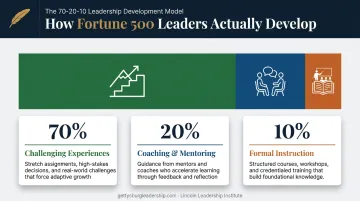
CCL's research, built on studies by Morgan McCall, Michael Lombardo, and Robert Eichinger, popularized the idea that leaders develop through 70% challenging experiences, 20% coaching and mentoring relationships, and only 10% formal instruction. Fortune 500 L&D teams increasingly structure their entire training portfolio around this ratio, weighting budgets toward experiential assignments and coaching over classroom hours.
That shift explains why immersive formats, such as historic-site simulations and live scenario-based exercises, are replacing traditional lecture-based training. A 2024 field experiment involving over 4,400 employees found that managers who completed combined classroom-and-simulation training were rated meaningfully higher on transformational leadership behavior by their teams than those in a no-training control group.
A few other shifts worth watching:
- Emotional intelligence assessments like EQ-i2.0 and EQ360 build self-awareness in high-potential leaders before formal training begins, often administered by certified practitioners such as LLI's Dr. Jared Peatman.
- Blended delivery models now pair in-person immersion with virtual follow-up coaching, a response to distributed workforces that can't always travel for multi-day programs.
- Analytics-driven L&D is expanding, though a gap remains: ATD research found that 74% of organizations use performance assessments to measure training, but only 30% feel effective at turning that data into business decisions.
Conclusion
Choosing the right management training partner means matching methodology to your organization's specific leadership gaps, whether that's first-time manager fundamentals, executive strategic thinking, or crisis decision-making under pressure. Reputation and price matter far less than this fit.
Before committing budget, evaluate these three factors:
- Faculty credibility and depth of real-world experience
- Format flexibility that fits your team's schedule
- Post-program reinforcement support
This reinforcement often determines whether training sticks or fades within a quarter.
For organizations looking for a proven, experiential option, Lincoln Leadership Institute's battlefield-based programs at Gettysburg, Normandy, and Pearl Harbor offer a distinctive path to measurable leadership transformation. With sessions scheduled throughout 2026, an immersive, history-grounded approach could be the right fit for your team's next chapter.
Frequently Asked Questions
What is the 70-20-10 rule for leadership development?
It's a framework holding that leaders develop through 70% challenging experiences, 20% coaching or mentoring, and 10% formal training. Fortune 500 L&D teams widely use it to allocate development budgets and program design.
What education do Fortune 500 CEOs typically have?
Among top Fortune 500 CEOs studied by Fortune in 2023, 75% held an MBA or another graduate degree, though only 5% attended an Ivy League undergraduate school. Executive education often supplements these degrees later in their careers.
How much do Fortune 500 companies spend on management training annually?
U.S. organizations with 100+ employees averaged $874 per learner in 2025, with large companies spending an average of $11.7 million in total training expenditure that year.
How long do Fortune 500 management training programs typically last?
Formats range widely: one-day summits, 2.5- to 3-day immersive programs, multi-month executive education modules, and multi-year enterprise partnerships, depending on the provider and organizational goals.
Can smaller companies access the same management training programs as Fortune 500 firms?
Yes. Most providers, including Lincoln Leadership Institute, offer open-enrollment sessions for small cohorts (3–5 leaders) alongside scalable formats accessible to mid-size organizations.
What's the difference between leadership training and management training?
Management training builds operational and process skills, like delegation and performance reviews. Leadership training focuses on vision, influence, and decision-making. Top programs typically blend both.