Many executive teams assume shared culture already exists simply because everyone holds a senior title. In reality, silos between departments, competing agendas, and unspoken tension are common at the top. Leaders just get better at masking it in meetings.
This guide breaks down why leadership-level culture building works differently than standard team activities, which strategies actually move the needle, and why immersive, high-stakes experiences tend to outlast the standard offsite icebreaker.
Key Takeaways
- Leadership culture cascades downward, shaping trust, decision speed, and retention throughout the organization
- Real culture change requires shared values, reinforcement, and modeled behavior, not one retreat
- The 5 C's offer useful language, but executives need application tailored to high-stakes dynamics
- Immersive, experiential formats create deeper behavior change in senior leaders than icebreakers
Why Culture-Building Matters Most at the Leadership Level
Executive teams function as the organization's culture template. The trust levels, communication habits, and decision-making style modeled in the C-suite become the default behavior everyone else copies, whether or not it's healthy.
The numbers back this up. Organizations where the top team shares a common vision are 1.9 times more likely to deliver above-median financial performance, according to McKinsey's research on high-performing teams. Alignment at the top operates as an enterprise performance system, directly driving measurable financial results.
The Unique Risks Facing Leadership Teams
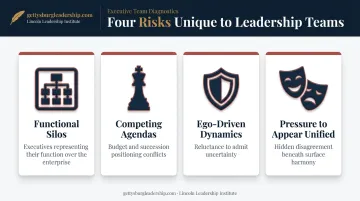
Leadership teams face failure modes that entry-level teams rarely encounter:
- Functional silos — each executive represents a department first, the enterprise second
- Competing personal agendas tied to budget, headcount, or succession positioning
- Ego-driven dynamics that make admitting uncertainty feel risky
- Pressure to appear unified, even when real disagreement exists behind closed doors
Generic games and icebreakers designed for junior staff rarely touch these problems. A trust fall doesn't surface who's quietly protecting their turf during a budget cycle.
Leadership teams also operate under compressed timelines and high-consequence decisions, which makes psychological safety more critical than it is for a standard department team. HR and L&D professionals increasingly treat leadership team culture as its own investment category, separate from general employee engagement programs.
Proven Strategies to Build a Strong Culture Within Your Leadership Team
Building executive-level culture takes deliberate mechanisms, not motivational posters. Here's what the evidence supports:
- Co-create shared values and vision with the full team rather than dictating them top-down. Ownership drives buy-in in a way mandates never do.
- Model vulnerability at the top. When leaders openly acknowledge mistakes, it signals safety. Amy Edmondson's research found psychological safety predicts team learning and performance, a finding Google's team-effectiveness research confirmed as the top driver among five team dynamics.
- Institute structured communication rituals, including recurring strategic retreats, decision post-mortems, and cross-functional check-ins, that force engagement beyond routine status updates.
- Align incentives with collaborative behavior. Rewarding only departmental wins reinforces the silos you're trying to break.
- Use validated EQ assessments, such as EQ-i 2.0 or EQ360 (the same tools Lincoln Leadership Institute's certified faculty administer), to surface individual and collective blind spots affecting trust and collaboration.
- Measure progress intentionally. A 2013 meta-analysis found that properly conducted debriefs improve performance by roughly 20% to 25%, meaning the follow-up conversation matters almost as much as the event itself.
These mechanisms work only through repetition. Treat them as ongoing habits, not a one-time checklist, and let them become your team's operating norm.
Why Experiential, Immersive Learning Outperforms Traditional Team Building for Executives
A two-hour icebreaker might loosen up a room. It rarely changes how a CFO and a Chief Revenue Officer resolve a genuine disagreement three months later.
Experiential learning theory explains why. Leaders retain and apply lessons far more effectively when placed in immersive, high-stakes scenarios that demand real decision-making under pressure, rather than passive discussion around a whiteboard. Generic activities designed for junior staff simply don't mirror the complexity senior leaders navigate daily.
Immersive Historical Leadership Development as a Model
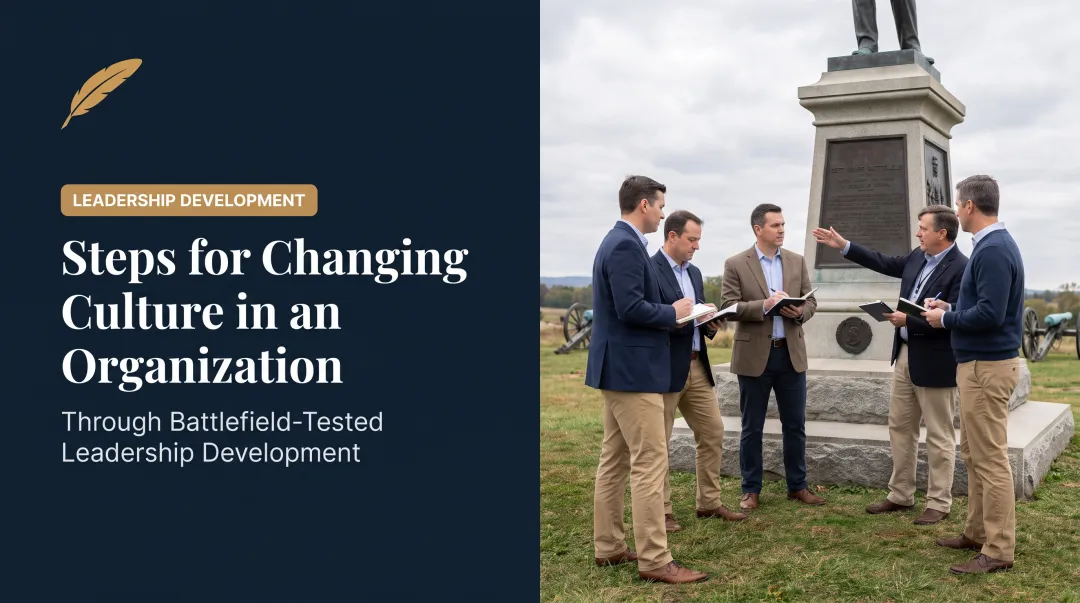
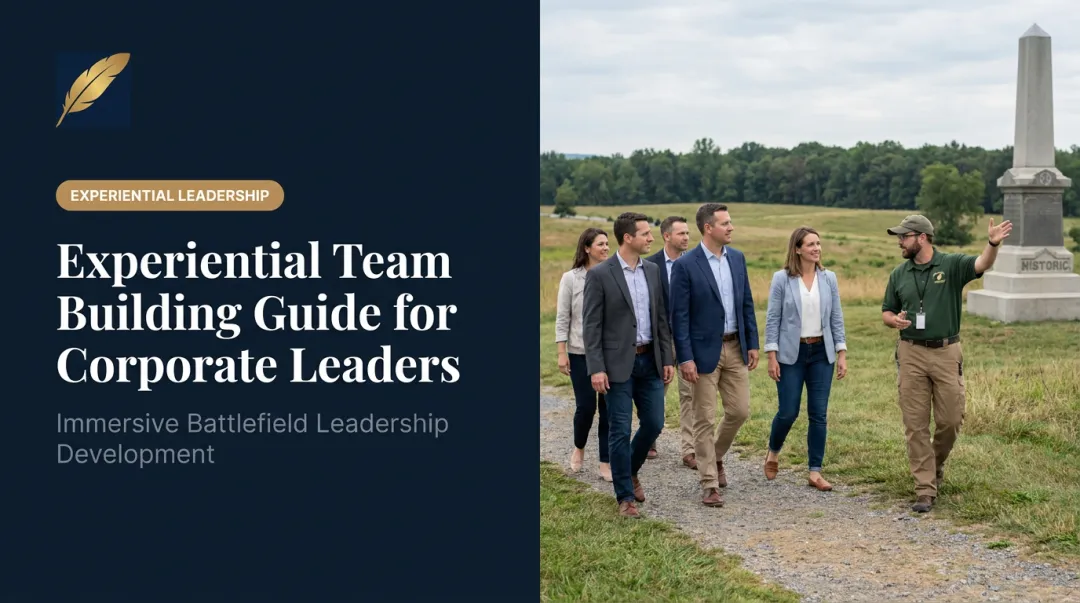
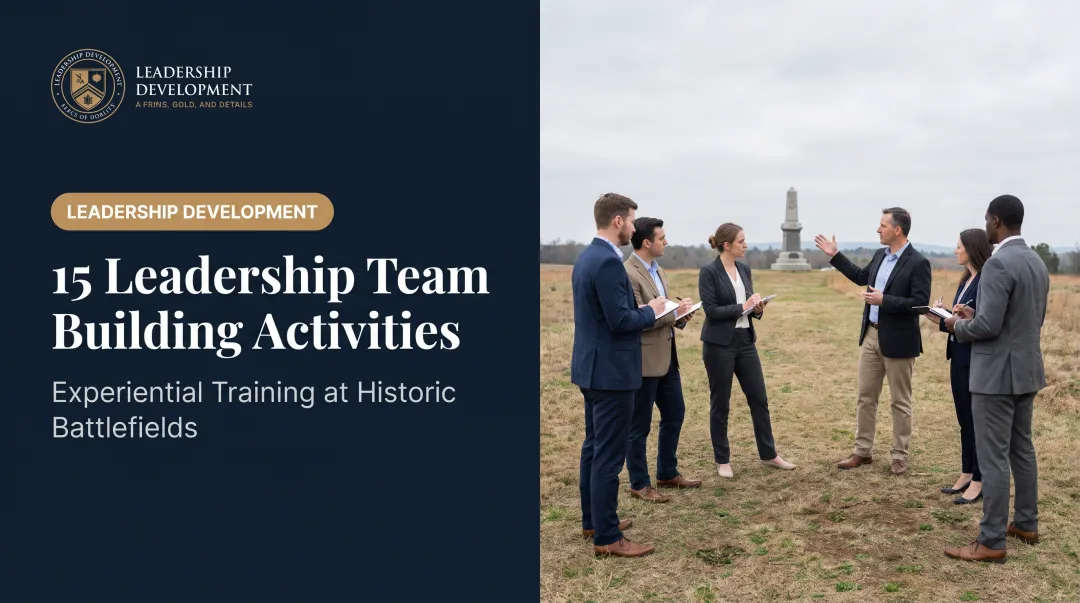
This is where battlefield-based leadership programs stand apart. At Lincoln Leadership Institute, executive teams work through the Gettysburg Leadership Journey, a 2.5-day immersive program held on the actual Gettysburg battlefield, with additional locations at Normandy and Pearl Harbor. Instead of a conference room case study, teams stand where real commanders made irreversible decisions with incomplete information and enormous consequences.
Faculty pairings make the difference. LLI's programs draw on instructors who've actually led under pressure, not just taught about it in theory:
- Retired generals with decades of strategic command experience
- A Navy Rear Admiral with 30+ years in Naval Special Warfare
- A career Navy SEAL who has led teams through life-or-death missions
- Licensed battlefield guides with decades of historical expertise
- Ph.D. historians who ground every lesson in academic rigor

That combination of battle-tested command experience and academic rigor is difficult for a generic corporate trainer to replicate.
That expertise builds credibility, but it's the program's length that builds trust.
A single overnight isn't enough for trust to build organically. Two nights of shared meals, individual coaching sessions, and sustained immersion give leadership teams the repeated experience that research links to genuine team cohesion.
Teams navigate ambiguity together on the terrain instead of discussing it in the abstract. That incremental structure lets lessons translate directly into workplace decision-making once everyone's back at the office.
Common Pitfalls That Undermine Leadership Team Culture
Even well-intentioned leadership teams sabotage their own progress. Watch for these three patterns:
- Treating culture-building as a single event. A great retreat that isn't tied to daily leadership behaviors afterward fades within weeks.
- Letting senior leaders observe instead of participate. If the CEO sits back while everyone else does the work, it signals culture-building is "for the team," not for leadership itself.
- Failing to measure or revisit progress. Without a debrief cadence or pulse survey, early momentum evaporates and old habits creep back in.
Frequently Asked Questions
How do you build culture in a team?
Leaders build culture through shared values, consistent communication, and modeled behavior, reinforced repeatedly over time. A single activity or retreat can spark momentum, but it can't sustain change on its own.
What are the 5 C's of team building?
The research-backed version comes from team scientist Eduardo Salas:
- Cooperation: working toward collective, not just individual, outcomes
- Coordination: sequencing interdependent contributions effectively
- Communication: timely, relevant information exchange
- Cognition: shared understanding of roles and priorities
- Coaching: leadership that develops and adapts the team
What are the three F's of workplace culture?
There's no single, universally standardized "3 F's" model in academic or HR research. Commonly cited variants mention fairness, freedom, and fun, but treat these as popular shorthand rather than settled research.
How often should leadership teams engage in culture-building activities?
Leadership culture needs ongoing reinforcement through regular touchpoints, such as check-ins and post-mortems. Leadership teams should also schedule a deeper immersive experience once or twice a year to reset alignment and rebuild trust.
What role does emotional intelligence play in leadership team culture?
EQ helps leaders recognize personal and collective blind spots, manage conflict productively, and build trust faster. That directly shapes team cohesion and the quality of high-stakes decisions.
Can virtual or hybrid leadership teams build strong culture remotely?
Some culture-building can happen virtually through consistent communication and shared rituals. However, shared, high-stakes, in-person experiences tend to build deeper and more durable trust for distributed leadership teams.