That gap exists because too many retreats rely on open discussion instead of structured exercises that force decisions. Talking about priorities isn't the same as ranking them. Talking about the future isn't the same as stress-testing it.
Leaders often leave these sessions inspired but without a documented plan or the buy-in needed to execute it. This guide breaks down the frameworks, specific exercises, and facilitation practices that turn a retreat from a pleasant offsite into a working session that produces a real strategy. We'll also look at how the right setting, including immersive formats that put teams in high-stakes decision environments, can sharpen the judgment your strategy actually depends on.
Key Takeaways
- Structured exercises, not open-ended discussion, force executive teams into real decisions
- The 5 C's and 5 P's frameworks give leaders a shared vocabulary for analysis
- Independent SWOT breakouts stop the loudest voice from dominating the room
- An outside facilitator and reflection questions keep egos and groupthink in check
- No retreat is complete without a written execution plan and clear accountability
What Is a Strategic Planning Retreat Exercise?
A strategic planning exercise is a structured, time-boxed activity built to do one of three things: surface facts, generate options, or force prioritization. It has a start time, an end time, and a required output, elements a typical roundtable discussion lacks.
That distinction matters because "strategic" and "planning" retreats aren't interchangeable. A strategic retreat sets direction. A planning retreat implements a strategy someone else already decided on. Mixing up the two derails sessions fast. Executives who show up expecting to debate direction get frustrated when the agenda only covers execution logistics, and vice versa.
Why Executive Teams Need This More Than Anyone Else
General staff retreats can tolerate some drift. Executive retreats can't. The decisions made in that room ripple across the entire organization, and the people in the room are peers, which makes consensus harder, not easier.
Structured exercises serve three core purposes:
- Aligning on reality: Getting everyone working from the same facts, not competing narratives
- Stress-testing assumptions: Challenging what the team believes about the future before it's acted on
- Converting insight into action: Turning discussion into a prioritized, owned plan
The stakes of skipping this are well documented. A 2005 Harvard Business Review study by Mankins and Steele examined 197 companies worldwide with sales above $500 million and found they captured only 63% of the financial performance their strategies promised.
Researchers attributed that gap to weak resource allocation, unclear accountability, and poor execution planning, not bad ideas. Good strategy dies in vague execution, and structured retreat exercises exist to close that exact gap.
Common Strategic Planning Frameworks to Anchor Your Retreat
Frameworks aren't the strategy itself. They're scaffolding that keeps a room of strong-willed executives analyzing the same categories instead of talking past each other.
The 5 C's Framework
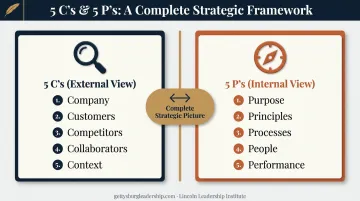
Developed at Harvard Business School, the 5 C's give teams a lens for external situation analysis: Company, Customers, Competitors, Collaborators, and Context (sometimes labeled Climate) (Dolan, Harvard Business School). Each element forces a distinct question:
- Company: What are our actual capabilities, not our assumed ones?
- Customers: What do they need that we're not delivering?
- Competitors: Where are we exposed?
- Collaborators: Who do we depend on to deliver value?
- Context: What's shifting in the wider environment?
Practical exercise: Split the executive team into five sub-groups, one per "C." Give each group 30-40 minutes to build their section using data, not opinion. Reconvene and have each group present findings to the full team before moving to synthesis.
The 5 P's Framework
Where the 5 C's look outward, the 5 P's look inward. The model covers Purpose, Principles, Processes, People, and Performance (Pryor, Anderson, Toombs, and Humphreys, Journal of Management Research):
- Purpose: mission, vision, and goals
- Principles: the values and assumptions driving decisions
- Processes: the systems that turn inputs into outputs
- People: who owns and performs the work
- Performance: the metrics proving it's working
Practical exercise: Have the team score each P from 1-5 based on current organizational strength, then discuss where the gaps are widest. This surfaces internal misalignment before it undermines execution of whatever strategy the retreat produces.
Running the 5 C's and 5 P's back-to-back gives a team a complete picture: what's happening outside the organization and whether the organization is actually built to respond to it.
SWOT and Other Complementary Tools
SWOT remains the most common retreat exercise for good reason: it's fast and familiar. The catch is quality. The U.S. Economic Development Administration stresses that SWOT should be built on relevant data, not impressions (EDA). CIPD goes further, warning that SWOT frequently produces vague conclusions unless every entry is backed by evidence (CIPD).
Don't stack every framework into one retreat. Pick one primary framework based on team maturity, then use SWOT or scenario tools as supporting exercises, not competing centerpieces.
Top Strategic Planning Retreat Exercises for Executive Teams
Once you've chosen a framework, these four exercises carry most retreats from analysis to decision.
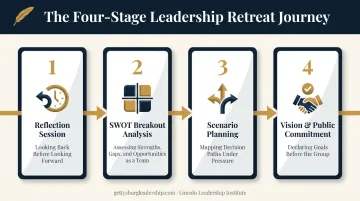
Reflection Session (Looking Back)
Start with a structured look-back at the past year using pre-distributed questions and hard performance data. Ask participants to identify three themes before arriving.
Facilitation tip: Open with wins. Teams that dive straight into misses get defensive fast, and defensiveness kills candor for the rest of the day.
SWOT Breakout Analysis (Assessing the Present)
Divide the executive team into small, cross-functional groups of 4-8 people. Each group works independently first. This is non-negotiable: combining input too early invites groupthink. Compare results across groups afterward to find where perceptions diverge.
Once factors are on the table, prioritize:
- Category A: requires immediate action
- Category B: important, but addressed later
- Category C: monitor only, no action yet
Scenario Planning (Envisioning the Future)
Select three to four future scenarios, plausible enough to stretch thinking but not so extreme they get dismissed. Shell, which pioneered corporate scenario planning, is explicit that scenarios are explorations, not forecasts.
The goal isn't predicting the future correctly. It's building the muscle to make decisive calls under uncertainty.
Score each scenario's risks on likelihood versus impact, a method formalized in project risk management guidance (UK Government Project Delivery Function), to see where your team's attention should actually go.
Vision, Mission, and Prioritization Exercise
Only revisit vision or mission statements if there's strong team consensus that change is needed. Reopening these debates without that consensus is disruptive and rarely resolves cleanly in a single session.
Close with a public commitment exercise, a simple standing or sitting vote on each major decision. It's blunt, but it surfaces quiet dissent before the team leaves the room instead of after.
How to Facilitate a Successful Strategic Planning Retreat
Great exercises fail with weak facilitation. Here's how the timeline should actually work.
Before the Retreat
Send 3-5 targeted reflection questions to participants at least two weeks out. Cold-starting a strategic debate wastes the first two hours of every retreat. Consider a short pre-retreat survey to gauge whether the team currently has enough trust for candid disagreement. Some teams need trust-building work before they can debate strategy honestly.
During the Retreat
Bring in an outside, neutral facilitator. Executive egos are real, and someone without a stake in the outcome is better positioned to keep the room moving and call out when a conversation is circling instead of progressing. Lincoln Leadership Institute pairs teams with facilitators like retired generals and admirals, bringing battlefield-tested authority without internal politics.
Structure the agenda around energy cycles:
- Morning: high-intensity exercises (scenario planning, SWOT breakouts)
- After lunch: reflective, lower-energy work (synthesis, vision discussions)
Executive off-sites can run anywhere from a single day to a full week, but the format matters less than the focus it creates away from daily interruptions (Frisch and Chandler, Harvard Business Review).
After the Retreat
A retreat without a documented execution plan is just an expensive conversation. Before anyone leaves:
- Assign an owner to every priority
- Set a follow-up review cadence (monthly or quarterly)
- Document the plan in writing and distribute it within 48 hours
Choosing the Right Setting: From Boardroom to Immersive Experience
A hotel conference room works. It's also forgettable. Traditional off-sites reduce distraction, but they rarely change how a team thinks about risk, pressure, or consensus.
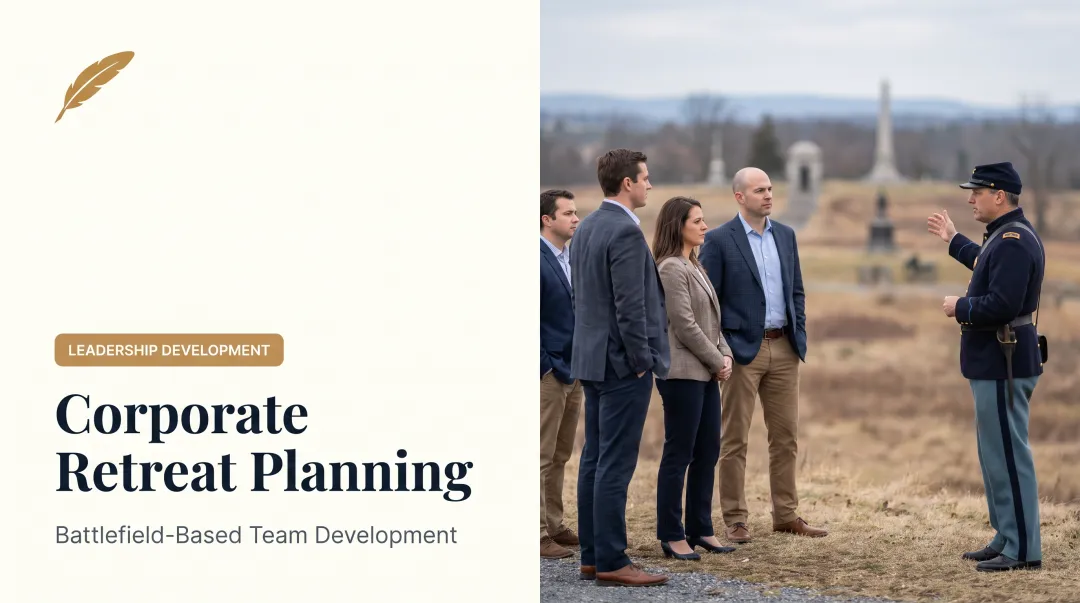
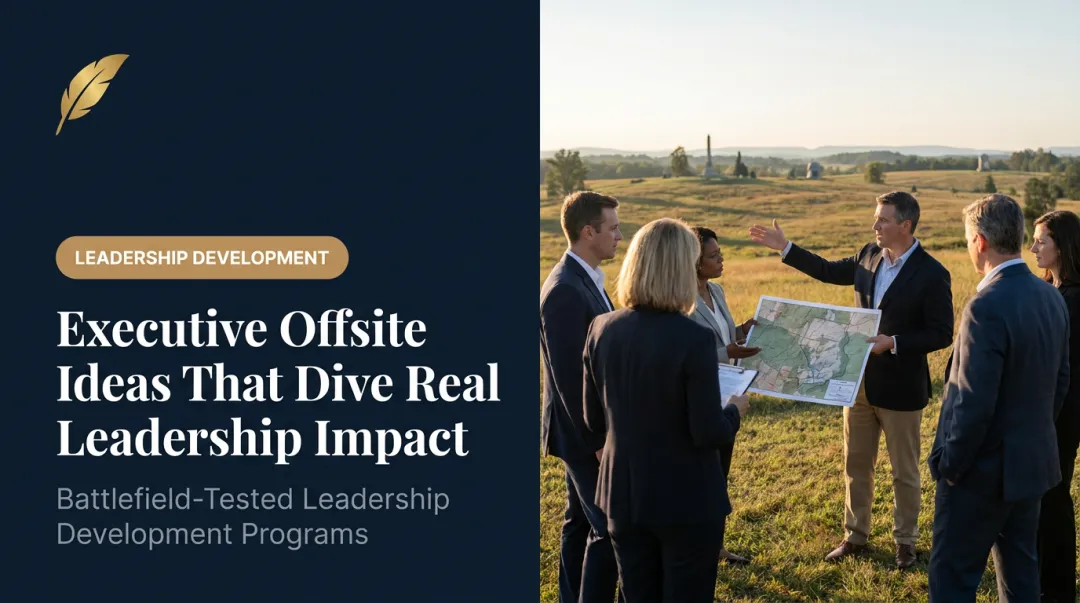
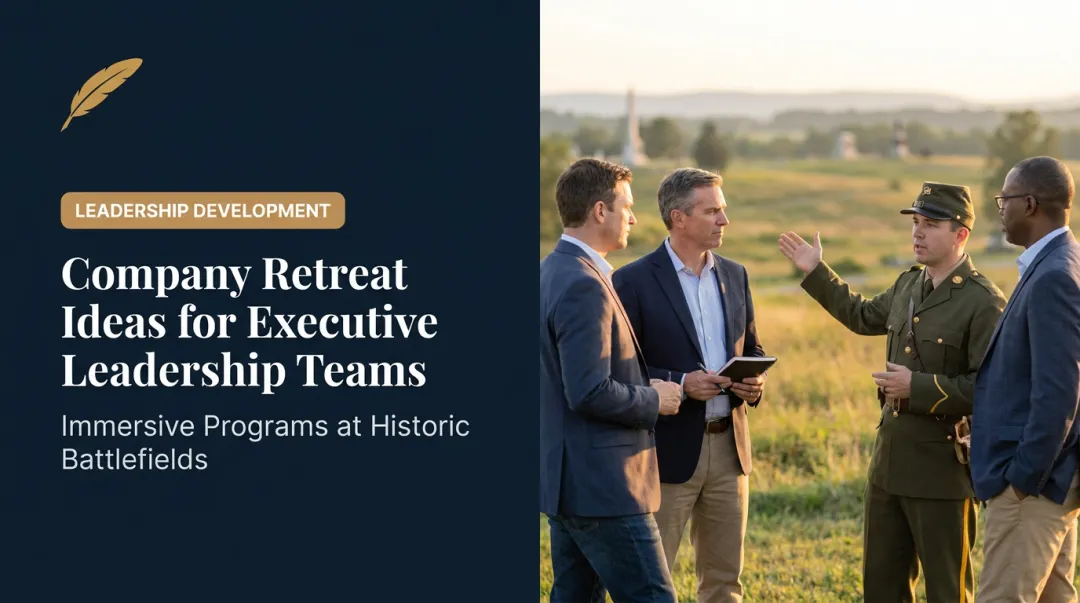
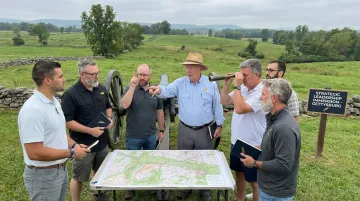
That's where immersive, experiential formats offer something different. Lincoln Leadership Institute's battlefield-based programs place executive teams on the actual Gettysburg terrain where historical leaders faced high-stakes decisions with incomplete information. Those conditions mirror the judgment calls and consensus-building challenges at the center of any strategic planning retreat.
LLI's Private Team Experience model, exclusive to a single organization with 8-20 participants, is built for exactly this kind of work. Past participants report concrete results:
- A GE executive said the program "provided a vehicle to rethink strategic planning and outcomes."
- A government agency participant called the ROI "immeasurable," citing direct applications to their agency's mission.
Pairing a traditional planning agenda with an experiential component isn't just memorable. Psychological safety, the shared belief that a team can speak candidly without punishment, is a documented prerequisite for real strategic debate (Harvard Business School Working Knowledge). Shared adversity, even historical and simulated, builds that trust faster than a conference room ever will.
Frequently Asked Questions
What are common strategic planning frameworks (for example the 5 C's and 5 P's)?
The 5 C's (Company, Customers, Competitors, Collaborators, Context) analyze the external environment. The 5 P's (Purpose, Principles, Processes, People, Performance) focus on internal alignment. SWOT is another widely used complementary tool.
How do you facilitate a strategic planning retreat?
Send reflection questions in advance, bring in an outside facilitator such as Lincoln Leadership Institute, and structure exercises so the day moves from analysis to prioritization to a documented execution plan. Skipping any of these three steps weakens the outcome.
What is a strategic planning exercise?
A strategic planning exercise is a structured, time-boxed activity designed to surface facts, generate strategic options, or force team prioritization, distinct from open discussion, which rarely produces a decision on its own.
How long should a strategic planning retreat be?
Most effective retreats run one to two full days. Complex organizations facing multiple strategic threats sometimes extend to three days to allow for deeper scenario work.
Should executive retreats be held on-site or off-site?
Off-site (or fully immersive) locations reduce everyday distractions and interruptions that pull executives back into operational mode. Physical distance alone won't fix a bad agenda, but it removes a major obstacle to focus.
How often should executive teams hold strategic planning retreats?
An annual full retreat paired with quarterly check-ins works well for most organizations. This mirrors the annual strategy cycle with more frequent reviews recommended by management researchers (Kaplan and Norton, Harvard Business Review).