Introduction
Trust is the load-bearing wall of every high-performing team. Remove it, and everything else—communication, execution, morale—starts to crack.
Most leaders treat trust like weather: something that happens naturally if you wait long enough. It doesn't. In PwC's 2024 survey of U.S. employees, 61% said a perceived lack of trust from leadership directly affects their ability to do their job well.
That gap widens further in remote and hybrid settings, where fewer informal moments exist to build rapport on their own.
Trust isn't a byproduct of shared tenure. It's built or eroded through every decision, every missed deadline, and every hard conversation a leader avoids.
This guide covers the exact steps for building trust on a team, the factors that drive it, the mistakes that quietly destroy it, and how to repair it once it's broken.
Key Takeaways
- Trust grows from consistent say-do alignment, not one-off gestures or offsites
- Four pillars drive team trust: credibility, reliability, connection, and selfless intent
- Broken promises and communication gaps cause most trust failures—not dramatic betrayals
- Rebuilding trust takes longer than building it and requires sustained, visible action
- Shared immersive experiences can compress months of trust-building into days
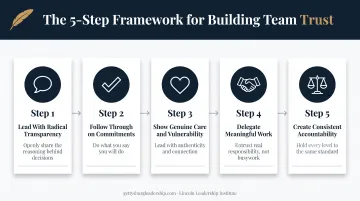
How to Build Trust in a Team: A Step-by-Step Framework
Trust isn't built through a single keynote or team-building day. It's built through five habits, repeated until they become how a leader operates by default.
Step 1: Lead With Radical Transparency
Share the reasoning behind decisions, especially the unpopular ones. Teams don't need to agree with every call, but they do need to understand it.
- Explain the "why," not just the directive itself
- Admit what you don't know instead of bluffing confidence you don't have
- Be candid about real challenges facing the organization, not the polished version
Gallup's research supports this. When employees strongly agreed their leaders communicated clearly, inspired confidence in the future, and supported change well, 95% reported high trust in leadership. Only 21% of the general workforce said the same.
Step 2: Follow Through on Every Commitment
Reliability compounds. Showing up on time for a 1:1 matters more over the long run than any single grand gesture.
- Keep small promises consistently: meeting times, feedback deadlines, follow-up emails
- Flag a commitment you can't meet before anyone notices, not after
- Treat a heads-up on a missed deadline as integrity, not optional courtesy
Step 3: Show Genuine Care and Practice Vulnerability
Invest time understanding your team as people, not just job titles. Ask about their weekend. Notice when something feels off.
Model vulnerability first. When a leader openly admits a mistake, it gives the rest of the team permission to do the same. Without that permission, people stay guarded and problems stay hidden until they're expensive to fix.
Step 4: Delegate Meaningful Work and Decision-Making
Real delegation hands over authority, not just leftover tasks. It signals genuine confidence in someone's judgment.
- Assign ownership of outcomes, not just checklists
- Resist the urge to hover or quietly re-decide after handing something off
- Stay available for support without reclaiming the decision
Micromanaging right after delegating cancels out the trust the delegation was meant to build. It tells the person you didn't mean it.
Step 5: Create Consistent Accountability and Recognition
Apply the same standards to everyone, including yourself. Trust erodes fast the moment a team senses a double standard.
- Have direct, specific conversations about performance gaps, even uncomfortable ones
- Recognize contributions and effort regularly, not only final outcomes
- Hold yourself to the same standards you set for the team
This consistency reinforces psychological safety: people take risks and speak up when they know the rules apply equally to everyone.
Key Factors That Influence Trust in a Team
Trust is built through how a leader shows up across several interacting dimensions. A well-known model for this is the Trust Equation from the 2000 book The Trusted Advisor. It breaks trustworthiness into credibility, reliability, and intimacy, reduced by self-orientation.
Factor 1: Credibility (Competence)
Team members need confidence that a leader has the judgment and expertise they can rely on. When credibility is thin, people second-guess calls—especially in high-stakes moments when the team most needs to move without hesitation.
Factor 2: Reliability (Consistency)
Predictable, dependable behavior lets people plan and act with confidence. Follow through on commitments, meet the standards you set, and keep your word in small things as well as large ones. A gap between what a leader says and what a leader does is one of the fastest ways trust breaks on a team.
Factor 3: Connection (Intimacy and Care)
People need to feel safe admitting mistakes and raising concerns without fear of embarrassment. That safety is what gets bad news to you early. Without it, teams withhold information and sit on problems until they escalate.
Factor 4: Selfless Intent
People trust leaders more when decisions clearly serve the team, not the leader's own advancement. Share credit, explain the "why" behind hard calls, and avoid protecting turf. Even subtle self-interest pushes teams to disengage and look out for themselves instead of collaborating.
Common Mistakes Leaders Make When Building Trust
Most trust failures aren't dramatic betrayals. They're small, repeated missteps that quietly compound.
- Choosing likability over honesty: skipping hard talks on performance or conflict to stay well-liked
- Overpromising under pressure: committing without a realistic plan, then quietly missing the mark
- Playing favorites: applying standards inconsistently—often without realizing it
- Treating trust as an event: running a single offsite or workshop and calling the work done
Each of these is fixable. The harder part is spotting them in your own behavior before the team names them in exit interviews.
How to Rebuild Trust When It's Been Broken
Even strong leaders damage trust sometimes. The right repair depends on the type of violation. Acting early—while the issue is still small—almost always beats waiting until resentment hardens.
Problem: Team Feels Excluded From Key Decisions
Likely cause: Unilateral calls made without input or explanation.
What to do:
- Share the reasoning behind past decisions, not just the outcomes
- Commit to inviting input before future calls that affect the team
Problem: A Broken Promise or Missed Commitment
Likely cause: Overcommitting without checking feasibility, or failing to flag a change in plans in time.
What to do:
- Name the specific broken commitment directly—don’t gloss over it
- Rebuild reliability with a visible pattern of small, kept promises
Problem: Team Has Stopped Speaking Up
Likely cause: Past instances of blame, punishment, or dismissiveness toward feedback.
What to do:
- Actively solicit feedback and respond without defensiveness
- Visibly act on at least one piece of input you receive
Rebuilding trust almost always takes longer than losing it did. Consistent, visible follow-through is the only path that works.
Why Experiential Leadership Development Builds Trust Faster
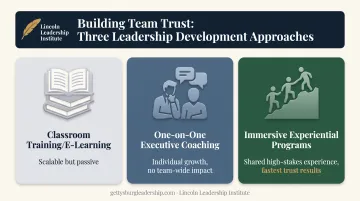
Daily habits build trust over months. Certain development approaches can accelerate that timeline meaningfully, especially when an entire team goes through the experience together rather than one person at a time.
Traditional Classroom Training or E-Learning
Useful for teaching foundational concepts or compliance-related trust topics at scale. The trade-off: passive learning rarely translates into real behavior change or lasting bonds between teammates.
One-on-One Executive Coaching
Effective for a leader working through a specific trust or communication blind spot. The trade-off: it doesn't touch team-level trust, since the rest of the team never enters the process.
Immersive, Experiential Leadership Programs
A program like the Lincoln Leadership Institute's Gettysburg Leadership Journey is built for this. Instead of a conference room, leaders work through decision-making, communication, and vulnerability together on the battlefield where those same pressures once played out with far higher stakes.
The Private Team Experience format is designed for intact groups:
- Brings 8 to 20 people from one organization into the same cohort
- Builds a shared leadership language through case studies tied to that team's real business environment
- Sends the same colleagues who practiced together back to lead together on Monday morning
Faculty include leaders such as retired Navy SEAL Command Master Chief Dave Cooper and Admiral Scott Moore, whose careers were built on leading teams under high-stakes pressure.
The trade-off: this approach requires more time and budget than a single workshop. In return, it produces trust forged through shared experience rather than a slide deck. Organizations like Milwaukee Tool and Pfizer have described that kind of shift as reshaping their culture, not just their calendar.
Conclusion
Building trust on a team comes from the daily compounding of credibility, reliability, connection, and selfless intent. One gesture, one offsite, or one great speech will not get you there. Those behaviors, repeated consistently, are what turn doubt into belief.
Most trust failures are avoidable: a missed commitment left unacknowledged, feedback dismissed once too often, a decision made without explanation. Fix those, and most of the damage never happens in the first place.
Leaders who need to accelerate this work can compress months of trust-building into days through shared, high-stakes experiential learning. Immersive programs that put people through demanding situations together turn a group of individuals into a team that actually trusts each other.
Frequently Asked Questions
What are the key elements of building trust in a team?
Trust rests on four pillars: credibility (competence), reliability (consistency), connection (genuine care), and selfless intent. Strengthening all four matters more than excelling at just one.
How long does it take to build trust in a team?
Consistent trustworthy behavior over weeks to months is typical for organic trust-building. Immersive, shared experiences can accelerate that timeline considerably.
What is the fastest way for a new leader to build trust with a team?
Lead with transparency, listen before directing, and win early credibility through small, kept commitments rather than big promises.
Can trust be rebuilt once it's broken?
Yes, but it requires acknowledging the specific breach directly and demonstrating consistent trustworthy behavior over time, not just a single apology.
How does trust affect team performance?
Teams that score above average on trust are 3.3 times more efficient and 5.1 times more likely to produce results, according to McKinsey's Team Effectiveness Index research.
What role does emotional intelligence play in building trust?
Emotional intelligence helps leaders read team dynamics, respond with empathy, and manage their own reactions under pressure, all of which shape whether a team feels safe with them.