It rarely does. Gallup estimates that replacing a manager costs roughly 200% of that person's annual salary, and in a recent survey of employees who quit voluntarily, 42% said their manager or organization could have prevented it, according to Gallup's research on preventable turnover.
Many organizations pour resources into frontline training while leaving the people who set culture and drive performance, their leaders, to figure it out on their own. That gap shows up in stalled succession plans, rising turnover, and teams that never quite hit their potential.
This guide covers what organizational professional development for leaders actually means, the frameworks that structure it, the program types worth your budget, and how to build a plan your organization will actually use.
Key Takeaways
- Leadership development blends structured frameworks with real-world application, not classroom theory alone
- Investing in leaders directly improves retention, succession readiness, and team performance
- Top programs blend formal training, coaching, and experiential learning under the 70-20-10 model
- Building a plan takes skills-gap analysis, SMART goals, blended activities, and ongoing measurement
- Experiential, historically grounded simulations build judgment that lecture-based training cannot replicate
What Is Organizational Professional Development for Leaders?
Organizational professional development for leaders is company-driven, strategic investment in the people who make decisions, set direction, and shape culture. It targets decision-making, communication, and team leadership capability, not general job skills.
That's the real difference from typical employee upskilling. A certification helps one person do one job better. Leadership development changes how that person influences everyone around them, for better or worse.
Organization-led vs. self-directed development:
- Organization-led programs align to business strategy, succession planning, and identified skill gaps
- Self-directed development follows individual curiosity or career ambition, often without organizational input
- Companies that rely only on the second type end up with leaders who are competent but not aligned
Beyond alignment, leadership carries higher stakes than most training because decisions cascade. A poorly prepared manager doesn't just underperform individually; their choices ripple through every person who reports to them.
The numbers back this up. 94% of employees say they'd stay at a company longer if it invested in their career development, according to LinkedIn's 2018 Workplace Learning Report. For leaders specifically, that investment signals the organization sees them as a long-term asset, not a placeholder waiting for the next reorg.
What Is an Organizational Development Professional?
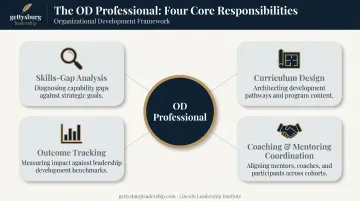
An organizational development professional, often titled an OD specialist or L&D business partner, is the person responsible for closing leadership and culture gaps before they cost the business.
Core responsibilities typically include:
- Running skills-gap analyses against business strategy and succession plans
- Designing leadership curricula, from new-manager onboarding to executive coaching tracks
- Coordinating coaching and mentoring relationships across the organization
- Tracking outcomes, tying program participation to retention, promotion readiness, and performance data
At Lincoln Leadership Institute, we work directly with these professionals. They're usually the ones scoping a Private Team Experience or managing a multi-year Enterprise Partnership on behalf of their organization.
Why Leadership Development Matters for Organizations
Retention and Succession Planning
Succession planning is where good intentions meet reality. Deloitte research reveals a stark gap between priority and execution:
- 86% of leaders call succession planning an urgent priority
- Only 14% believe their organization handles it well
- At least 30% of externally hired executives fail within 18 months, largely due to poor cultural fit
Structured leadership development closes that gap by building a bench of internal candidates who already understand the business, the culture, and each other.
Performance and Bottom-Line Impact
Leadership development moves performance numbers, not just retention rates. Gallup research on coaching-focused manager development found:
- Managers who received coaching improved their own engagement by up to 22%
- Their teams saw engagement gains of up to 18%
- Those same teams experienced 21-28% lower turnover
The catch: training only works if leaders can apply it. Harvard Business Review has noted that leadership training often fails when employees return to systems and cultures that don't support the new behavior. Development has to be reinforced on the job, not just delivered in a classroom.
Culture and Trust
Leaders who've been developed deliberately, not accidentally, model something specific: resilience under pressure, values-based decisions, and communication that builds trust instead of eroding it. Teams take their cues from how a leader handles a bad quarter or a hard conversation, and that behavior spreads.
Core Frameworks Every Leader Development Program Should Know
The 5 Stages of Professional Development
Skill development follows a predictable arc. The most well-documented version comes from Stuart Dreyfus's model of skill acquisition: Novice, Advanced Beginner, Competence, Proficiency, and Expertise.
- Novices follow rules without context and need explicit instructions
- Advanced beginners start recognizing patterns beyond the rulebook
- Competent performers can plan, prioritize, and own the outcome of their decisions
- Proficient performers read situations intuitively but still deliberate over their response
- Experts act on instinct, drawing on pattern recognition built from repeated experience
Mapping leaders to a stage, rather than assuming everyone needs the same workshop, lets organizations personalize development. A newly promoted manager needs different support than a director five years into the role.
The 5 P's of Professional Development
Terminology varies by source, but one commonly referenced version breaks development into five parts: Purpose, Plan, Practice, Product, and Performance.
- Purpose: why this development matters to the leader and the business
- Plan: specific goals and a timeline
- Practice: repeated application, not a single session
- Product: a tangible outcome, a project led, a decision made under pressure
- Performance: reflection and review against the original goals
Leaders should run this loop every quarter, not treat it as a one-time exercise.
The 70-20-10 Rule for Leaders
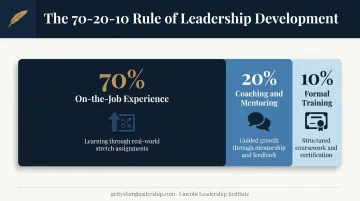
The 70-20-10 rule, developed by the Center for Creative Leadership from decades of research into how executives actually learn, breaks leadership growth into three sources. 70% comes from on-the-job experience and stretch assignments, 20% from coaching and mentoring relationships, and 10% from formal training.
CCL is clear this is a guideline, not a rigid formula. Formal training amplifies what someone learns from experience and relationships. It doesn't compete with it.
The 70% matters most for leaders specifically. Reading about a hard decision isn't the same as making one with incomplete information and real consequences. That's the gap classroom training can't close on its own, and it's exactly what sets up the program types below.
Types of Leadership Development Programs and Activities
Most leadership growth follows the 70-20-10 model: 70% experiential learning, 20% coaching, and 10% formal training. Each category below maps to one piece of that framework.
Formal Training and Certificate Programs
Structured courses, workshops, and certificate programs build the foundational 10%, the knowledge leaders need before they can apply it.
Lincoln Leadership Institute's Leadership Excellence Certificate Program, developed with Purdue University Global, is one example. It combines LLI's experiential battlefield methodology with Purdue's academic framework, and graduates earn a Certificate of Leadership they can display on LinkedIn or a resume.
Coaching and Mentoring
This is the 20%, developmental relationships that help leaders process real decisions in real time. A recent survey by ATD (the Association for Talent Development) found:
- 29% of organizations run formal mentoring programs
- 37% rely on informal mentoring instead
- 57% rate their formal programs highly effective for meeting learning goals
Tools like emotional intelligence assessments, such as EQ-i 2.0 and EQ360, add structure to coaching by giving leaders concrete feedback on how they come across, not just what they intend.
Experiential and Immersive Learning
The 70% experiential component is hardest to manufacture in a normal office, which is why some organizations look outside the building entirely.
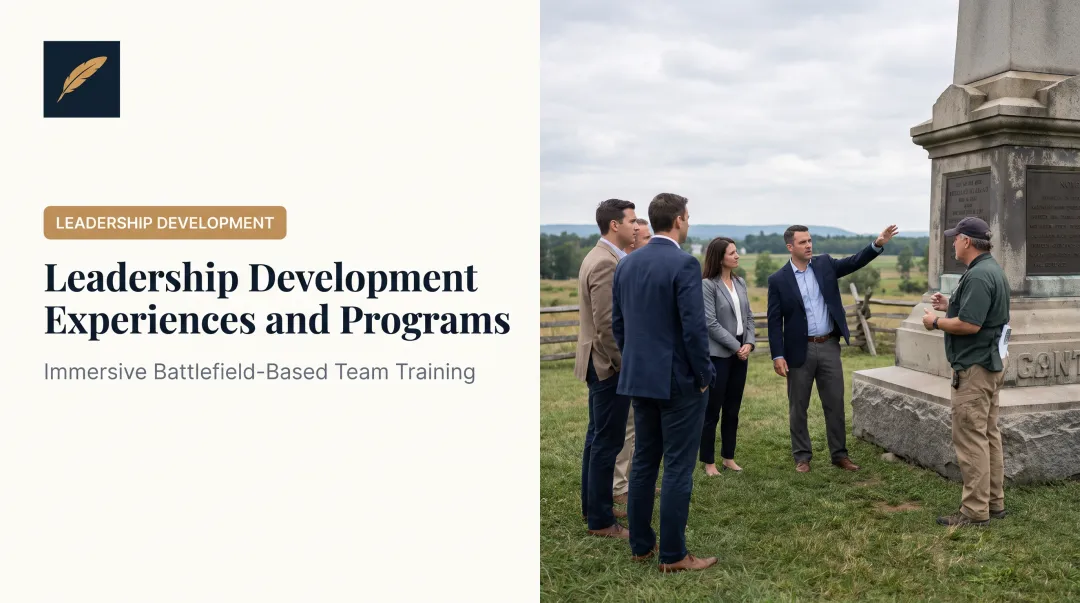
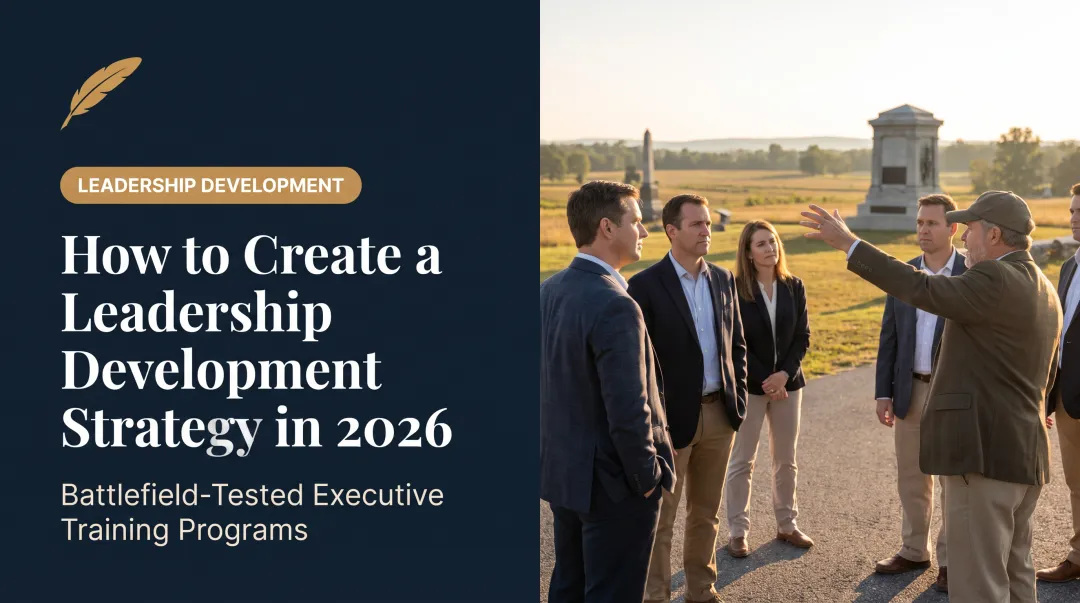
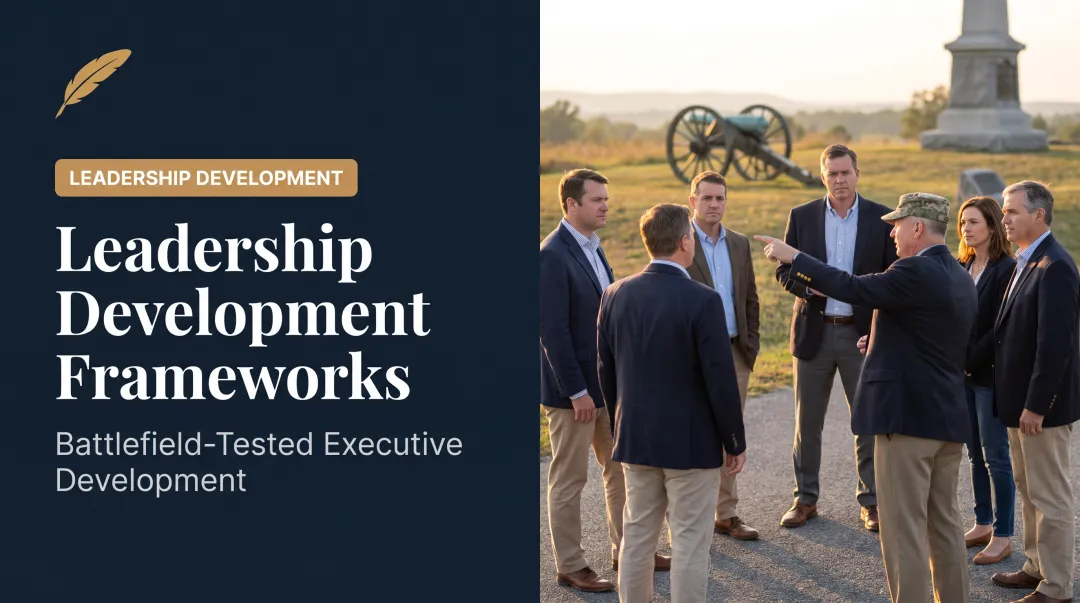
Lincoln Leadership Institute's programs place leaders on the actual ground where historic decisions were made — Gettysburg, Normandy, Pearl Harbor, the Alamo. There, they walk through the same pressure and consequences military and civilian leaders once faced. Faculty include retired generals, a 35-year Navy SEAL veteran, licensed battlefield guides, and Ph.D. historians.
Formats range from a one-day Leadership Summit to a 2.5-day Gettysburg Leadership Journey or a fully customized multi-day Private Team Experience. Each is built around the same idea: standing where a decision actually happened teaches judgment in a way a slide deck can't.
How to Build an Organizational Leadership Development Plan
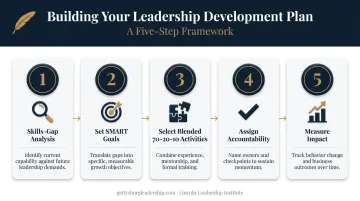
Frameworks only matter once you turn them into a plan. Here's the process HR and OD teams typically follow.
Conduct a skills-gap analysis. Map current leadership capability against business strategy and succession needs. Where's the gap between who you have and who you'll need in three years?
Set SMART goals for individuals and cohorts. Specific, measurable, achievable, relevant, time-bound targets, both for individual leaders and for cohorts moving through a program together.
Select a blended mix of activities using 70-20-10. Pair stretch assignments with coaching relationships and formal training, in that order of priority.
Assign accountability. HR and OD professionals design the program, but direct managers own day-to-day reinforcement. Without a manager checking in, even good training fades within weeks.
Measure impact and choose the right delivery model. Track retention, engagement scores, and performance metrics tied to participation.
| Model | Best For | Group Size | Customization |
|---|---|---|---|
| Open Enrollment | Small cohorts, cross-industry exposure | 3-5 leaders | Standard curriculum |
| Private Team Experience | Single-organization focus | 8-20 participants | Fully customized |
| Enterprise Partnership | Organization-wide transformation | 20+, multi-cohort | Fully customized, executive coaching included |
Organizations earlier in their leadership pipeline often start with Open Enrollment to test the approach, then move to a Private Team Experience or Enterprise Partnership as they scale.
LLI has supported this progression with Fortune 1000 clients including Pfizer, FedEx, and GE. These organizations needed leadership development woven into daily operations, delivered continuously rather than as an annual event.
Frequently Asked Questions
What is an organizational development professional?
An organizational development professional is the HR or L&D specialist who diagnoses leadership and culture gaps, then designs and measures the development programs built to close them.
What are the 5 stages of professional development?
The most established model, from Stuart Dreyfus's skill-acquisition research, moves from Novice to Advanced Beginner, Competence, Proficiency, and finally Expertise as judgment develops.
What are the 5 P's of professional development?
Terminology varies by source, but one common version covers Purpose, Plan, Practice, Product, and Performance, a repeatable framework for setting and reviewing development goals.
What is the 70-20-10 rule for leaders?
It breaks leadership growth into 70% on-the-job experience, 20% coaching and mentoring, and 10% formal training. The Center for Creative Leadership developed the model as a guideline, not a strict formula.
How much should organizations invest in leadership development?
Investment varies by organization size and program scope. Rather than fixating on a per-leader number, prioritize experiential and coaching-based methods over one-time training events.
What makes leadership development programs effective long-term?
Effective programs reinforce learning through real-world application and ongoing measurement, not a single session. Manager accountability and follow-up coaching are what make new behaviors stick.