Introduction
Picture this: your leadership team just left a two-hour strategy meeting. Everyone nodded along, shook hands, and agreed on the plan. Three weeks later, you discover three different departments are executing three different versions of that "agreed-upon" plan.
Leadership misalignment runs deeper than a communication glitch, and it's more common than most executives admit.
Misalignment slows decisions, fractures culture, and erodes employee trust long before anyone calls it a crisis.
This guide breaks down what a leadership team alignment workshop actually is, when your organization needs one, how to structure it step by step, and why some formats produce lasting change while others fade within a month.
Key Takeaways
- A leadership alignment workshop unifies your team around vision, strategy, and decision rights.
- Misalignment shows up early: inconsistent decisions, siloed communication, and slower execution.
- Effective workshops produce named owners and follow-up plans, not just good conversation.
- Immersive, experiential formats build trust faster than another conference-room session.
What Is a Leadership Team Alignment Workshop?
A leadership team alignment workshop is a facilitated session where a leadership team clarifies shared vision, strategic priorities, and how they'll operate together moving forward. Treat it as a deliberate intervention rather than a casual offsite chat.
This is different from generic team building. A trust fall or a group dinner might improve relationships, but it doesn't address who owns which decisions or whether leaders interpret company direction the same way. Alignment work focuses squarely on:
- Decision-making authority across the leadership group
- Strategic clarity on what the organization is actually trying to achieve
- Consistency of practice among the people whose behavior sets the tone for everyone else
Harvard Business Review frames strategic alignment as the careful arrangement of a company's core value drivers, including market strategy, people, culture, and processes. When those drivers point in different directions at the leadership level, the effects cascade downward fast.
Core Components of an Effective Workshop
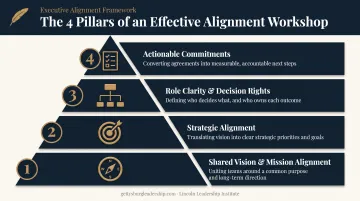
Not every session labeled "alignment workshop" delivers results. The ones that work include four specific components:
- Shared vision and mission alignment. Every leader needs to interpret organizational direction the same way. If your CFO and your VP of Operations describe the company's top priority differently, that gap will show up in every budget decision they make.
- Strategic alignment. Vision only matters once it's translated into measurable objectives, with each leader's specific contribution spelled out.
- Role clarity and decision rights. Who owns which call? Overlapping authority creates confusion; undefined authority creates paralysis. Both need to be named explicitly.
- Actionable commitments. Vague intentions like "we'll communicate better" don't survive contact with a busy quarter. Effective workshops end with concrete next steps, named owners, and real timelines.
Warning Signs Your Leadership Team Needs an Alignment Workshop
Misalignment rarely announces itself. It shows up as friction long before it becomes a headline problem.
The decision-making data backs this up. In McKinsey's decision-making research, 61% of respondents said at least half the time spent making decisions was ineffective. That inefficiency compounds when the people making decisions aren't operating from the same playbook.
These signs usually show up first:
- Inconsistent standards. One department head runs tight performance reviews while another lets things slide. Employees notice, and they resent it.
- Decisions that keep getting revisited. Leaders leave a meeting believing they agreed, only to discover weeks later they interpreted the outcome completely differently.
- A recent trigger event. Rapid growth, a merger, a new hybrid work structure, or a leadership transition can outpace informal alignment almost overnight.
The Ripple Effect on Culture and Retention
Misaligned leadership doesn't stay contained at the top. Employees take behavioral cues directly from how leaders operate day to day.
Gallup found that management accounts for 70% of the variance in a team's engagement. When leaders send mixed signals about priorities and standards, that variance shows up as disengagement, inconsistent culture, and eventually, turnover. Alignment at the top is the foundation everything else stands on.
How to Structure a Leadership Alignment Workshop: A Step-by-Step Framework
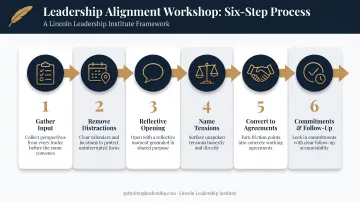
A productive alignment workshop follows a deliberate sequence. Skipping steps, especially the diagnostic and follow-up ones, is why so many sessions produce great conversation and zero lasting change.
- Clarify objectives and gather real input first. Use a short survey, informal interviews, or a lightweight SWOT exercise before the session. Start with actual data, not assumptions about what's wrong.
- Remove the team from everyday distractions. Block off at least half a day, and choose a setting that signals this conversation matters. A conference room between two other meetings sends the wrong message.
- Open with a reflective prompt. Something like "Describe a leadership moment that shaped how you lead" surfaces honest perspective before anyone jumps to solutions.
- Name the tensions explicitly. Speed versus quality. Local ownership versus shared standards. Pretending these tradeoffs don't exist just pushes the conflict underground.
- Convert insight into specific agreements. Every agreement needs a named owner and clear decision rights attached. "We'll communicate better" doesn't count.
- Close with individual commitments and a follow-up date. Schedule a check-in two to six weeks out to see whether the agreements actually hold up against real work.
McKinsey research on team decision-making backs the same close. End by recording the decision, next actions, owners, deadlines, and who will communicate the outcome to the wider organization.
Why Experiential, Battlefield-Based Alignment Workshops Drive Deeper Results
Most leadership teams have sat through conference-room strategy sessions before. Many can recite the exercise: whiteboard the vision, debate priorities, agree to disagree less, go back to work. The trouble is that hypothetical scenarios rarely surface real tension.
Experiential learning works differently because it puts leaders inside a genuine high-stakes decision, even if that decision happened over 150 years ago. The Center for Creative Leadership's 70-20-10 framework estimates that roughly 70% of a leader's development comes from challenging experiences, not classroom instruction.
Shared, immersive experiences build candor faster than another slide deck. Leaders process something real together—not a case study on paper.
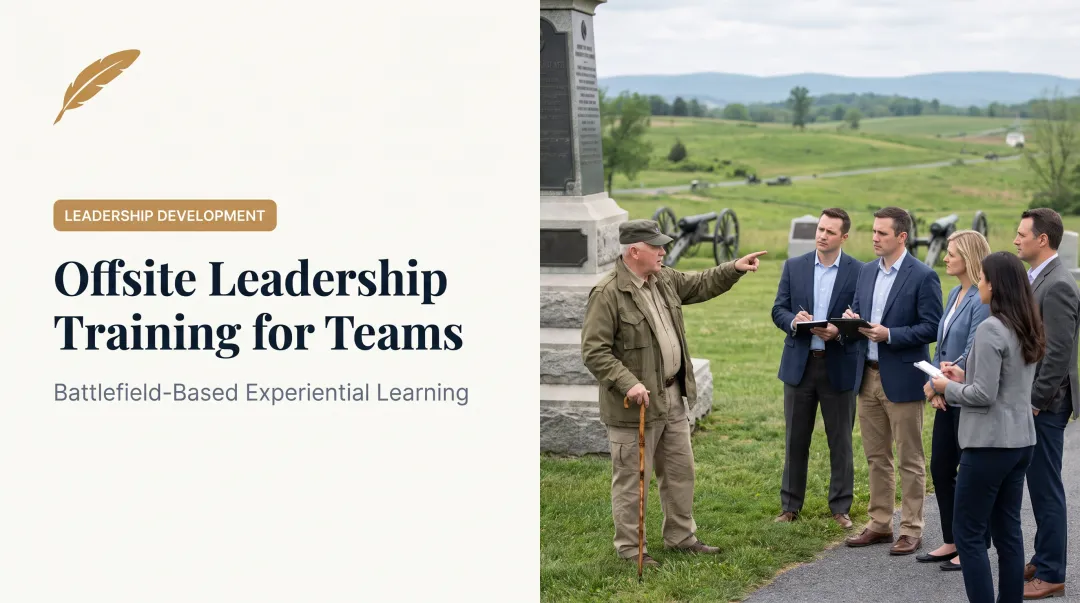
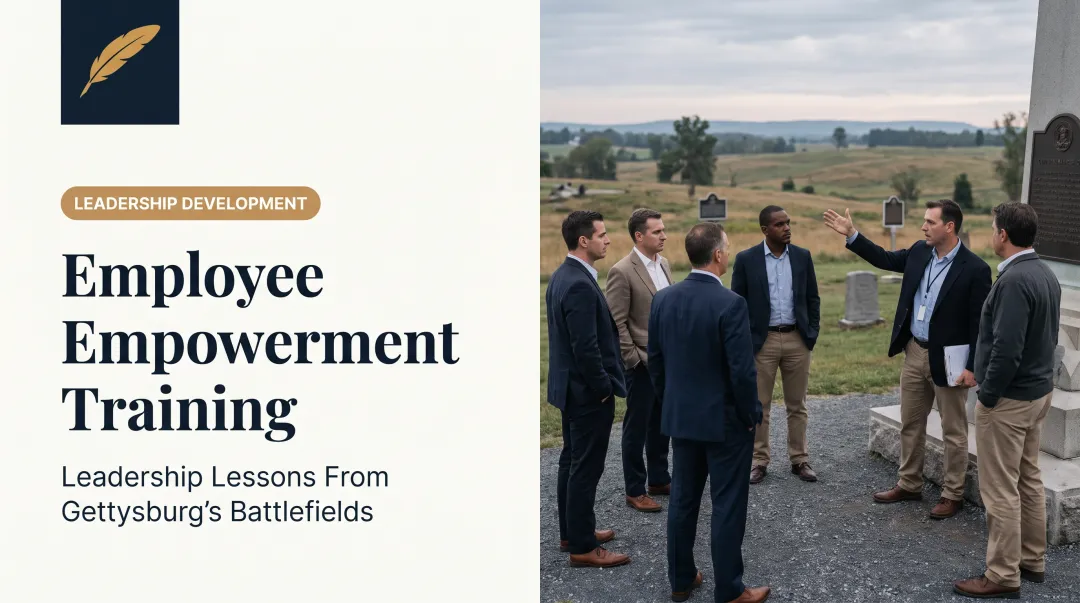
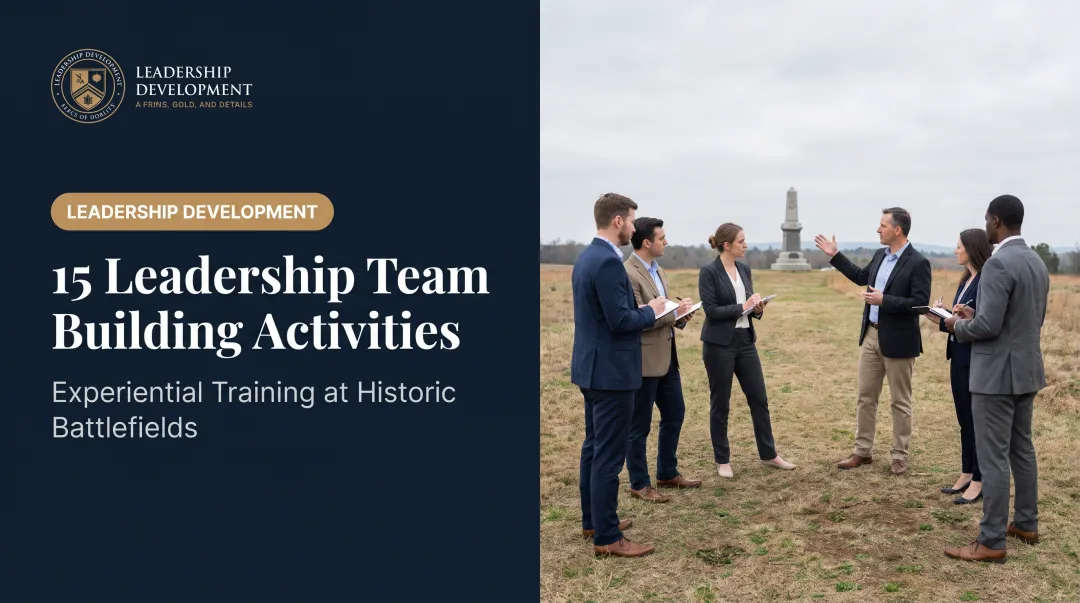
That is how Gettysburg Leadership runs alignment work. Instead of another hotel ballroom, teams walk the ground where high-stakes decisions were actually made:
- Gettysburg — Buford's positioning and Chamberlain's handling of the 20th Maine mutineers teach vision-setting and role clarity under pressure.
- Normandy — D-Day's coordination challenges mirror what large organizations face when strategy has to survive contact with execution.
- Pearl Harbor — Crisis leadership when there's no time for a second meeting.
- The Alamo — Risk assessment when the stakes are irreversible.
Faculty guiding these discussions aren't hypothetical experts. The teaching team includes retired generals and admirals, a career Navy SEAL, Emmy-winning journalist Dennis Owens, and Ph.D. historians like Dr. Jared Peatman, who has spent years studying leadership at Gettysburg specifically.
Teams that want a lasting credential can pursue the Leadership Excellence Certificate, offered in partnership with Purdue University Global—a verifiable line on a résumé that documents the alignment work.
Best Practices to Sustain Alignment After the Workshop
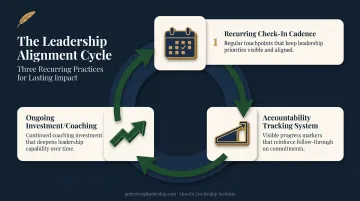
A single great session doesn't fix misalignment permanently. Organizations change, and agreements need to keep pace.
- Set a recurring check-in cadence. Monthly or quarterly reviews keep agreements alive as priorities shift, rather than letting them quietly expire.
- Track commitments with a simple accountability system. Named owners, visible progress, and honest reporting when something isn't working beat a polished action plan that nobody revisits.
- Invest in alignment on an ongoing basis. Coaching, refresher sessions, or a structured certificate program reinforce habits long after the initial workshop ends.
Lincoln Leadership Institute's Enterprise Partnership model builds this sustained approach directly into the engagement, combining executive coaching with a multi-year cohort progression instead of a single event. For smaller teams, even a scheduled 90-day follow-up conversation can prevent hard-won agreements from slipping away.
Frequently Asked Questions
What is an alignment workshop?
An alignment workshop is a structured, facilitated session where a group clarifies shared goals, working agreements, and commitments needed to move forward together. It produces specific outputs, not just discussion.
What is the purpose of a leadership workshop?
The purpose is to build shared vision, sharpen decision-making, and strengthen leadership skills participants can apply immediately back at work. It should leave leaders more capable, not just more informed.
What are some good ideas for a leadership workshop?
Strong formats include facilitated strategy sessions, scenario-based or experiential learning, communication and emotional intelligence exercises, and immersive off-site experiences like battlefield-based programs. Strong formats include facilitated strategy sessions, scenario-based learning, communication and emotional intelligence exercises, and immersive off-site experiences such as battlefield-based programs at historic sites.
How long should a leadership alignment workshop be?
Sessions typically run from a half-day to multi-day immersive formats, depending on team size and how complex the underlying issues are. Lincoln Leadership Institute's flagship Gettysburg program, for example, runs 2.5 days.
How often should a leadership team revisit alignment?
Quarterly check-ins are common, plus a full workshop after any major organizational change, such as a merger, restructuring, or leadership transition.
What's the difference between a leadership alignment workshop and general team building?
Alignment workshops target strategic clarity, decision rights, and roles among leaders. Team building focuses more broadly on relationships and morale, without necessarily addressing who owns what.