Introduction
Command-and-control management is losing ground fast. Organizations facing constant disruption can't afford managers who claim to have all the answers, and employees increasingly expect their leaders to develop them, not just direct them.
Here's the catch: most managers were promoted because they were great at their old job, not because anyone taught them how to coach. Technical skill got them the title. Nobody handed them a playbook for developing people.
This guide breaks down what coaching leadership is and the frameworks that make it repeatable. You'll get the real benefits and trade-offs, how it stacks up against other management styles, and how to build the skill instead of just reading about it.
Key Takeaways
- Coaching leadership grows people through feedback and self-awareness, not top-down directives
- Frameworks like GROW and Assessment-Challenge-Support give leaders a repeatable structure for coaching conversations
- Trust and engagement rise under coaching leaders, but the approach demands real time investment
- Overlaps with servant leadership, yet differs sharply from autocratic and transactional styles
- Build real coaching skill by practicing decisions under pressure, not from theory alone
What Is the Coaching Leadership Style?
The International Coaching Federation defines coaching as "partnering with clients in a thought-provoking and creative process that inspires them to maximize their personal and professional potential." Applied to leadership, that means a manager who facilitates growth rather than issuing orders.
Compare that to directive, command-and-control leadership, where the leader sets the goal, defines the steps, and expects execution. Coaching leadership flips the dynamic: the employee owns the problem, and the leader helps them think it through.
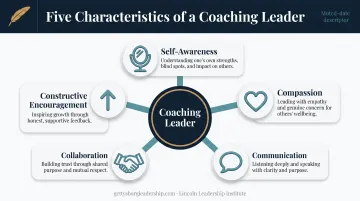
Core characteristics of coaching leaders:
- Self-awareness: understand their own triggers and blind spots before addressing anyone else's
- Compassion: treat mistakes as learning opportunities rather than failures to punish
- Communication: ask more than they tell
- Collaboration: make decisions with the employee, not for them
- Constructive encouragement: feedback that pushes people forward instead of only pointing out what went wrong
Coaching leaders also build a mentor-mentee dynamic. That starts with assessing each person's strengths and gaps, then mapping a growth path tailored to them rather than a one-size-fits-all development plan.
This is a slower game by design. Coaching leadership favors long-term confidence-building over quick fixes. A coaching leader might spend twenty minutes helping someone work through a decision they could have answered in thirty seconds.
That patience requires emotional intelligence. A leader who can't manage their own frustration will default to directing instead of coaching, especially under deadline pressure.
Adoption is already widespread. A 2019 survey by the International Coaching Federation and Human Capital Institute found that 82% of organizations already used managers or leaders with coaching skills, and 83% planned to expand that approach within five years.
Principles, Models, and Frameworks for Effective Coaching Leadership
Coaching leadership isn't just a mindset. It runs on structured, repeatable frameworks that keep conversations productive instead of aimless.
Six Foundational Coaching Principles
The Center for Creative Leadership identifies six principles that guide effective coaching:
- Create a safe yet challenging environment
- Work within the coachee's own agenda, not the leader's
- Facilitate rather than direct
- Promote self-awareness
- Encourage learning from direct experience
- Model the behavior being coached
The ACS and GROW Models
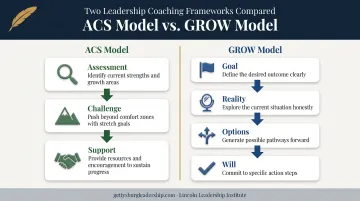
The Assessment-Challenge-Support (ACS) model structures a coaching conversation into three phases:
- Assessment — Understand the coachee's current reality without jumping to solutions
- Challenge — Safely stretch their thinking and question assumptions
- Support — Help them convert insight into action while keeping ownership in their hands
For one-on-ones, the GROW model offers a simple sequence:
- Goal — What outcome are we working toward?
- Reality — Where do things actually stand right now?
- Options — What choices exist?
- Will — What will you commit to doing?
Powerful Questioning and Emotional Intelligence
Both frameworks depend on one core skill: asking better questions instead of handing out answers. Active listening (catching what's said and unsaid) plus powerful questioning builds a coachee's problem-solving muscle faster than advice alone.
Emotional intelligence assessments help leaders spot coaching blind spots before those gaps show up in conversation. At Lincoln Leadership Institute, Dr. Jared Peatman, Director of Curriculum, is certified to deliver the EQ-i2.0 and EQ360 assessments, tools that surface the self-awareness gaps that undermine coaching effectiveness.
Structured coaching also shows up in the data. A 2023 meta-analysis of 20 executive coaching studies covering 2,240 participants found a leadership-outcome effect of g=0.44, a moderate improvement tied to structured coaching engagement.
Benefits and Challenges of Coaching Leadership
Benefits of Coaching Leadership
Coaching leadership builds trust in a way directive management rarely does. When a leader consistently invests in someone's growth instead of just their output, that relationship deepens, and team cohesion follows.
It also builds confidence. Team members coached through stretch assignments, rather than told exactly how to complete them, become more willing to take on unfamiliar challenges later without hand-holding.
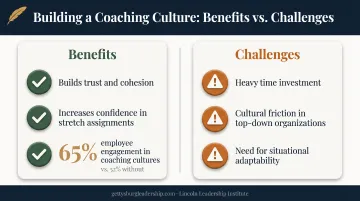
The engagement numbers support this. A 2014 ICF/HCI study of 545 respondents found that 65% of employees in strong coaching cultures rated themselves highly engaged, compared to just 52% in organizations without one.
Challenges of Coaching Leadership
Coaching leadership isn't free. It costs time, and time is the resource most managers already lack.
- Time investment: Every person needs individualized attention, which doesn't scale the way a group memo does
- Cultural friction: Coaching leadership can clash with organizations still built on top-down decision-making, where employees expect to be told what to do
- Situational adaptability: A coaching approach that works for a seasoned employee can fall flat with someone who genuinely needs direct instruction, not open-ended questions
That third point matters more than it sounds. Real coaching adapts to the person in front of you; a single script for everyone is still one-size-fits-all management.
Coaching Leadership vs. Other Leadership and Management Styles
Coaching leadership doesn't exist in isolation. Understanding how it differs from other approaches makes it easier to know when to use it.
| Style | Decision-Making | Primary Focus | Key Difference from Coaching |
|---|---|---|---|
| Coaching | Shared, with employee ownership | Individual growth and self-discovery | Uses questions and reflection to build long-term capability |
| Autocratic/Directive | Leader-controlled | Task completion and structure | Leader sets goals and sequences work directly; little room for employee input |
| Servant | Follower-centered | Service and well-being | Shares coaching's growth focus, but the goal is follower welfare, not a specific development conversation |
| Transactional | Leader-defined exchange | Performance through reward/correction | Compliance-based; rewards and consequences replace employee-led reflection |
Coaching vs. autocratic leadership: Autocratic leaders set the destination and the route. Coaching leaders help employees find their own route, even if it takes longer.
Coaching vs. servant leadership: Both put individual growth first. Servant leadership treats that growth as an act of service to the follower; coaching treats it as a structured development process, often using tools like GROW.
Coaching vs. transactional leadership: Transactional leadership runs on contingent rewards and corrective action. Coaching runs on questions and reflection—one manages behavior, the other builds capability.
How to Develop a Coaching Leadership Style in Your Organization
Reading about coaching leadership won't make anyone good at it. This is a practiced skill, closer to learning an instrument than memorizing a textbook.
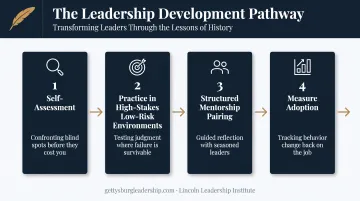
Start with self-assessment. Tools like 360-degree feedback or EQ assessments (such as EQ-i2.0 and EQ360) show leaders exactly where their coaching instincts are strong and where they default to directing instead.
Practice in high-stakes, low-risk environments. Reading a case study about a tough call is nothing like making one. Lincoln Leadership Institute's immersive programs put leaders on the ground at Gettysburg and Normandy. Participants work through historical decisions under pressure, incomplete information, and competing priorities, then debrief immediately on what they'd do differently.
Pair new coaching leaders with structured mentorship. Cohort-based accountability keeps the skill from fading after a single workshop. LLI's Enterprise Partnerships build this in directly, combining multi-year cohort progression with embedded executive coaching rather than a one-off seminar.
Measure adoption, don't assume it. Follow-up assessments and team engagement surveys reveal whether coaching behaviors actually stuck. Formal credentialing, such as the Leadership Excellence Certificate Program through LLI's Purdue University partnership, gives development a recognized, trackable structure.
The organizations that get this right treat coaching leadership as an ongoing practice, not a training event with an end date.
Frequently Asked Questions
Why is leadership important as a coach?
Leadership gives a coach the credibility and trust needed to guide someone's growth. Without it, coaching feedback carries less weight and people are less likely to act on it.
What are the five C's of leadership?
While there's no single official standard, leadership development commonly points to Character, Competence, Communication, Commitment, and Courage. Each one supports a different part of a leader's ability to earn trust and drive results.
What is the 70/30 rule in coaching?
It's an informal guideline suggesting a coach should spend roughly 70% of a conversation listening and asking questions, and only 30% talking or directing. The exact ratio matters less than the principle: questions before answers.
What's the difference between a leadership coach and a manager?
A manager focuses on tasks, deadlines, and day-to-day direction. A coach focuses on long-term growth, helping someone build self-awareness and problem-solving skills they'll use well beyond the current project.
Does coaching leadership work in every organization?
It works best with organizational buy-in and struggles in rigid, top-down cultures unless leaders adapt their approach. A single coaching manager surrounded by directive peers will hit friction fast.
How long does it take to develop a coaching leadership style?
Months to years, not a weekend workshop. Consistent practice, feedback, and real-world application build the skill gradually, the same way any complex interpersonal ability develops.