That shift creates a real problem. Most managers were promoted because they hit their numbers or mastered a technical skill, not because anyone taught them how to run a coaching conversation. The result: one-on-ones that turn into status updates, reviews that feel like lectures, and advice-giving dressed up as development.
This guide breaks down the coaching skills that actually move the needle — active listening, powerful questioning, trust-building, and the GROW model — along with practical ways to use them daily. We'll draw on what Lincoln Leadership Institute has learned developing leaders for more than 25 years through high-stakes, experiential training, because coaching skills stick best when practiced under real pressure, not just read about.
Key Takeaways
- Coaching unlocks potential through powerful questions, not answers, setting it apart from managing or mentoring
- Four capabilities anchor nearly every coaching model: listening, questioning, trust, and accountability
- The GROW framework (Goal, Reality, Options, Will) gives any coaching conversation a repeatable structure
- Skills sharpen fastest through practice under pressure, which is why experiential training outpaces theory alone
What Are Coaching Skills, and Why Do They Matter for Leaders and Managers?
Coaching skills are the abilities a leader uses to help someone find their own solution, rather than simply telling them what to do. Instead of directing action, a coaching-minded leader asks the question that helps an employee see the path themselves, building capability that outlasts any single decision.
That distinction matters more than it sounds. According to Gallup's manager-development research, managers who build stronger coaching habits see measurable gains compared to peers without coaching training:
- Manager engagement improves by up to 22%
- Team engagement rises by up to 18%
- Turnover drops 21% to 28%
- Performance-improvement likelihood grows 20% to 28%
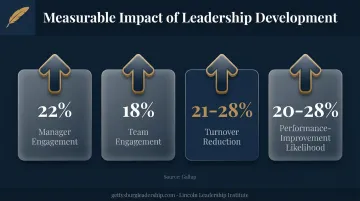
These figures compare similar managers rather than promise universal results. Still, the pattern holds: coaching capability correlates with retention and performance gains few other manager habits can match.
Coaching vs. Managing vs. Mentoring: Knowing the Difference
Leaders often use these three words interchangeably. They shouldn't.
| Approach | Focus | Time Horizon | Style |
|---|---|---|---|
| Managing | Day-to-day deliverables, deadlines, execution | Short-term | Directive, task-focused |
| Coaching | Skill-building through guided reflection and practice | Immediate to mid-term | Non-directive, question-led |
| Mentoring | Career trajectory, modeling leadership behavior | Long-term relationship | Advisory, experience-sharing |
A manager tells a struggling rep exactly which script to follow on the next call. A coach asks what the rep noticed didn't land, and what they'd try differently. A mentor might spend eighteen months helping that same rep think through whether sales leadership is even the right path. All three roles matter, but only one of them is coaching.
The Essential Coaching Skills Every Leader and Manager Must Master
Search "coaching skills" and you'll find lists of four, five, seven, even twelve. ICF names eight core competencies. CIPD narrows it to four: questioning, listening, clarifying, and reframing. The exact count matters less than the overlap. Nearly every credible model centers on the same handful of capabilities.
Listening and Powerful Questioning
Most managers think they're listening when they're actually just waiting to respond. The Co-Active Training Institute's three-levels framework offers a useful check:
- Level 1 (Internal): Your attention sits on your own reactions and judgments, not theirs
- Level 2 (Focused): You're tuned into their words, tone, and meaning
- Level 3 (Global): You're picking up the room's energy, body language, and what's unsaid
Coaching happens at levels two and three. Getting there requires questions that provoke insight instead of supplying it:
- "What outcome do you actually want here?"
- "What have you already tried?"
- "What else could you do that you haven't considered?"
- "What would success look like six months from now?"
None of these questions hand over an answer. That's the point.
Trust, Psychological Safety, and Emotional Intelligence
Coaching fails without psychological safety. Google's multi-year Project Aristotle study analyzed 180 internal teams and found psychological safety — the shared belief that it's safe to take interpersonal risks — mattered more than skill, experience, or resources combined. If an employee doesn't trust you enough to admit they're stuck, no question you ask will get an honest answer.
Emotional intelligence is what makes that trust possible: the capacity to regulate your own reactions while reading someone else's. This is where formal assessment tools earn their keep.
At Lincoln Leadership Institute, Director of Curriculum Dr. Jared Peatman is certified to administer both the EQ-i 2.0 and EQ360 assessments, giving leaders an objective read on their emotional intelligence rather than a guess based on self-perception. Pairing that data with real feedback from colleagues through the 360 version often surfaces blind spots leaders didn't know they had.
Feedback, Accountability, and the GROW Model
Feedback that changes behavior is specific, balanced, and tied to observable outcomes, not assumptions about intent. "You missed the deadline and the client escalated" lands. "You don't seem to care about deadlines" doesn't.
The GROW model, developed by Sir John Whitmore in the late 1980s, gives coaching conversations a repeatable shape:
- Goal – What outcome do you want? Define it before discussing anything else.
- Reality – What's actually happening right now? Get the facts on the table.
- Options – What ideas have you considered? Generate several before picking one.
- Will – When will you start? Lock in the specific commitment.
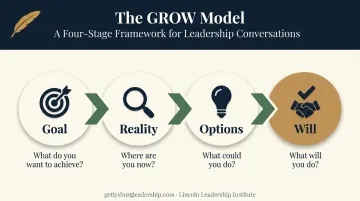
Skipping that last step is the most common coaching mistake. A conversation without a defined next step and a follow-up date isn't coaching. It's just a nice chat.
How to Apply Coaching Skills in Everyday Leadership
Coaching doesn't require a calendar invite marked "Coaching Session." Some of the most effective coaching happens in a two-minute hallway exchange, a scheduled one-on-one, or a team meeting where you resist the urge to just solve the problem yourself.
One-on-Ones and Team Coaching Moments
Most one-on-ones default to status updates: what did you do, what's next, any blockers. Restructure them around three things instead:
- Goals – What are you working toward this month, not just this week?
- Progress – What's moving, and what's stuck?
- Open questions – What's the real obstacle, and what have you tried?
Team meetings can carry coaching too. Instead of announcing a decision, pose the shared challenge to the group and let them work through it together. You're teaching a skill, not just delivering an answer.
Shifting from a Directive Mindset to a Coaching Mindset Under Pressure
The hardest part is resisting the urge to just answer, especially when the clock is running and the stakes are real. Under pressure, most leaders default to what got them promoted: giving the answer fast.
This is exactly why classroom theory struggles to build lasting coaching habits. Lincoln Leadership Institute addresses this by putting leaders through scenario-based exercises on the actual grounds where high-stakes decisions were made.
At Gettysburg, participants work through moments where commanders had incomplete information and competing priorities. At Normandy, the focus shifts to leading diverse teams and building alliances under extreme pressure. Practicing that pause under real stress builds the muscle faster than any workshop slide ever could.
Coaching Skills for Leaders vs. Managers — and Overcoming Common Challenges
Leader-level coaching and manager-level coaching draw on the same core skills, but they point in different directions.
Leader-level coaching centers on vision, strategic thinking, and long-term capability building, such as helping a VP develop their own bench strength.
Manager-level coaching centers on day-to-day execution, such as helping a new hire figure out why a process keeps breaking down. Same skill set, different altitude.
Three obstacles come up constantly, regardless of level:
- Lack of time: Treat coaching as a five-minute addition to existing meetings, not a separate calendar block
- Inconsistent follow-up: End every coaching conversation with a specific action and a specific date to check back in
- Old directive habits: Count your questions versus your statements in the next few conversations. Most leaders are surprised how lopsided it is
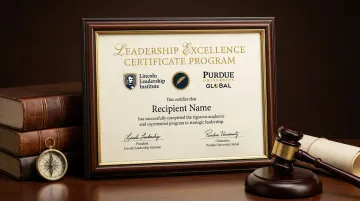
Overcoming these obstacles takes more than a single workshop; it requires sustained practice over time. Lincoln Leadership Institute's Leadership Excellence Certificate Program, delivered in partnership with Purdue University Global, pairs academic rigor with the Institute's experiential battlefield methodology. The result: a credentialed path for building these skills over months, not one afternoon.
Frequently Asked Questions
What are the 5 skills of coaching?
Most models converge on five: active listening, powerful questioning, building trust and psychological safety, giving specific feedback, and goal-setting with accountability. The exact count varies by source (ICF names eight competencies, CIPD names four), but these five capture the common ground.
What are the 7 leadership skills in management?
Harvard Business School Online identifies seven: clear communication, emotional intelligence, organization, delegation, openness, problem-solving, and decision-making. Coaching ability increasingly overlaps with several of these, especially communication and emotional intelligence.
What is the difference between coaching and mentoring in leadership?
Coaching is short-term and skill-focused, using questions to help someone solve a specific problem or build a specific capability. Mentoring is a longer-term relationship centered on career growth, with an experienced person sharing knowledge and modeling behavior.
How often should managers hold coaching conversations with employees?
Gallup recommends at least one meaningful conversation per week with each employee. Weekly is ideal; every other week is the practical minimum before coaching momentum starts to fade.
What is the GROW model in coaching?
GROW is a four-stage framework (Goal, Reality, Options, Will) that structures a coaching conversation from defining the desired outcome through committing to a specific next step. It was developed by Sir John Whitmore in the late 1980s.
Can coaching skills really be learned, or are they innate?
Yes. A controlled study of 41 executives and managers found significant increases in coaching skill, engagement, and performance after a structured training program. Coaching is a trainable behavior, not a fixed trait.