Most leaders in this spot don't fail because they lack intelligence or effort. They fail because they apply the wrong decision-making approach to the situation actually in front of them — analyzing when they should act, or acting when they should analyze.
This article breaks down a proven framework, rooted in the Cynefin model, for diagnosing any crisis and choosing the right response. We'll pull from modern leadership research and more than 150 years of battlefield decision-making history to show how it works in practice.
Key Takeaways
- Most crisis decisions fail from misreading situations, not missing information
- Clear, Complicated, Complex, and Chaotic situations each demand different responses
- A repeatable process builds confidence, preventing leaders from freezing or overreacting
- Lincoln's Gettysburg decisions mirror the exact crisis contexts leaders face today
- Sound crisis judgment comes from deliberate practice, not theory alone
Why Most Leaders Struggle to Decide Well Under Pressure
Pressure changes the way your brain works, and not for the better. A meta-analysis covering 51 studies and 2,486 participants found that acute stress measurably impaired working memory and cognitive flexibility — the exact mental functions leaders lean on when a crisis hits (Shields, Sazma & Yonelinas).
Organizations aren't compensating for this well, either. In a McKinsey survey of over 1,200 professionals, respondents said they spent 37% of their working time on decisions, and viewed more than half of that time as wasted (McKinsey, 2019). Only one in five believed their organization excelled at decision-making at all.
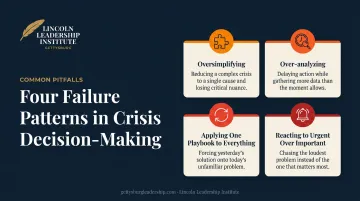
Under real pressure, four failure patterns show up again and again:
- Oversimplifying a genuinely complex problem to make it feel manageable
- Over-analyzing when the moment calls for immediate action
- Applying one playbook to every situation, regardless of what it actually requires
- Reacting to what's urgent instead of what's important
None of this stems from a lack of skill. The real gap is simpler and more fixable: most leaders have no structured way to diagnose a situation before they act on it.
The Four Contexts of Crisis Decision-Making: A Practical Framework
David Snowden and Mary Boone laid out the answer in their 2007 Harvard Business Review article, A Leader's Framework for Decision Making. The premise: not every hard situation is the same kind of hard. Before choosing how to respond, a leader has to categorize what they're actually dealing with.
Clear/Simple Situations
Cause and effect are obvious, and best practices already exist. The job here is execution. Sense the facts, categorize them against known protocol, and respond. Slowing down to deliberate only burns time you don't need to spend.
Complicated Situations
An answer exists, but it isn't obvious without expertise, and several "right" answers may even compete with each other. This is where leaders bring in specialists rather than guessing, sensing the problem, analyzing it with the right experts, then responding.
Complex Situations
There's no pre-determined right answer, because cause and effect only become clear in hindsight. Forcing a solution here backfires, so leaders probe with small, safe-to-fail experiments, watch what patterns emerge, then respond by amplifying what works.
Chaotic Situations (True Crisis)
This is where most real crises actually live, and where getting it wrong costs the most. There's no time to analyze; the leader's first job is to act to stabilize the situation, then sense what's happening, then respond. Treating chaos like a complex problem, or worse, like a simple one, is how leaders lose critical time when it matters most.
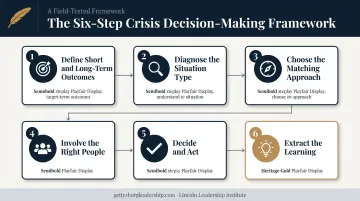
A 6-Step Decision-Making Process for Leaders in Any Crisis
Once you've diagnosed the context, here's the sequence to apply.
Step 1-2: Define the Outcome and Diagnose the Situation
Before choosing an approach, get specific about what success looks like:
- Short-term outcome: what needs to be true in the next 48-72 hours
- Long-term outcome: what "resolved" actually means for the organization
Then classify the situation against the four contexts above. This single step prevents most of the failures that come from applying the wrong approach.
Step 3-4: Choose the Approach and Involve the Right People
The approach has to match the context: bold, decisive execution in chaos; incremental experimentation in complexity; expert-driven analysis in complicated territory. Once you've set the approach, choose who's involved using three filters:
- Expertise: who actually understands this domain
- Impact: who is most affected by the outcome
- Implementation responsibility: who has to execute the decision afterward
Step 5-6: Decide, Act, and Extract the Learning
Make the call, calibrated to the context you diagnosed. Don't hedge a chaotic moment or rush a complex one. Then, after the dust settles, run a short reflection: what did you intend, and what actually happened? Research on structured after-action reviews consistently finds meaningful performance gains for teams that debrief this way rather than simply moving on to the next fire. Skipping this step is how leaders keep relearning the same lesson.
Timeless Lessons From the Battlefield: How History's Greatest Leaders Decided Under Fire
The same four contexts playing out in boardrooms today played out on America's most consequential battlefields — the founding premise behind how Lincoln Leadership Institute builds its programs.
Gettysburg: Deciding Without Time to Analyze
Consider Gettysburg, July 1, 1863. Union cavalry commander John Buford had no time for analysis when Confederate infantry appeared on the roads north and west of town.
He acted first: positioning his dismounted troopers to contest the approaches and forcing the enemy column to deploy from road-march formation into battle lines. That delay bought the hours Union infantry needed to arrive.
This is a textbook chaotic-context response: stabilize first, assess second.
The Emancipation Proclamation: A Months-Long Complex-Context Decision
Abraham Lincoln's path to the Emancipation Proclamation shows the opposite context: months of staged, complex-context leadership rather than a single decisive moment.
He weighed military necessity against constitutional limits and absorbed a divided cabinet. Stanton pushed for immediate action, Blair warned of electoral fallout, and Seward argued for better timing. Lincoln adjusted the announcement date around battlefield conditions at Antietam.
No formula existed for that decision. Lincoln probed, sensed the shifting political and military landscape, and responded in stages.
Lincoln Leadership Institute's faculty, including retired Generals, Admirals, and Navy SEALs, bring this same battlefield lens to modern leaders, translating historic crisis moments into frameworks executives can use immediately.
Standing on the actual ground where Buford held the line, or where Lincoln's cabinet debated emancipation, makes these decision-making patterns visceral in a way a case study on a slide never will.
From Insight to Instinct: Building Crisis-Ready Judgment Before You Need It
Knowing a framework intellectually and executing it under real pressure are two different things. Judgment has to be conditioned in advance; it can't be improvised the moment a crisis lands on your desk.
Leaders who've already clarified their values and decision-making instincts move faster and with more confidence when the real thing hits. There's no time to figure out what you stand for while the building is on fire.
This is the thinking behind Lincoln Leadership Institute's immersive battlefield programs, including:
- The Purdue University Global-affiliated Leadership Excellence Certificate, giving participants a recognized credential alongside experiential learning
- EQ-i2.0 emotional intelligence assessments, administered by certified faculty to help leaders understand their own decision-making tendencies under stress
- Enterprise cohort partnerships, pairing multi-year executive coaching with recurring battlefield scenarios to keep judgment sharp between crises

Fortune 1000 companies and public-sector agencies use these programs to build decision-making capacity experientially, ahead of the next crisis, not during it.
Frequently Asked Questions
What is the Cynefin framework and how does it help leaders in a crisis?
It's a model for categorizing any situation into Clear, Complicated, Complex, or Chaotic contexts. Once you know which one you're in, you can match your response instead of guessing.
How do I know if I'm in a chaotic situation versus a complex one?
Chaotic situations demand immediate stabilizing action with no time for analysis. Complex situations allow room to probe, experiment, and let patterns emerge before you commit to a course of action.
What's the biggest mistake leaders make during a crisis?
Applying the same approach (usually over-analysis or oversimplification) no matter what the situation actually calls for. The context should dictate the response, not habit.
How can I train myself to make better decisions under pressure?
Practice the framework on smaller, lower-stakes decisions first. Clarify your values and priorities before a crisis hits, and build a habit of reflecting on what you intended versus what actually happened.
Can experiential leadership training really improve crisis decision-making?
Yes. Immersive, high-stakes simulations build the emotional and cognitive conditioning that classroom training alone can't replicate. Standing where real decisions were made under fire sharpens instinct in a way lectures don't.
What decision-making lessons can modern leaders learn from historical figures like Lincoln?
Lincoln shows how to make high-stakes calls with incomplete information while staying anchored to a clear long-term outcome. He adapted timing and tactics constantly, but never lost sight of the goal itself.