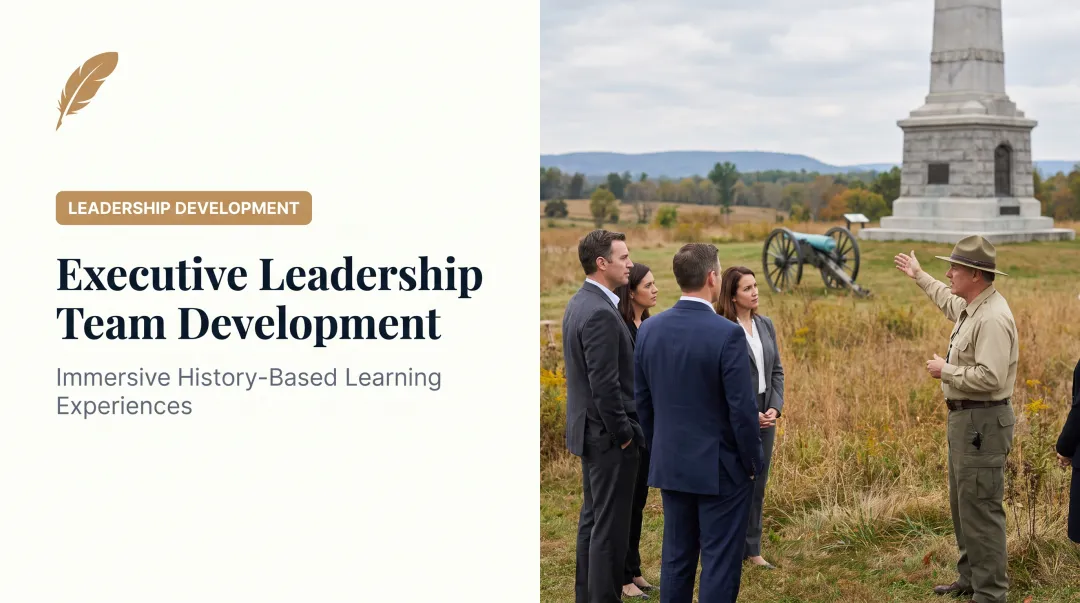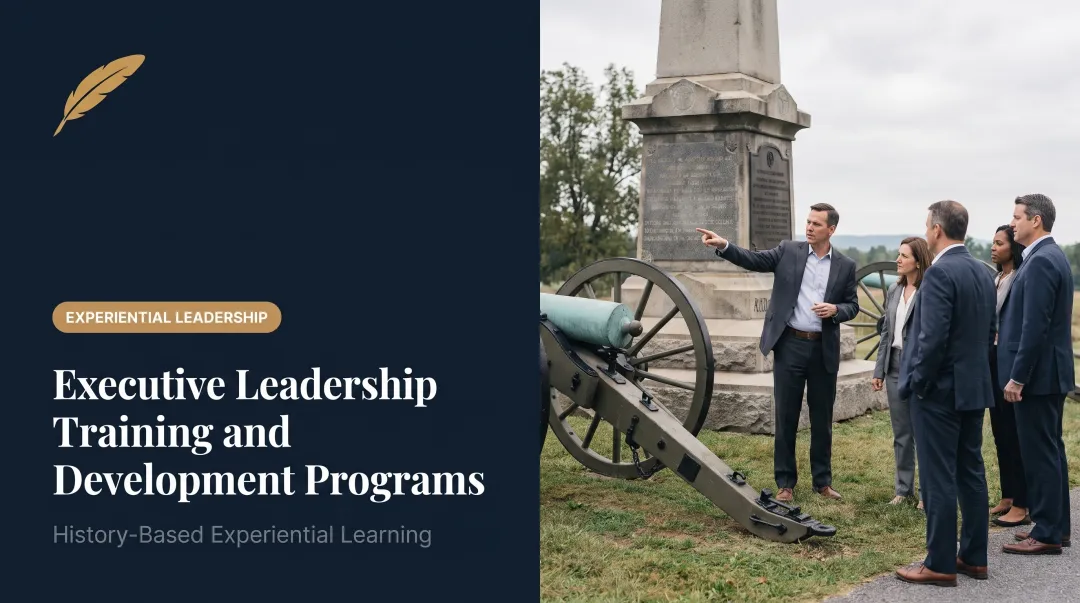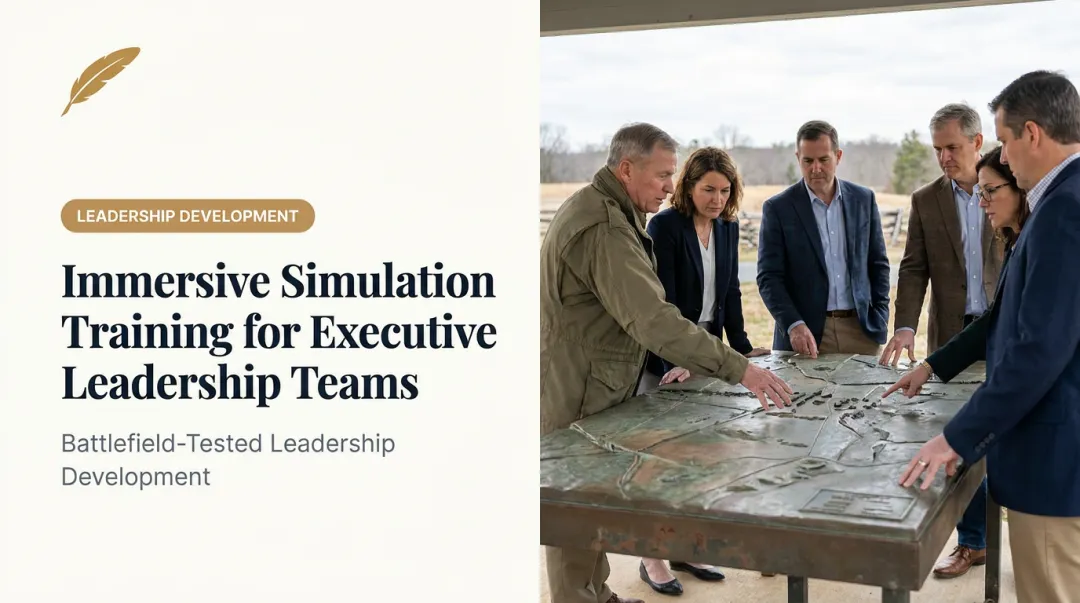
On-site training gets discussed in generic terms: travel budgets, convenience, a change of scenery. For executive leadership teams, though, the real value runs deeper. It's about behavior change under pressure, cohesion that survives real conflict, and communication that doesn't collapse when the stakes rise.
This article breaks down why immersive, on-location leadership training, the kind conducted at actual historic battlefields rather than hotel ballrooms, produces measurably different outcomes for C-suite and high-potential leaders than virtual or classroom alternatives.
Key Takeaways
- Keeps executives engaged and distraction-free during high-stakes learning
- Builds trust and candid communication among leaders faster than virtual formats
- Sharpens decision-making and strategic clarity through immersive, on-location formats
- Shows high-potential leaders that the organization invests in their growth
- Delivers the strongest results as an ongoing practice, not a one-time event
What Is On-Site Training for Executive Leadership Teams?
On-site training, in this context, means leadership development delivered in person at a dedicated, immersive location, not a virtual platform, not a generic classroom.
For executive teams, "on-site" rarely means training in the company's own conference room. It usually means traveling somewhere purpose-built for experiential learning: a historic battlefield, a leadership institute campus, a location with weight and meaning that a hotel ballroom doesn't have.
That distinction matters. Lincoln Leadership Institute describes its methodology as taking leaders "out of the boardroom and into the field, literally," using sites like Gettysburg, Normandy, and Pearl Harbor as living classrooms. The physical setting is itself part of the curriculum.
On-site executive training is a deliberate choice to build three specific capabilities:
- Decision-making capacity under ambiguity and time pressure
- Team trust forged through shared, unscripted experience
- Culture alignment around how leaders actually want to lead
Those three capabilities directly shape the performance outcomes covered next.
Key Advantages of On-Site Training for Executive Leadership Teams
The advantages below focus on measurable leadership performance, not abstract training theory. Each ties to metrics organizations already track: leadership bench strength, executive retention, team performance scores, and crisis-readiness.
Advantage 1: Builds Decisive Leadership Under Real Pressure
Scenario-based training conducted on-site immerses executives in complex, high-stakes situations that mirror the ambiguity and time pressure of real business crises. There's a meaningful difference between reading a case study about a leader who had to make a call with incomplete intelligence and standing on the actual ground where that decision happened.
Physically walking through historical decision points, actual terrain, actual timelines, forces active engagement in a way passive listening never does. You can't multitask your way through a battlefield walk the way you can zone out during a virtual module with your camera off.
Why this works: Experiential immersion activates emotional and cognitive engagement simultaneously, improving both retention and real-world application compared to lecture-based formats.
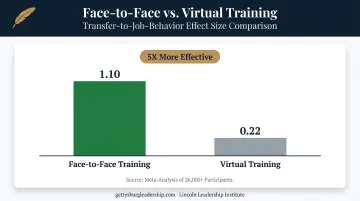
A 2017 meta-analysis covering 335 independent samples and more than 26,000 participants found that face-to-face leadership training produced a corrected transfer-to-job-behavior effect of 1.10, compared to just 0.22 for virtual programs. That's roughly a fivefold difference in how much training actually shows up in on-the-job behavior.
Programs like Lincoln Leadership Institute's Gettysburg Leadership Journey lean into this directly. Licensed battlefield guides and military faculty walk executives through moments where leaders had to act with incomplete information and enormous stakes, then connect those decisions to the ambiguity executives face during a market shift or a failed product launch.
KPIs this advantage impacts:
- Decision speed during simulated and real crisis scenarios
- Crisis response effectiveness ratings
- Strategic clarity scores measured post-training
- Behavior-change assessments conducted weeks or months later
When this matters most: This capability is most valuable ahead of major transitions, M&A integration, restructuring, market disruption, or succession planning: situations where leaders must act decisively without complete information.
Advantage 2: Strengthens Executive Team Cohesion, Trust, and Communication
Take a leadership team out of the office, away from the email pings and Slack notifications that fragment every conversation, and something shifts. People stop performing for the room and start actually talking to each other.
That's the core of this advantage: on-site formats strip away the distractions that let executives avoid genuine engagement with their peers. Shared physical experiences, group challenges on unfamiliar terrain, guided historical walks, structured debriefs after a difficult exercise, build trust faster than a virtual breakout room or an asynchronous coaching call ever could.
Why this works: In-person, unscripted dialogue surfaces candid feedback and interpersonal friction that virtual formats tend to smooth over. It's easy to stay guarded on a video call. It's harder when you're standing with your peers at a site where poor communication once cost lives, and the facilitator just asked what your team would have done differently.
Lincoln Leadership Institute's private team experiences are built around this dynamic, pairing outdoor facilitated discussions with faculty who've led in genuinely high-stakes environments themselves.
One faculty member, a retired surgical services executive now serving as a licensed battlefield guide, connects operating-room crisis leadership directly to battlefield decision-making. That combination gives executives permission to talk about their own pressure points more openly.
KPIs this advantage impacts:
- Team trust and psychological safety scores
- Cross-departmental collaboration ratings
- Time-to-consensus on major strategic decisions
When this matters most: Newly formed executive teams, post-merger leadership groups, and teams showing early signs of siloed decision-making benefit the most. If your leadership meetings feel polite but never quite honest, that's usually the tell.
Advantage 3: Signals Investment in Leadership and Drives Retention
Executives notice where the training budget goes. When a company commits real money and real time to a multi-day immersive program rather than an inexpensive online course, that decision sends a signal high-potential leaders read clearly: leadership is planning around your future here.
Programs that pair experiential learning with academic credentialing raise the stakes further. Lincoln Leadership Institute's Leadership Excellence Certificate Program, delivered in partnership with Purdue University Global, combines the battlefield experience with a university-issued certificate and a verified digital badge leaders can display on LinkedIn. That adds tangible career value on top of the experience itself.
Why this works: Visible investment in leadership development links directly to reduced voluntary turnover among high-potential employees.
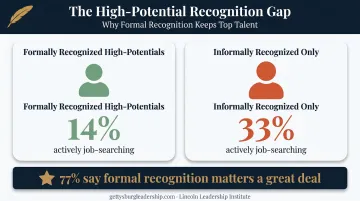
A Center for Creative Leadership study of 199 leaders in development programs found that just 14% of formally identified high-potential employees were actively job-searching, compared to 33% of those identified only informally. 77% said being formally recognized as high-potential mattered a great deal to them.
KPIs this advantage impacts:
- Voluntary attrition among high-potential leaders
- Internal promotion rates
- Leadership pipeline strength and succession readiness
When this matters most: This advantage carries the most weight in competitive talent markets or industries already facing high executive turnover and succession gaps.
What Happens When On-Site Executive Training Is Missing or Ignored
Skip the immersive piece, and problems don't announce themselves immediately. They show up months later, in ways that are hard to trace back to a training decision.
Leadership teams relying solely on virtual or generic classroom training develop predictable gaps. Everyone learns the same framework, technically, but nobody applies it the same way under pressure.
Common patterns include:
- Develop inconsistent decision-making styles that ripple across departments and compound at the executive level
- Understand concepts intellectually but freeze when applying them under real pressure
- Default to reactive crisis management driven by panic instead of practiced judgment
The retention cost compounds this problem. Gallup research found that 42% of employees who voluntarily left their jobs said their departure could have been prevented, and replacing a manager or leader typically costs around 200% of that person's salary.
Organizations that skip meaningful leadership investment tend to see exactly this pattern: higher unplanned turnover among high-potential leaders and thinner succession pipelines over time.
How to Get the Most Value from On-Site Executive Leadership Training
On-site training delivers its strongest return when treated as a recurring practice, not a single off-site event. Annual cohorts, multi-year enterprise partnerships, and structured follow-up all compound the initial investment rather than letting it fade after the flight home.
Choose a provider with a genuine track record. Look for experienced faculty, such as former military leaders, historians, and executive coaches, who tie immersive experiences to measurable business frameworks rather than a memorable day outdoors.
Gettysburg Leadership, for example, has delivered these programs for more than 25 years, working with over 25,000 Fortune 1000 and public sector clients. That volume of repeat, high-stakes engagements signals proven program quality.
Match the format to the objective:
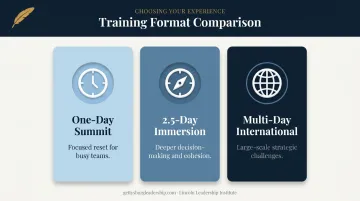
- One-day summits work for busy teams needing a focused reset
- 2.5-day immersions suit teams building deeper decision-making and cohesion
- Multi-day international programs (Normandy, Pearl Harbor) fit executives tackling large-scale strategic challenges
Reinforce with follow-up. The on-site experience should feed into ongoing development, not stand alone. Sustained results come from:
- Follow-up coaching sessions with faculty or internal leaders
- Virtual refreshers that revisit key battlefield lessons
- Structured assessments, such as the EQ-i2.0 emotional intelligence assessment
Without this reinforcement, the insights fade quickly once leaders return to daily routines.
Conclusion
On-site executive training delivers value far beyond a change of scenery or line-item budget savings. The real payoff is decision-making clarity forged under actual pressure, team trust built through shared unscripted experience, and a visible signal to your best people that their growth is worth real investment.
These advantages compound. A single off-site event might inspire a leadership team for a few weeks. A leadership development practice built around recurring, immersive experiences, reinforced with follow-up coaching, changes how an executive team actually operates, year over year.
If your leadership team is facing a major transition, wrestling with siloed decision-making, or simply overdue for development that goes beyond another virtual module, Gettysburg Leadership can help. Our immersive, historically grounded programs are tailored to your team's specific challenges. Reach out at (717) 338-9971 to talk through what that could look like.
Frequently Asked Questions
What does on-site training mean?
On-site training means in-person instruction delivered at a physical location rather than through a virtual platform. For executive programs, that often means a dedicated experiential venue, like a historic battlefield, rather than the company's own office.
What are the main types of training methods and how does on-site training differ from off-site training?
The three main formats are classroom instruction, virtual instructor-led training, and on-site experiential training. On-site programs offer hands-on, immersive engagement that virtual sessions and generic off-site venues typically can't replicate.
How long should an on-site leadership training program last for executive teams?
Programs range from one-day summits to 2.5-day battlefield immersions to multi-day international experiences. The right length depends on team size, objectives, and how deep you need the behavior change to go.
Is on-site executive training worth the investment compared to virtual programs?
Virtual training costs less upfront, but face-to-face programs consistently produce a stronger transfer of skills into actual job behavior. For teams facing high-stakes decisions, that gap in applied outcomes usually justifies the added investment.
What makes experiential, historic-site based leadership training effective for executives?
Connecting real historical decision points to modern business challenges creates emotionally engaging lessons that stick. Walking the ground where leaders once faced life-or-death decisions makes abstract concepts concrete and memorable.
How do organizations measure ROI from on-site leadership development programs?
Common metrics include retention rates, engagement scores, promotion velocity, and post-program behavior assessments. Programs should also be evaluated against the specific business objectives they were designed to address.