Introduction
You're told you "lack executive presence." Maybe it's "gravitas." Maybe it's "readiness." Whatever word your last performance review used, nobody handed you a fix — just a vague label and an awkward silence.
That's frustrating, especially when your results speak for themselves. Here's the good news: executive presence isn't a personality you're born with. It's a set of visible behaviors around communication, decision-making, and composure — and behaviors can be coached.
Research from CoQual (formerly the Center for Talent Innovation) found that executive presence accounts for 26% of what senior leaders say it takes to earn the next promotion, separate from raw performance.
This guide walks through the exact coaching process for building it: what to do first, what determines your results, and the mistakes that quietly derail progress.
Key Takeaways
- Executive presence is built from observable behaviors, not innate charisma—which is why coaching works
- Effective coaching follows a sequence: assess, diagnose the gap, practice under pressure, then reinforce
- Behavior change often shows within weeks, but colleagues' perceptions can lag months behind
- Coaching works when new behaviors are tested in high-stakes situations, not just workshop rehearsals
How to Develop Executive Presence Through Coaching: A Step-by-Step Process
Executive presence coaching isn't a single seminar. It's a sequence, and skipping steps is why so many leaders leave a workshop feeling inspired but return to work unchanged.
Step 1: Complete a Baseline Assessment
Coaching should start with data, not assumptions. That usually means:
- 360-degree feedback from peers, managers, and direct reports
- An emotional intelligence instrument such as EQ-i 2.0 or EQ 360
- A behavioral or personality assessment that surfaces blind spots
The goal is to surface the gap between how you believe you come across and how the people around you actually experience you. At Lincoln Leadership Institute, Dr. Jared Peatman, the Director of Curriculum, is certified to administer both the EQ-i 2.0 and EQ 360 assessments to establish that starting point.
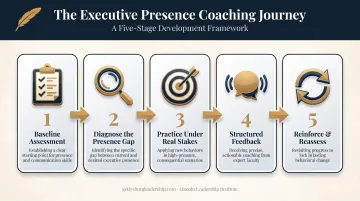
Step 2: Diagnose the Specific Presence Gap
"Lacking presence" isn't one problem. It's usually one of three:
- Under-expressed engagement: you're thinking strategically, but nobody can tell because you're not signaling it
- Under-occupied authority: you haven't fully stepped into the weight your title carries
- Style-culture mismatch: your natural approach doesn't match what your organization rewards
HBR's framework on executive presence identifies gravitas, communication, and appearance as the traditional pillars. Generic advice to "be more confident" targets none of them specifically. Naming your actual gap lets coaching aim at the right behaviors instead of a vague personality overhaul.
Step 3: Practice New Behaviors Under Real, High-Stakes Conditions
Composure rehearsed in a conference room role-play often collapses the first time real stakes show up. This is where immersive, real-world exercises earn their keep.
Lincoln Leadership Institute's battlefield-based programs put leaders into scenarios with genuine time pressure and incomplete information. Faculty blend executive coaching backgrounds with organizational psychology and, in some cases, decades of military command experience.
In the 2.5-day Gettysburg Leadership Journey, for example, participants lead a team through an ambiguous, fast-moving scenario while narrating their decision-making aloud in real time. That single act, thinking out loud under pressure, is one of the behaviors most linked to perceived executive presence.
Step 4: Receive Structured, Specific Feedback and Adjust
Feedback only helps if it targets the behaviors identified back in Step 2. That means specifics like:
- Pacing during a presentation or crisis briefing
- Decision narration to your team in the moment
- Room entry that establishes authority in a meeting
Facilitator debriefs delivered immediately after a high-pressure exercise, while the experience is still fresh, tend to land harder than a written report two weeks later.
Step 5: Reinforce Through Ongoing Coaching and Reassessment
One workshop rarely creates lasting change. A controlled study of leadership coaching found that employees noticed short-term behavioral improvement quickly, but supervisors didn't report significant change until four months after the program ended. Your behavior moves first. Everyone else's perception of you moves later.
Build in a cadence: follow-up coaching sessions, plus a reassessment (a targeted 360 or EQ retest) at the three-to-six-month mark to confirm the shift is visible to others, not just felt by you.
When Should You Invest in Executive Presence Coaching?
Timing matters. Coaching pays off most at specific inflection points:
- Moving from functional expert (the person who executes) to a broader leadership mandate
- Preparing for a promotion or increased board-level visibility
- Leading a team or division through organizational turbulence
Signals it's a presence issue, not a competence issue:
- You're valued for execution but consistently excluded from strategic conversations
- Feedback repeatedly uses words like "gravitas" or "readiness" without concrete examples
- Your ideas don't land in meetings despite solid content
Coaching isn't always the right answer. If the feedback reflects an organizational culture that narrowly and unfairly defines what "executive" behavior looks like, the fix is organizational—not individual. No amount of personal coaching solves a culture problem.
What You Need Before Starting Executive Presence Coaching
Coaching works best when three things are already in place before day one.
Self-Awareness Foundation
You need genuine willingness to hear and act on feedback, not just intellectual agreement that "presence matters." There's a real difference between nodding along in a debrief and actually changing how you run your next meeting.
Organizational and Stakeholder Buy-In
Manager and peer support meaningfully speeds up results. When colleagues know you're working on something specific and agree to give honest feedback afterward, you get real-world data faster than any classroom exercise could provide.
Commitment to a Structured, Sustained Program
Presence develops through defined milestones, not a single session. Credentialed pathways add structure and a verifiable outcome. Programs such as Lincoln Leadership Institute's Leadership Excellence Certificate Program, delivered in partnership with Purdue University Global, pair multi-stage development with a university-backed credential.
Key Factors That Affect Executive Presence Coaching Results
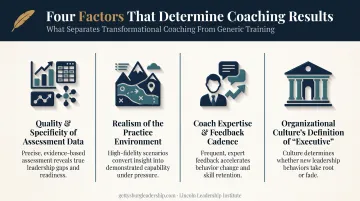
Two leaders can go through nearly identical coaching programs and get very different results. The variables usually come down to four things.
- Quality and specificity of assessment data. Vague feedback like "be more confident" can't be coached directly. Instrument-based data (EQ scores, 360 results, behavioral assessments) lets coaching target the actual gap and shortens time to visible change.
- Realism of the practice environment. Composure learned in low-stakes role-play often collapses under genuine pressure. Practice in realistic, high-consequence conditions builds behaviors that transfer to the boardroom or a crisis call.
- Coach expertise and feedback cadence. Coaches without a clear diagnostic method default to generic, personality-based advice. Frequent, behavior-specific feedback loops—not one-off sessions—help new habits replace old patterns.
- Organizational culture's definition of "executive." Presence is judged differently everywhere. A style that reads as authoritative at one company might read as insufficiently decisive at another. Coaching that ignores this context risks training a style the organization doesn't reward.
Common Mistakes to Avoid When Developing Executive Presence
Even well-intentioned coaching efforts fail for predictable reasons:
- Treating presence as a personality overhaul instead of specific, practicable behaviors
- Relying on generic training (posture tips, voice coaching) without diagnosing whether the gap is expression, authority, or cultural mismatch
- Expecting perception to shift as fast as behavior, then quitting before colleagues catch up
- Practicing only in artificial settings and never testing new behaviors in a real high-stakes meeting
That last one is the most common, and the most costly. A workshop can teach you the move. Only a real meeting proves you can make it.
Frequently Asked Questions
What are the 7 pillars of coaching?
There's no single official standard, but the foundations most often cited are trust, active listening, powerful questioning, goal-setting, accountability, feedback, and continuous development.
What is executive presence and why does it matter for career advancement?
Executive presence is the ability to project confidence, credibility, and composure so others trust your judgment. Competence gets you in the room; presence strongly influences who gets promoted.
How long does it take to develop executive presence through coaching?
Visible behavior change often appears within weeks of focused coaching. Colleagues' perception of that change typically takes several months longer to catch up.
Can introverted leaders develop strong executive presence?
Yes. Executive presence isn't about being the loudest voice in the room. Coaching helps introverted leaders project clarity and authority in ways that stay authentic to their natural style.
Is executive presence coaching different from executive communication training?
Communication training mostly focuses on message clarity and delivery. Executive presence coaching also addresses composure under pressure, decision-making, and how your style fits your organization's culture.
How is executive presence measured before and after coaching?
Most programs start with 360-degree feedback and EQ or behavioral assessments. They repeat those measures three to six months later to confirm observable change.