Introduction
Leadership gaps are expensive. Low employee engagement alone costs the global economy an estimated $8.9 trillion, or 9% of global GDP, according to Gallup's 2024 State of the Global Workplace report. Gallup has also found that management accounts for roughly 70% of the variance in team engagement, so who you promote—and how you develop them—carries outsized weight.
L&D leaders rarely need convincing that leadership development matters. The harder call is which mix of programs, coaching, and immersive experiences will actually change behavior—not just fill a training calendar.
This guide breaks down the major types of leadership development programs, what separates the effective ones from the forgettable ones, and how to choose or design the right experience for your organization.
Key Takeaways
- Real behavior change needs formal learning plus on-the-job or immersive experience, not classroom theory alone.
- Tie programs to a specific business priority and tailor them by leadership level.
- High-stakes, emotionally resonant formats, such as historic battlefield simulations, build lasting decision-making frameworks.
- Measure impact before, during, and after a program to separate proven ROI from guesswork.
What Is Leadership Development?
Leadership development is the deliberate, ongoing process of building the judgment, self-awareness, and interpersonal skill needed to lead others well. That differs from leadership "training," which usually means a single course or workshop aimed at one skill.
Development is a career-long arc. Training is one input into it.
The 70-20-10 Reality
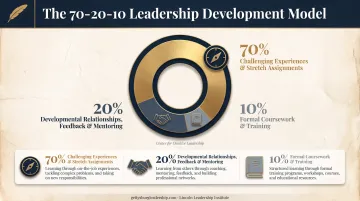
The Center for Creative Leadership's widely cited 70-20-10 model breaks down where leadership growth actually comes from:
- 70% — challenging experiences and stretch assignments
- 20% — developmental relationships, feedback, and mentoring
- 10% — formal coursework and structured training
CCL is clear that this is a guideline built on decades of research into how executives actually develop, not a rigid formula. The takeaway is clear: most growth happens on the job, not in a seminar room.
Leadership development also spans a wider range than people assume:
- An individual contributor stepping into a first team-lead role
- Mid-level managers building cross-functional influence
- Organizations mapping C-suite succession several moves out
Format and depth need to match that range—not treat every leader the same.
Types of Leadership Development Programs and Experiences
No single format does everything. Organizations that see real results tend to blend several of the following.
Formal Coursework and Certificate Programs
University-affiliated or accredited certificate programs give leaders structured curricula and a credential they can put on LinkedIn or a resume. These programs work well for building shared vocabulary across a cohort, though on their own they rarely change behavior—hence CCL's 10% figure above.
Coaching, Mentoring, and 360-Degree Assessments
One-on-one coaching, peer mentoring, and assessment tools such as EQ-i 2.0 or 360-degree reviews help leaders spot blind spots they can't see on their own. A leader who thinks they're a strong listener but scores low on that dimension from direct reports gets a data point they can't argue with.
On-the-Job and Stretch Assignments
Cross-functional projects, temporary team leadership, and other "heat experiences" push leaders past their comfort zone with real consequences attached. These assignments build capability faster than almost anything else, provided there's enough support to keep the challenge from tipping into burnout.
Experiential and Immersive Learning
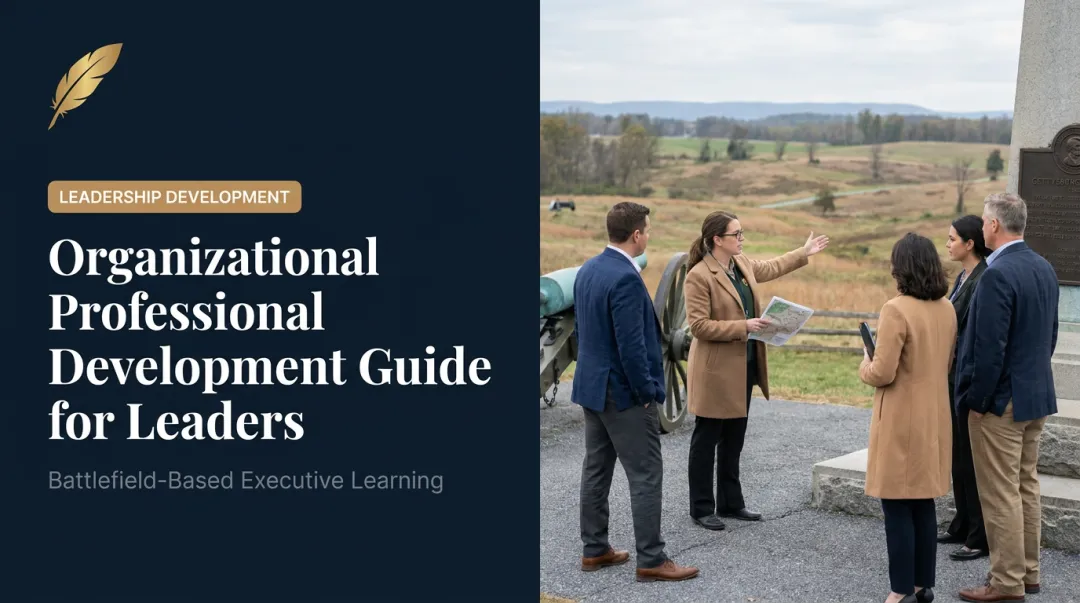
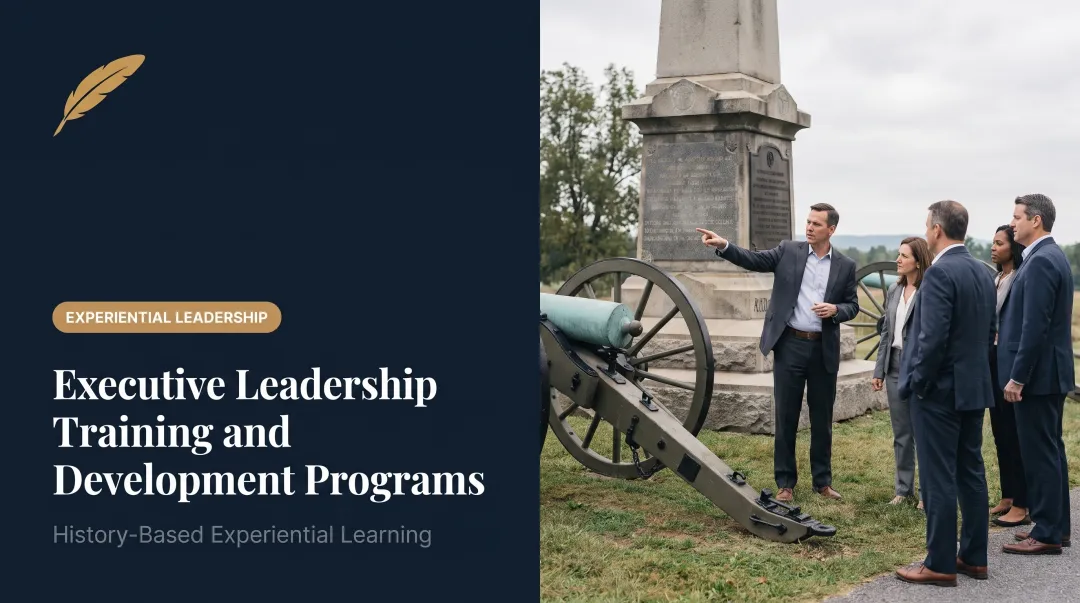
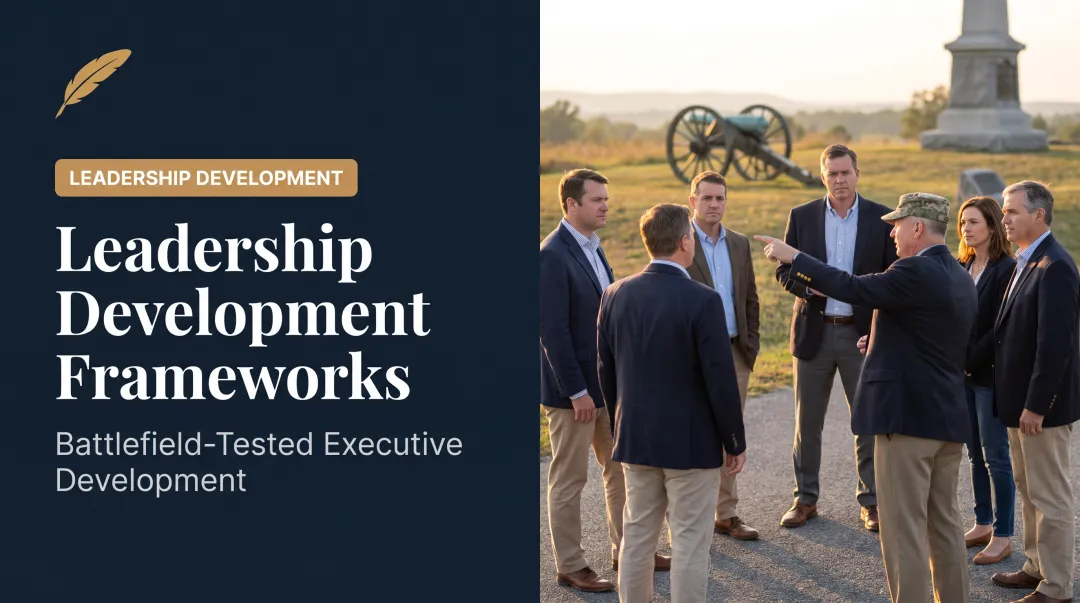
Experiential programs put leaders inside simulated or real high-stakes environments to practice decision-making under pressure. Lincoln Leadership Institute built its entire approach around this model, taking leaders to historic sites including Gettysburg, Normandy, Pearl Harbor, and the Alamo. Participants walk the same ground where commanders made consequential decisions under pressure and incomplete information.
Virtual and Blended Programs
Live virtual leadership cohorts extend access to distributed teams without losing the cohort-based connection that makes group learning stick. Programs like Lincoln Leadership Live bring historically grounded lessons to remote teams through interactive video sessions, filling the gap for organizations that can't fly a whole cohort to a battlefield.
Core Elements of an Effective Leadership Development Program
A generic program produces generic results. Effectiveness starts before a single session is designed.
Design choices that separate effective programs from generic ones include:
- Tie every module to a clear business outcome (revenue growth, retention, innovation, or faster decision-making) before content is built
- Open with structured reflection, feedback, and assessment so leaders identify blind spots early
- Match format and time commitment to level: one-day summits for frontline managers, multi-day immersions for executive and high-potential tracks
- Favor practice in realistic scenarios over slides and lectures so skills actually stick
- Pair executive sponsors with cohort communities so accountability continues after people return to their desks
- Track behavior change and business impact before, during, and after so you know whether to repeat or redesign next year
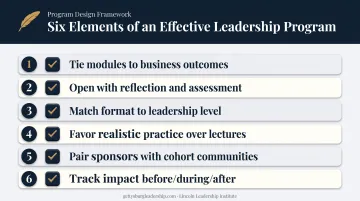
When those elements work together, learning transfers back to the job instead of fading once the session ends.
Why Experiential Learning at Historic Battlefields Works
The Psychology of Heat Experiences
CCL describes intentional stretch assignments as "trial by fire" or heat experiences. Properly harnessed heat accelerates learning and helps leaders make larger leaps when facing uncertainty and complexity. The key is "properly harnessed": uncontrolled pressure without support can hurt engagement rather than build it.
Battlefield-based programs use that same mechanism, minus the career risk. Walking the ground where historic leaders made life-or-death decisions with incomplete information creates a vivid, memorable framework participants carry into their own high-stakes moments: a product launch gone sideways, or a team locked in conflict.
The Lincoln Leadership Institute Model
Lincoln Leadership Institute turns that heat into structured practice. It pioneered this approach more than 25 years ago and has since worked with over 40,000 leaders and 25,488+ Fortune 1000 and public-sector clients, including Pfizer, FedEx, GE, the Department of Defense, and the U.S. Treasury.
What sets the faculty apart is who's actually teaching:
- Retired admirals and Navy SEALs with decades of Naval Special Warfare experience
- Army colonels and generals who led at the highest levels of special operations
- An Emmy-winning political journalist who translates crisis communication under scrutiny into practical frameworks
- Ph.D. historians who connect primary-source events at Gettysburg, Normandy, and Pearl Harbor to modern organizational problems
The program's Leadership Excellence Certificate, delivered in partnership with Purdue University Global, adds a verifiable, shareable credential to the field experience. Leaders leave with a sharper decision-making lens and a credential they can put on LinkedIn and in their development file.
How to Choose the Right Program for Your Organization
Start with the same question top L&D teams use before picking any provider: what specific performance outcome should this program drive? Innovation, retention, decision-making under pressure, and succession readiness all call for different content and formats.
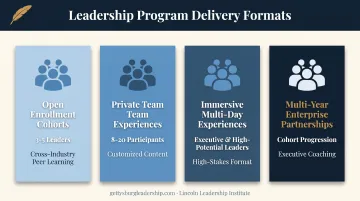
From there, match the delivery model to leadership level and organizational context:
- Open enrollment cohorts for individual high-potentials or small groups (typically 3–5 leaders per organization) who benefit from cross-industry peer learning
- Private team experiences (typically 8–20 participants) when one organization needs customized content and exclusive scheduling
- Immersive multi-day experiences for executive and high-potential cohorts who need a high-stakes, memorable format
- Multi-year enterprise partnerships with cohort progression and executive coaching for organizations building a sustained leadership pipeline
When evaluating providers, weigh more than surface credentials:
- Track record: Years in operation and scale of clients served
- Customization: Ability to tailor content to your real organizational challenges
- Impact measurement: Evidence of performance outcomes, not only satisfaction scores
Lincoln Leadership Institute organizes around the same distinctions—Open Enrollment Groups, Private Team Experiences, and multi-year Enterprise Partnerships—so program fit can scale with team size and pipeline goals.
Frequently Asked Questions
Can you give me some examples of leadership development?
Common examples include executive coaching, 360-degree assessments, mentoring, stretch assignments, formal certificate courses, and experiential or immersive programs such as battlefield leadership journeys. Most organizations combine several of these.
What are the 5 C's of leadership development?
There's no single agreed-upon list. One commonly referenced version from Forbes Coaches Council includes Creativity, Courage, Curiosity, Confident Humility, and Collaboration, though other sources define the five C's differently.
What is the difference between leadership training and leadership development?
Training is a formal, short-term process aimed at improving a specific skill. Development is the broader, ongoing process that combines experience, relationships, and training to prepare someone for expanded responsibility over time.
What is experiential leadership development?
Experiential leadership development immerses participants in realistic or historic high-stakes scenarios to practice decision-making, rather than relying on lecture-based instruction. Battlefield leadership programs are a well-known example of this format.
How long does a leadership development program typically take?
Formats range from one-day summits to 2.5- to 3-day immersive experiences to multi-year enterprise partnerships. The right length depends on your budget, leadership level, and how deep the behavior change needs to go.
How do you measure the ROI of a leadership development program?
Measurement typically combines pre- and post-program assessments, tracked behavior change back on the job, and business metrics like retention, engagement, and performance data. The Kirkpatrick and Phillips models are the two most established frameworks for structuring this evaluation.