For HR leaders, executives, and managers navigating mergers, leadership transitions, or performance turnarounds, this distinction matters. Get it wrong, and the costs are real. Low employee engagement cost the global economy $8.9 trillion in 2023, or 9% of global GDP, according to Gallup's 2024 State of the Global Workplace report.
"Change the culture" has become one of the most commonly cited but poorly executed leadership mandates. It gets reduced to values posters, a one-off training day, or a new mission statement nobody references again by Friday.
This article breaks down what culture change actually is, why organizations need it, the concrete steps to do it right, and the factors and mistakes that determine whether the effort sticks or quietly fades.
Key Takeaways
- Culture change sticks when strategy, structure, and processes shift first, not speeches or slogans
- Follow a clear sequence: define, assess, align leaders, change systems, communicate, build capability, reinforce
- Leadership behavior is both the biggest lever and the biggest failure point in culture transformation
- Track engagement, retention, and adoption metrics to confirm the new culture is taking hold
What Is Organizational Culture Change?
Organizational culture change is the intentional process of shifting the collective values, behaviors, and unwritten norms that shape how employees make decisions and collaborate. It's the difference between what a company says it values and what actually happens when a deadline is missed or a customer complaint lands on someone's desk.
The goal is straightforward: align day-to-day behavior with strategic goals so performance, engagement, and adaptability improve. When culture and strategy pull in the same direction, execution gets faster and friction drops.
Culture change is often confused with two related, narrower efforts:
- Change management manages adoption of a single initiative, such as a new CRM rollout or reorganization, and typically has a defined end date.
- Employee engagement programs address how people feel about their work, but don't necessarily touch the underlying norms driving behavior.
Culture change is broader and more permanent: it's the operating system beneath both. A new software rollout can succeed through solid change management while the underlying culture remains exactly as dysfunctional as before.
Why Organizations Need to Change Their Culture
Culture change rarely happens because someone woke up wanting to write new values statements. It's typically triggered by external or structural shifts:
- Mergers and acquisitions that combine two distinct ways of working
- New leadership with a different vision for how the business should operate
- Market disruption that makes old operating norms obsolete
- Corporate restructuring that changes reporting lines and decision rights
Warning Signs You're Already Behind
Several internal signals suggest a culture shift is overdue, and organizations often wait too long to act on them:
- High turnover, particularly among strong performers
- Stagnant growth despite adequate resources
- Silos between departments that should be collaborating
- A visible disconnect between what leadership says and how staff actually behave
- Resistance to innovation or new ways of working
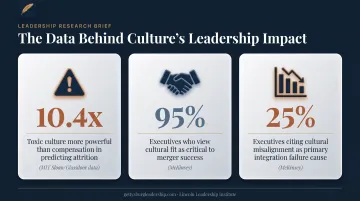
The stakes here are higher than most leaders assume. An MIT Sloan Management Review analysis of 34 million employee profiles found that toxic corporate culture was 10.4 times more powerful than compensation in predicting a company's industry-adjusted attrition rate. The finding drew on research covering more than 1.4 million Glassdoor reviews. Pay raises don't fix a broken culture. People leave anyway.
In merger contexts specifically, McKinsey found that 95% of executives view cultural fit as critical to integration success, yet 25% cite cultural misalignment as the primary reason integration efforts fail.
When organizations ignore these pressures, the pattern is predictable: performance declines, brand reputation takes a hit, and top talent walks out the door—often to a direct competitor.
Culture change in these scenarios is operationally necessary. It can't be delegated to HR and forgotten. It works best when tied to a specific business problem, like innovation stagnation or poor cross-team collaboration, rather than treated as an abstract values exercise.
The Steps for Changing Culture in an Organization
Effective culture change follows a sequence. It starts with clarity of purpose, moves through leadership alignment and structural change, and ends with reinforcement and measurement. Skipping steps, especially starting with communication alone, is the most common reason initiatives fail.
Step 1: Define the Desired Culture and Tie It to Strategy
Leaders need to articulate specific, observable behaviors, not vague values like "innovation" or "integrity" that mean something different to everyone. If the strategy requires faster decision-making, the target behavior might be "decisions get made at the lowest appropriate level within 48 hours," not "we empower our people."
The target culture also needs to be measurable enough to reinforce later. Vague aspirations can't be tracked, and what can't be tracked won't be sustained.
Step 2: Assess the Current Culture and Identify the Gaps
You can't close a gap you haven't measured. This step uses:
- Employee surveys to capture sentiment and perceived norms at scale
- Focus groups to surface the "why" behind survey numbers
- Behavioral observation to see what actually happens versus what people report
The output is a specific list of gaps between where the organization stands today and where the target culture needs it to be.
Step 3: Secure Leadership Alignment and Commitment
This is the step organizations most often underestimate. Leaders at every level must visibly model the new behaviors first. Employees calibrate against what leadership actually does, not what leadership says in a memo. If executives talk about collaboration while continuing to hoard information and make unilateral calls, employees notice within weeks.
Gartner's research found that only 32% of business leaders reported healthy employee adoption on their last change effort. Consistent, visible leadership commitment made employees three times more likely to adopt new behavior, even in low-trust environments.
Step 4: Change the Systems, Structures, and Processes First
This is the step most culture initiatives get backward. Harvard Business Review researchers Jay Lorsch and Emily McTague found that leaders they interviewed didn't treat culture as something directly fixable. Instead, culture shifted as a byproduct of new processes and structures introduced to solve real business problems.
A frequently cited example: when Alan Mulally became Ford's CEO in 2006, he introduced cross-unit meetings focused on solving major business problems, not on changing attitudes directly. Changing how the work got done changed the collaboration norms — and the culture followed.
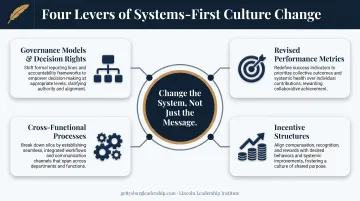
Practical levers here include:
- New governance models and decision rights
- Revised performance metrics that reward the behaviors you actually want
- Cross-functional processes that force collaboration by design
- Incentive structures aligned with the new priorities
Step 5: Communicate the Change with Consistency and Transparency
Once systems are shifting, communication becomes the connective tissue. It needs to explain the "why," acknowledge concerns honestly, and repeat the message across multiple channels. A single town hall won't cut it.
Without repetition, employees reasonably conclude the change is a passing initiative that will fade by next quarter. Many will wait it out rather than engage.
Step 6: Build Leadership and Employee Capability
Sustained culture change requires equipping leaders with real decision-making, communication, and resilience skills, not just a policy briefing that gets skimmed once. This is where experiential, immersive leadership development earns its place in the process. Programs that put leaders in high-pressure, ambiguous scenarios build the decisive, values-based behaviors a new culture depends on, far more effectively than a slide deck ever will.
At the Lincoln Leadership Institute, for example, leaders spend 2.5 days on the Gettysburg battlefield working through historical decision points that mirror the pressure and incomplete information they face on the job. Faculty include retired military leaders such as Admiral Scott Moore (a former Navy Rear Admiral with 30-plus years in Naval Special Warfare), along with historians and organizational psychologists.
The work builds muscle for decisive action, honest communication under pressure, and resilience, so the new culture takes hold in practice rather than theory.
Organizations pursuing this at scale can choose from three models:
- Open Enrollment: Send 3 to 5 leaders to a scheduled program; cost-effective for smaller cohorts
- Private Team: Run an 8 to 20-person program with case studies tied to your business challenges
- Enterprise Partnership: Multi-year, cohort-based progression with executive coaching for organization-wide change
Step 7: Reinforce, Measure, and Sustain the New Culture
Culture change doesn't end when the training concludes or the new process launches. Organizations need to track:
- Engagement survey trends over successive quarters
- Retention rates, especially among high performers
- Adoption rates of the new processes and behaviors
- Business performance indicators tied to the original strategic goal
Celebrating visible wins matters here. When employees see a concrete example of the new behavior producing a better outcome, it reinforces that the change is real, not decorative. Skip this step, and organizations drift back to old norms within a year. The default gravity of "how we've always done it" is strong.
Key Factors and Common Mistakes That Determine Success
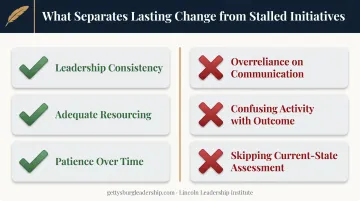
Even well-designed culture change efforts fail for predictable reasons. These factors separate lasting change from stalled initiatives:
- Leadership consistency: Mixed signals from leaders—saying one thing, doing another—destroy trust faster than almost any other factor.
- Resourcing: Culture change is people-intensive. Initiatives that starve leadership time stall before new behaviors take hold; McKinsey research found that time investment doubled success odds, yet only 43% of executives made it.
- Timing and patience: Meaningful shifts typically take multiple quarters to years to embed, not weeks. Expecting fast results is a common trap.
- Overreliance on communication alone: Slogans, town halls, and posters feel productive but change little unless you rewrite the systems that drive behavior.
- Confusing activity with outcome: Training sessions and surveys are not behavior change. Only sustained behavioral shifts and improved metrics signal real progress.
- Skipping current-state assessment: Jumping to the desired culture without mapping existing norms and resistance points sets the effort up to fail.
Conclusion
Changing organizational culture is a structured, sequential process. It starts with strategy and systems, not slogans, and it moves through assessment, leadership alignment, structural change, communication, capability building, and reinforcement — in that order.
Leadership behavior determines whether the effort takes hold or fades. Consistent modeling, sustained investment, and patience separate organizations that successfully shift their culture from those still wondering why last year's initiative didn't work.
Apply this process deliberately. Skip the generic culture campaign, and build the behaviors your strategy actually requires.
Frequently Asked Questions
What is the best way to change culture in an organization?
The most effective approach ties culture change to concrete shifts in strategy, systems, and leadership behavior rather than communication campaigns alone. Follow a defined sequence: assess, align leadership, change systems, then reinforce.
How long does it take to change organizational culture?
Meaningful culture shifts typically take one to three years, and sometimes longer, depending on organization size and complexity. Expecting quick results is one of the most common causes of failed initiatives.
Who is responsible for driving culture change in a company?
HR often facilitates the process, but senior leadership and managers at every level are ultimately responsible. Employees model their behavior after what leaders visibly do, not what HR documents describe.
Can company culture change without changing leadership?
Yes, existing leadership can drive culture change if they're willing to visibly shift their own behavior first. Persistent misalignment at the top, however, usually requires actual leadership changes to succeed.
What are the biggest risks of a failed culture change initiative?
Failed initiatives breed employee cynicism, waste resources, increase turnover, and damage trust in future change efforts. Each failed attempt makes the next one harder to sell to a skeptical workforce.
How do you measure whether a culture change effort is working?
Track engagement survey trends, retention rates, adoption of new processes, and business performance indicators over time. Sustained improvement across these metrics, not a single survey score, signals real progress.