Introduction
Pulling eight senior leaders out of the business for three days isn't a scheduling favor. It's a real cost, measured in delayed decisions and missed calls back to the office.
Executives already spend nearly 23 meeting hours a week in scheduled sessions alone, according to Harvard Business Review's research on executive time. Add a retreat that produces vague notes and no follow-through, and the investment returns nothing.
Most retreat failures don't come from the wrong venue or a tight budget. They come from a weak agenda: sessions with no thread connecting them, or no defined purpose.
This guide shows what a working executive retreat agenda looks like: a sample 2–3 day template, the components no agenda should skip, and the planning habits that turn a forgettable offsite into one that changes how a leadership team operates.
Key Takeaways
- Balance structured strategy work with unstructured connection time and built-in reflection
- Tie every session to a purpose defined before any activity gets scheduled
- Build 2–3 day agendas around objectives, skill-building, forward planning, and deliberate downtime
- Choose experiential, immersive formats over conference rooms to sharpen decision-making and resilience
- Lock in post-retreat accountability so insights turn into lasting behavior change
Why Your Retreat Agenda Makes or Breaks the Outcome
A retreat agenda is the operational translation of why you're gathering leaders—not a list of start times.
Skip that translation step, and retreats default to one of two failure modes:
- A loose string of disconnected activities with no through-line
- A "PowerPoint marathon": days of presentations with no room to think
A clear agenda signals respect for executive time. When every hour has a stated purpose, senior leaders engage differently. They stop mentally drafting emails because they trust the next 90 minutes will matter.
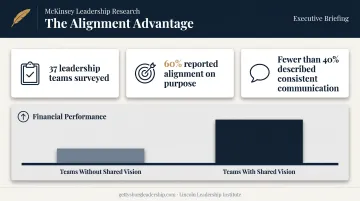
The stakes aren't abstract. McKinsey's research across 37 leadership teams and roughly 430 respondents found only 60% reported alignment on purpose, and fewer than 40% described consistent communication across the team. Teams with a shared, meaningful vision were nearly twice as likely to land above-median financial performance than teams without one.
A retreat agenda is one of the few structured chances a leadership team gets to build that alignment on purpose. Waiting for it to emerge between quarterly business reviews rarely works.
Core Components Every Executive Retreat Agenda Should Include
Every strong agenda, regardless of length or location, includes the same six building blocks. Leave one out and the retreat feels incomplete, even if attendees can't quite say why.
- Objective-setting session: Open by aligning leaders on the "why"—succession planning, a culture shift, or a strategic pivot—before anything else runs.
- Structured strategic work blocks: Vision-setting, SWOT-style assessments, or scenario planning tied to a real business challenge, not a generic case study.
- Leadership skill-building: Decision-making under pressure, communication, or emotional intelligence work anchored in a live scenario rather than abstract theory.
- Dedicated unstructured time: Informal dinners, walks, or open evenings apart from programmed sessions, where candid peer conversations actually happen.
- Wellness and recovery blocks: Movement, quiet reflection, or time outdoors. High-performing executives hit diminishing returns fast without a built-in pause.
- Action-planning and accountability: Near the close, document commitments with named owners and specific timelines—not vague intentions.
Only three of these six components involve traditional "content." The rest exist to make that content stick.
Sample Executive Leadership Retreat Agenda: A 2-3 Day Template
This template works for groups of 8 to 20 senior leaders—small enough for real dialogue, large enough for diverse perspectives. Shorter one-day summits or longer multi-day immersions can scale from this same base structure.
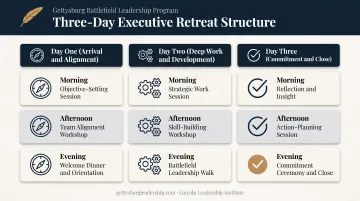
Day One: Arrival and Alignment
- Morning: Arrival, welcome briefing, and objective-setting—leaders co-create success metrics instead of receiving them secondhand
- Midday: First strategic work block (vision or challenge-mapping), then a working lunch to hold momentum
- Afternoon: Experiential or skill-building activity that surfaces real leadership behavior under mild pressure—not theory alone
- Evening: Unstructured dinner and connection time, left open on the printed agenda
Day Two: Deep Work and Development
- Morning: Core strategic planning or a scenario-based exercise tied to a live organizational challenge
- Afternoon: Breakouts for peer coaching or skill practice, then a debrief circle on what surfaced
- Evening: Reflection time or a memorable shared experience leaders will still reference months later
Day Three: Commitment and Close
- Morning: Synthesis session that turns two days of insight into an action plan with owners and deadlines
- Closing: Commitments shared aloud, follow-up cadence agreed, and a formal close-out that ends with clarity—not a rushed goodbye
Adapt the length to your goals: compress into a one-day summit, or extend development blocks when the work needs more room. Private executive teams often deepen Days One and Two with immersive, history-based experiential sessions so strategy talk is tested against real decision pressure before commitments lock in on Day Three.
Planning Best Practices for a High-Impact Agenda
Getting the agenda right starts well before the retreat itself.
- Start planning 3-6 months out. Securing the right venue, facilitators, and executive calendars takes lead time. Waiting until six weeks out limits your options considerably.
- Run pre-retreat interviews or short surveys. Ask attendees what's actually keeping them up at night. Building the agenda around real concerns beats guessing at generic leadership themes.
- Match the tone to your existing culture. A retreat agenda built for a fast-moving startup will fall flat at a century-old manufacturer, and vice versa. Don't force a template that fights your organization's norms.
Common Agenda Mistakes That Undermine ROI
Even well-intentioned planners fall into predictable traps:
- Overloading the schedule. Back-to-back sessions with zero white space leave no room for the informal dialogue where real breakthroughs happen.
- Skipping the follow-up owner. Without someone named to track action items, commitments disappear the moment leaders return to their inboxes.
- Treating the agenda as fixed. A skilled facilitator adjusts in real time based on group energy. An inflexible agenda fights the room instead of serving it.
Beyond the Boardroom: Why Experiential, Immersive Formats Outperform Traditional Retreats
Fortune 1000 and public-sector organizations are moving away from hotel ballrooms. The shift favors real-world environments that put leaders in high-stakes settings instead of another windowless conference room.
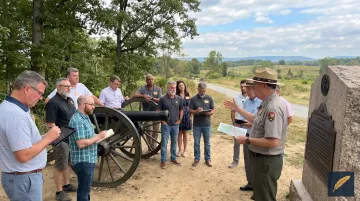
Experiential formats, including leadership programs held on actual historic battlefields, force decisive action in ways slide decks simply can't. There's no hiding in the back row when the scenario in front of you demands a call, right now, with incomplete information.
Research from ATD found that 75% of organizations now use experiential learning in leadership development to some extent. High-performing firms are roughly three times more likely to deploy it for both frontline and senior leaders.
Lincoln Leadership Institute has spent more than 25 years pioneering this exact model. Working from its home base in Gettysburg, Pennsylvania, the Institute delivers agenda-based leadership immersions at four historic sites, each built around a distinct leadership theme:
| Location | Core Leadership Theme |
|---|---|
| Gettysburg | Decisive leadership under pressure |
| Normandy | Strategic decision-making under uncertainty |
| Pearl Harbor | Crisis management and rapid response |
| The Alamo | Resilience and leading through adversity |
More than 25,000 Fortune 1000 and public-sector clients, including Pfizer, FedEx, GE, and the Department of Defense, have run leaders through these programs.
The faculty roster is part of why the model sticks:
- Retired generals and admirals
- A former Navy SEAL Command Master Chief
- An Emmy-winning political journalist
- Ph.D. historians teaching alongside practitioners
That mix gives the agenda built-in authority a generic outside facilitator can't match.
Organizations that want a lasting credential can add the Leadership Excellence Certificate Program, delivered with Purdue University Global, so the retreat produces a professional development outcome that outlasts the trip.
Frequently Asked Questions
How long should an executive leadership retreat be?
Two to three days is typical, long enough for real strategic work without stretching executive calendars too thin. Shorter one-day summits or longer multi-day immersions can scale based on your objectives.
What is the ideal group size for an executive retreat?
Between 8 and 20 participants works best for meaningful dialogue. Larger groups still work but need breakout structures and additional facilitators to keep conversation substantive.
How far in advance should we start planning our retreat agenda?
Aim for 3 to 6 months of lead time. That window covers venue booking, aligning executive calendars, and building an agenda tailored to your team rather than a generic template.
Should we use an external facilitator for our executive retreat?
Yes, in most cases. An external facilitator lets leaders fully participate instead of managing logistics or steering discussion, which produces more candid, productive conversations.
How do you measure the ROI of an executive leadership retreat?
Track action-item completion rates, post-retreat engagement surveys, and downstream performance metrics tied to the retreat's stated objectives. Define those objectives before the retreat so you can score results against them afterward.
What's the difference between a leadership retreat and a general team-building retreat?
Leadership retreats focus on strategic alignment, decision-making, and executive development. Team-building retreats emphasize broader morale and relationship-building across all levels of an organization.