That gap matters more than ever. In DDI's 2025 Global Leadership Forecast, only 20% of CHROs said they had enough ready-now leaders to fill critical roles, and just 49% of critical leadership positions could be filled immediately by internal candidates.
Experiential learning closes that gap differently. Instead of describing leadership, it forces people to practice it under pressure, then reflect on what happened. This article breaks down what experiential learning actually is, which leadership qualities it builds, and a practical framework any organization can use to develop leaders who are ready before the crisis hits.
Key Takeaways
- Experiential learning builds decision-making and resilience faster than lectures through real-time action.
- Strategic thinking, emotional intelligence, and courage develop through immersive, real-stakes experiences.
- A structured assess-immerse-debrief-apply framework turns experience into lasting capability.
- Trained managers lift team engagement by up to 18% and cut turnover by 21%-28%, per Gallup research.
What Is Experiential Learning in Leadership Development?
Experiential learning is education built on doing, not listening. It follows David Kolb's four-stage cycle: concrete experience (a real or simulated event), reflective observation (examining what happened), abstract conceptualization (drawing out principles), and active experimentation (testing those principles somewhere new). The cycle repeats, and each pass deepens the lesson.
This is a different model than a classroom or an e-learning module. Passive formats hand participants information and hope it sticks. Experiential formats put participants inside a scenario where they have to make a call, live with the outcome, and unpack why it worked or didn't.
Why Active Practice Beats Passive Instruction
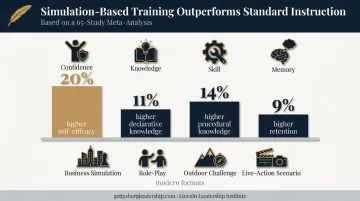
A widely cited meta-analysis of 65 studies and 6,476 learners compared simulation-based training with other instructional approaches, according to a 2011 study published in Personnel Psychology. The results were striking: 20% higher self-efficacy, 11% higher declarative knowledge, 14% higher procedural knowledge, and 9% higher retention. The pattern holds across formats:
- Business simulations that mimic real strategic decisions
- Role-play negotiations with genuine stakes and consequences
- Outdoor challenge courses that test teamwork under physical stress
- Live-action scenarios modeled on actual organizational crises
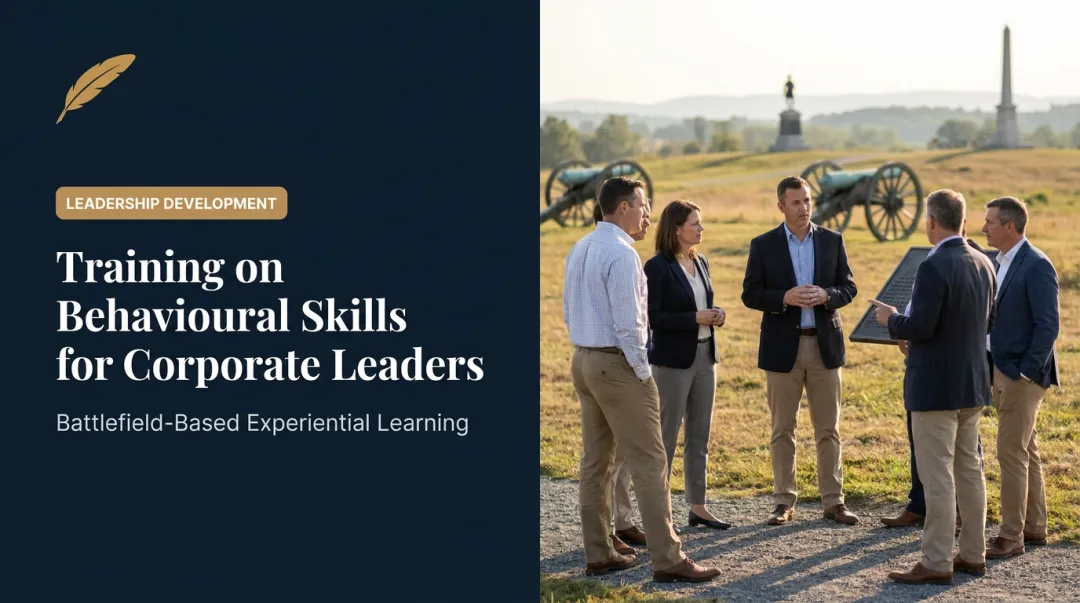
High-stakes historical environments, such as battlefields or crisis simulations, work particularly well because they naturally contain what modern business decisions often lack: ambiguity, incomplete information, and consequences that can't be undone. Leaders can't fake their way through a scenario where the pressure is real.
The Qualities That Make a Good Business Leader — And How Experience Builds Them
Textbooks can define strategic thinking. They can't make you practice it while the clock is running. Experiential formats build five core leadership qualities in ways passive training can't reach.
- Strategic thinking under incomplete information. Immersive scenarios strip away perfect data, forcing leaders to make calls the way they actually have to at work: with partial visibility and real consequences.
- Emotional intelligence and self-awareness. Tools such as EQ-i 2.0 and EQ360 measure growth in self-management and social awareness, replacing guesswork with concrete evidence. Dr. Jared Peatman, the Institute's Director of Curriculum, is certified to administer both assessments.
- Resilience and composure under pressure. Simulated high-stakes stress builds the mental toughness leaders need when an actual crisis lands on their desk.
- Communication and influence. Exercises that require rallying a team or negotiating in real time develop influence skills no lecture can replicate.
- Values-based, ethical decision-making. Examining historic leadership dilemmas helps leaders internalize integrity and a service-driven mindset, translating directly into modern ethical judgment calls.
None of these qualities develop through observation alone. They require the leader to be the one making the decision, feeling the pressure, and living with what comes next.
How to Develop Business Leaders Through Experiential Learning
A single immersive event won't create lasting change on its own. Organizations that see real results follow a structured, repeatable sequence.
Step 1: Assess Current Leadership Levels and Gaps
Emerging leaders, mid-level managers, and executives face different pressures, so their development needs differ too. A first-year supervisor typically needs practice making decisions with incomplete information, while a vice president needs to stress-test long-term strategic judgment under organizational pressure.
Segmenting leaders by tenure and responsibility before choosing a program ensures the experience matches what each group needs to practice. Lincoln Leadership Institute addresses this through three enrollment models — open enrollment cohorts for a handful of rising leaders, private team experiences for intact departments, and multi-year enterprise partnerships for large-scale succession planning — each calibrated to a different leadership stage.
Step 2: Choose an Immersive, High-Stakes Learning Environment
Not every format fits every audience. Look for three criteria: realism, relevance to the organization's actual challenges, and psychological safety to fail without real-world damage.
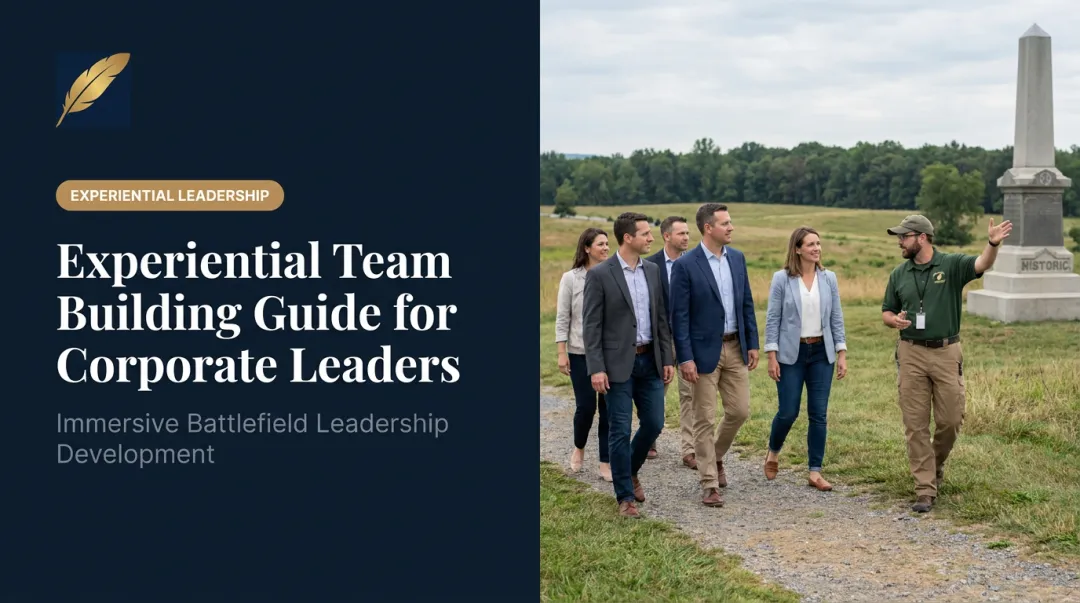
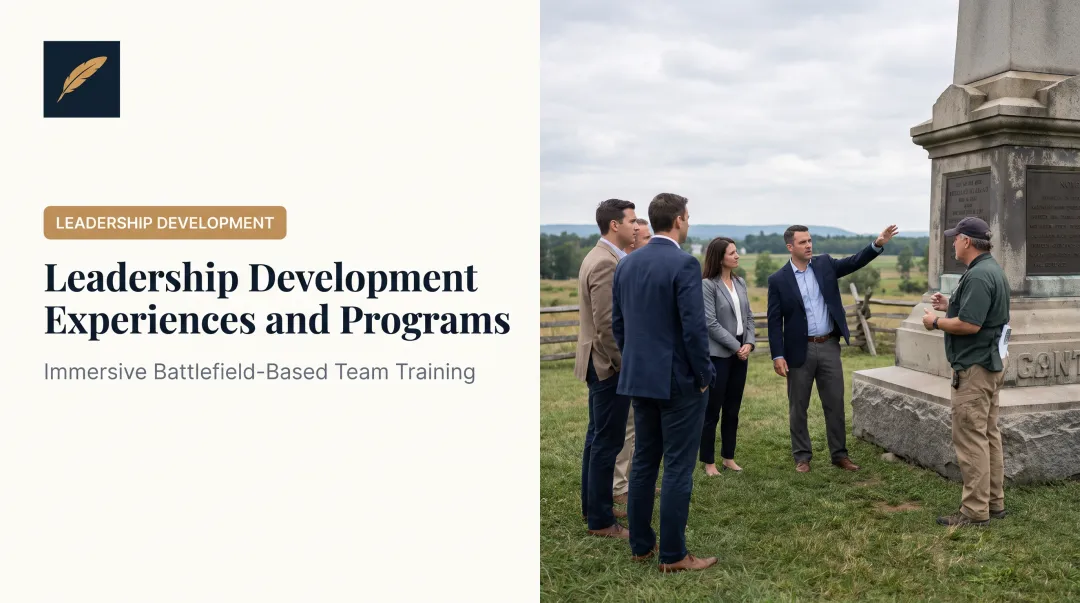
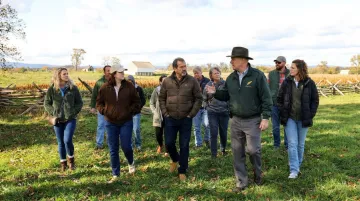
At Gettysburg, Normandy, or Pearl Harbor, leaders walk the same terrain where commanders made irreversible decisions under fire — a physical, high-stakes stand-in for the choices they'll face back in the boardroom. A program that checks all three criteria lets leaders take genuine risks and learn from the outcome, rather than sitting through a lecture about risk.
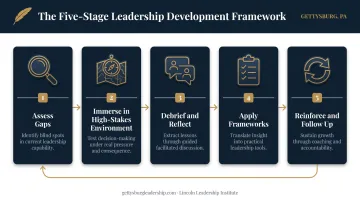
Step 3: Facilitate Structured Reflection and Debrief
The activity itself isn't the lesson. Guided debriefs and facilitator-led discussion are what turn an experience into something a leader can carry back to the office.
Faculty who have led under pressure themselves, including retired Navy SEALs, Army colonels, and federal executives, bring a level of credibility to these conversations that a standard corporate trainer can't replicate. Skip this step, and the experience becomes a memorable outing with no lasting behavior change.
Step 4: Translate Insights into Actionable Frameworks
Inspiration fades fast without a tool to apply it. Effective programs hand participants practical frameworks they can use the following Monday, not just a story they'll tell at the next team meeting.
This might include a validated tool such as the EQ-i 2.0 emotional intelligence assessment, a decision-making model drawn from historical case studies, or credentialed coursework like a Purdue University-backed leadership certificate. The goal is a takeaway leaders can point to, not just an experience they remember fondly.
Step 5: Reinforce Through Follow-Up and Accountability
Behavior change doesn't happen in a single weekend. Post-program coaching, credentialing, and periodic check-ins keep the lessons alive months after the initial experience ends.
Digital credential badges that leaders can display on LinkedIn add a layer of accountability, since the certification signals a specific, verifiable commitment to their team. Programs without this follow-through risk fading into a distant memory within weeks.
Popular Experiential Learning Formats for Leadership Development
Organizations have several proven formats to choose from, each suited to different goals and budgets.
- Business simulations and case-based role-play, which corporate training providers use to mirror strategic decision-making without real-world risk
- Outdoor and physical challenge programs, which build teamwork and resilience by putting participants under genuine physical and mental stress
- Historic-site and battlefield immersion programs, which uniquely combine real historical stakes with facilitated leadership frameworks
That third category deserves a closer look, since it blends realism with structure in a way few other formats can match.
Real-World Example: How Lincoln Leadership Institute Applies Experiential Learning
Lincoln Leadership Institute takes leaders out of the boardroom entirely. Programs run at Gettysburg, Normandy, Pearl Harbor, and the Alamo, each site chosen for a distinct leadership lesson:
| Location | Core Focus |
|---|---|
| Gettysburg, PA | Decision-making and communication under pressure |
| Normandy, France | Strategic planning and alliance-building |
| Pearl Harbor, HI | Crisis management and calm in chaos |
| The Alamo, TX | Courage, resilience, and perseverance |
Faculty include retired Navy Rear Admiral Scott Moore, Command Master Chief and Navy SEAL Dave Cooper, Colonel (Ret.) Mark Erwin, Emmy Award-winning journalist Dennis Owens, and Ph.D. historians including Dr. Jared Peatman.
This blend of military command experience and academic rigor, sharpened by seasoned crisis-communication expertise, is what translates battlefield decision-making into frameworks executives can actually use.
The Institute also partners with Purdue University Global to offer an accredited Leadership Excellence Certificate Program, giving participants a formal credential alongside the experiential work.
That credibility is backed by scale. Over more than 25 years, Lincoln Leadership Institute has worked with 25,000+ Fortune 1000 and public sector clients, including Pfizer, FedEx, GE, and the Department of Defense, and has transformed more than 40,000 leaders.
Frequently Asked Questions
How do you develop business leaders?
Follow an assess-immerse-debrief-apply framework: diagnose leadership gaps, place leaders in a realistic high-stakes scenario, guide structured reflection, and give them tools to apply immediately. Passive training alone rarely produces lasting change.
What qualities make a good business leader?
Strategic thinking, emotional intelligence, resilience under pressure, strong communication, and ethical decision-making. Experiential formats develop all five faster than lecture-based training because leaders practice them under real conditions.
What is experiential learning in leadership development?
It's learning through direct, real-stakes experience followed by structured reflection, rather than passive absorption of information. Kolb's four-stage cycle (experience, reflection, conceptualization, and experimentation) describes how the process works.
How long does it take to see results from experiential leadership training?
Immersive programs can shift mindset within days, but lasting behavior change typically takes months of reinforcement through coaching, follow-up, and continued practice back on the job.
Is experiential leadership training worth the investment?
Yes. Gallup's research links manager development to up to 18% higher team engagement and 21%-28% lower turnover. It also signals to high-potential talent that the organization is investing in their growth.
What industries benefit most from experiential leadership development?
Corporate, public sector, healthcare, financial services, and technology organizations all use it, particularly for high-potential and executive-level leaders facing high-stakes, high-ambiguity decisions.