Many organizations default to standard team-building activities — escape rooms, cooking classes, the occasional round of golf. These build morale. They rarely build the decisive, values-based leadership skills executives actually need when the stakes are real and the data is incomplete.
Executive development remains a genuine budget priority: **69% of organizations now offer dedicated executive development programs**, according to ATD's 2025 State of the Industry report. The question isn't whether to invest. It's which format actually changes behavior.
This guide covers five proven executive retreat formats, how to match one to your team, and how to measure whether it worked.
Key Takeaways
- Executive retreats should prioritize strategic thinking and character-building, not entertainment
- Five formats exist: historic immersion, strategic offsites, adventure, EQ/coaching, and wellness retreats
- Format choice depends on leadership maturity, team goals, and measurable outcomes
- Track post-retreat behavior change to justify continued investment to your board
Why Executive Leadership Retreats Are Different From Standard Team Off-Sites
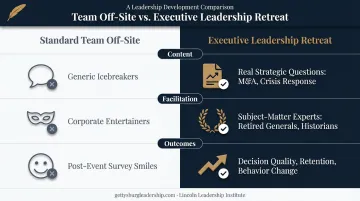
A standard team off-site aims to build rapport. Executives already know each other — what they need is a shared framework for making high-stakes calls when the outcome affects thousands of employees.
Executive leadership retreats differ in three concrete ways:
- Content: Built around real strategic questions (market entry, restructuring, crisis response) rather than generic icebreakers
- Facilitation: Led by subject-matter experts (military commanders, coaches, historians), not corporate entertainers
- Outcomes: Measured in decision quality, retention, and behavior change, not post-event survey smiles
Corporate spending backs this distinction. Management and supervisory training claimed 13% of total U.S. training budgets in 2024-2025, tied for the largest content-area share, alongside that 69% executive-development adoption rate. That's a lot of budget riding on programs that need to do more than build camaraderie.
The sections below break down the five retreat formats best suited to senior leadership teams, from historic battlefield immersion to wellness-focused resilience programs.
Top Company Retreat Ideas for Executive Leadership Teams
The best options share four traits: strategic relevance, experiential depth, faculty expertise, and outcomes you can measure — not novelty for its own sake.
Historic Battlefield Leadership Immersion
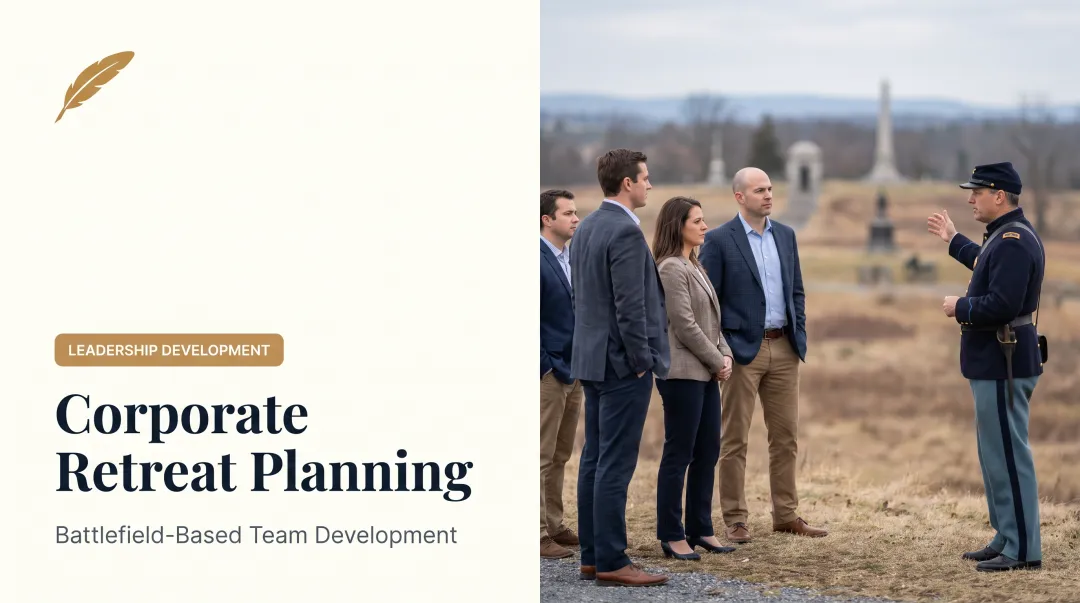
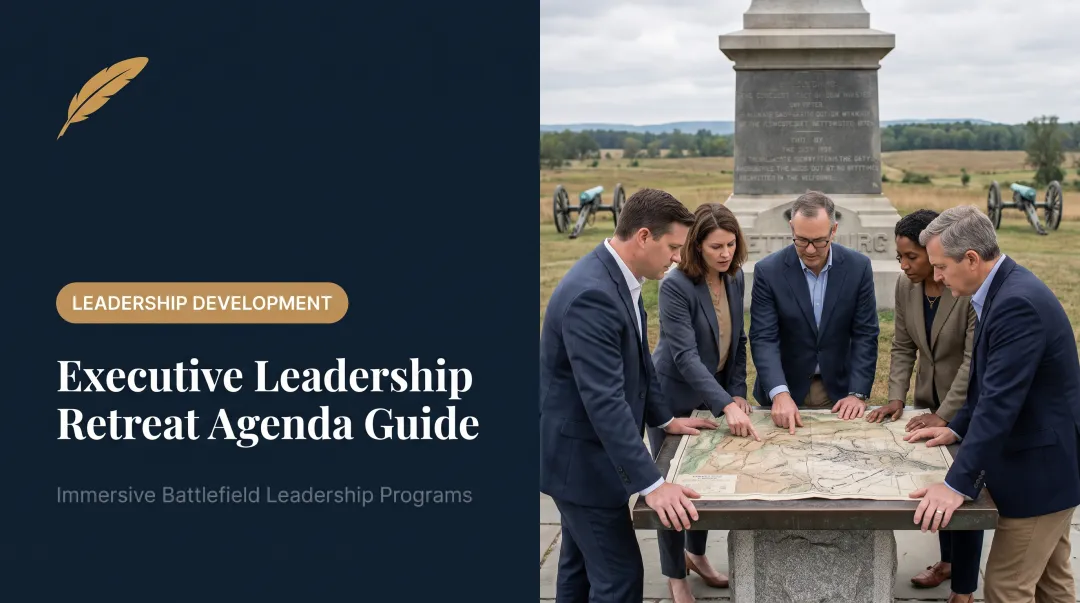
Historic battlefield immersion places executives on the actual ground where history's highest-stakes decisions were made, then asks them to work through analogous scenarios in real time. The Lincoln Leadership Institute has run this model for more than 25 years at Gettysburg, Normandy, Pearl Harbor, and the Alamo.
What sets it apart:
- Faculty includes retired Generals and Admirals, a 30-plus-year Naval Special Warfare veteran, and a Navy SEAL since 1988
- Ph.D. historians who've spent careers studying the exact battles being taught
- Programs incorporate EQ-i2.0 and EQ360 emotional intelligence assessments
- Participants can earn a Leadership Excellence Certificate through a Purdue University Global partnership, a credential shareable on LinkedIn
| Attribute | Details |
|---|---|
| Format & Duration | Multi-day immersive journeys (2.5+ days), one-day leadership summits, or virtual Lincoln Leadership Live sessions |
| Key Focus Areas | Decisive leadership under pressure, values-based decision-making, strategic vision, resilience and courage |
| Ideal For | C-suite teams, high-potential leader cohorts, Fortune 1000 and public sector organizations |
Strategic Vision & Off-Site Planning Summits
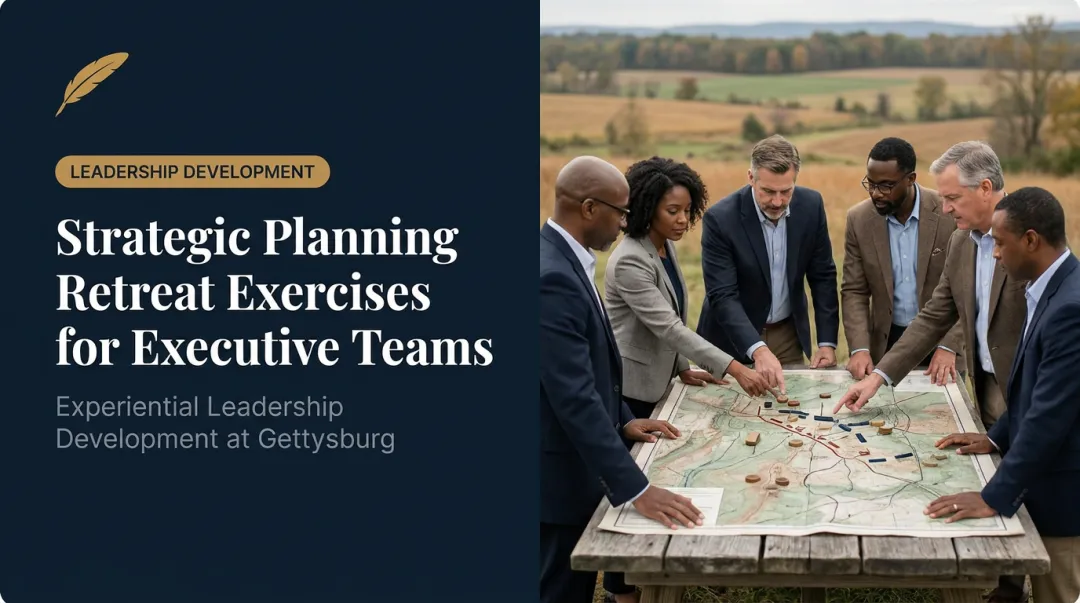
Strategic offsites carve out dedicated time, away from inboxes and daily fires, to define long-term vision, set OKRs, and align the executive team on direction. Done well, they focus only on decisions that require the whole leadership team's input — not status updates any one person could send by email.
These sessions typically involve outside strategy facilitators, sometimes paired with executive coaching afterward to keep commitments on track. The strongest ones circulate pre-reading materials in advance, so debate time isn't wasted on background.
| Attribute | Details |
|---|---|
| Format & Duration | Typically 1-3 day facilitated sessions at a neutral offsite venue |
| Key Focus Areas | Long-term strategy alignment, prioritization, cross-functional buy-in |
| Ideal For | Leadership teams undergoing growth, restructuring, or M&A transitions |
Outdoor Adventure & High-Stakes Team Challenges
Rock climbing, whitewater rafting, and wilderness survival exercises push executives past their comfort zones into unscripted decision-making. The goal: build trust and risk tolerance under real physical and mental stress, not simulated pressure.
The evidence here is promising but mixed. A 2024 case study of a nine-person team found meaningful confidence gains after a five-day outdoor program. A separate 2025 evaluation of 27 participants found no measurable change in workplace performance or engagement. Treat outdoor formats as a strong trust-building tool, not a guaranteed performance fix.
| Attribute | Details |
|---|---|
| Format & Duration | Half-day to multi-day outdoor expeditions |
| Key Focus Areas | Risk management, trust-building, adaptive decision-making |
| Ideal For | Teams needing to rebuild trust or improve cross-functional collaboration |
Executive Coaching, EQ & 360-Degree Assessment Retreats
These retreats combine one-on-one or group executive coaching with EQ and 360-degree feedback assessments, turning abstract feedback into a concrete development plan. Differentiators include personalized action plans, validated psychometric tools, and coaching support that continues after everyone goes home.
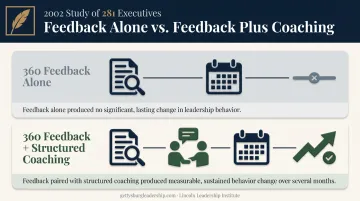
Feedback alone rarely changes behavior. A 2002 study of 281 executives found real gains only when 360 assessments were paired with structured coaching sessions over several months. Don't hand someone a feedback report and call it development: build in discussion and follow-through.
| Attribute | Details |
|---|---|
| Format & Duration | 1-2 day intensive sessions with pre/post individual coaching |
| Key Focus Areas | Self-awareness, emotional intelligence, interpersonal influence |
| Ideal For | Leaders transitioning to new roles or teams with interpersonal friction |
Wellness, Resilience & Mindfulness Retreats for Leaders
These retreats address executive burnout directly through yoga, meditation, sleep coaching, and nutrition guidance, with a goal of sustainable performance rather than spa-day indulgence.
The need is real. 71% of leaders reported significantly higher stress over the prior year, according to DDI's 2025 research on burnout, and more than half of that group were concerned about burnout specifically.
Ignoring it shows up as turnover: nearly 70% of C-suite respondents in one industry survey said they'd consider leaving for a role that better supported their well-being.
| Attribute | Details |
|---|---|
| Format & Duration | 1-3 day wellness-focused retreats at spa or nature-based venues |
| Key Focus Areas | Stress management, sustainable high performance, mental clarity |
| Ideal For | Leadership teams showing signs of burnout or decision fatigue |
Measuring the Impact of an Executive Leadership Retreat
A retreat without pre-defined KPIs is just an expensive few days away from the office. Before anyone books flights, define what success looks like: faster decision cycles, improved retention among high-potential leaders, or measurable gains in team performance.
Effective measurement follows a chain, not a single survey:
- Baseline – Document current behavior and business metrics before the retreat
- Reaction and learning – Capture immediate feedback and knowledge gained
- Application – Track whether new behaviors show up 30-90 days later
- Business impact – Connect the program to retention, productivity, or decision quality
- ROI – Isolate the program's contribution from other factors before claiming credit
This full chain matters because reaction alone doesn't predict whether leaders actually changed how they operate day to day.
Tracking behavior change closes one loop, but boards and executives also want proof they can point to and share. Credentials meet that need by turning abstract development into something concrete. The Lincoln Leadership Institute's Leadership Excellence Certificate, issued in partnership with Purdue University Global, works this way: participants earn a verified digital badge they can display on LinkedIn. That badge turns a multi-day experience into documented evidence of leadership investment.
Boards want proof, not anecdotes. A well-measured retreat delivers three proof points:
- A shareable credential
- A documented behavior-change plan
- A 90-day follow-up review
This combination is far easier to justify than success measured solely by attendee enthusiasm.
How to Choose the Right Retreat Format for Your Leadership Team
The most common mistake? Picking a format because it's trendy or fun, then hoping leadership skills follow. Match the format to your team's actual situation instead.
Factors to Weigh Before Committing
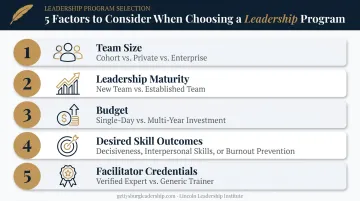
Consider these five factors before locking in a format:
- Team size – Open-enrollment cohorts (3-5 leaders) suit smaller groups testing a new approach, while private formats (8-20 participants) fit a full leadership team and enterprise partnerships suit multi-year pipelines across dozens of leaders
- Leadership maturity – New leadership teams may need trust-building through adventure challenges; established teams facing a specific decision need strategic planning summits instead
- Budget – Multi-day immersive and enterprise programs require greater investment than a single planning day
- Desired skill outcomes – Decisiveness under pressure calls for a different format than interpersonal friction or burnout prevention
- Facilitator credentials – A retired Admiral or Ph.D. historian brings different value than a generic corporate trainer. Verify expertise before signing a contract
Organizations testing a new leadership development partner often start with a smaller open-enrollment cohort before committing a full executive team to a private, fully customized experience. That lower-risk entry point lets HR and L&D leaders confirm fit before scaling further.
Conclusion
The right executive retreat format maps directly to your organization's strategic goals, leadership maturity, and the specific behaviors you need to change, not to review scores or scenic backdrops.
Before committing, weigh long-term impact against cost. A one-day summit might sharpen communication skills; a multi-year enterprise partnership might rebuild an entire leadership pipeline. Neither is inherently better — the right choice depends on what your board needs to see next quarter and next year.
Organizations from Pfizer to FedEx, GE, the Department of Defense, and the US Treasury have chosen historically grounded, experiential leadership development because it produces leaders who can make hard calls under real pressure. If your team needs that same battle-tested foundation, the Lincoln Leadership Institute's programs at Gettysburg, Normandy, Pearl Harbor, and the Alamo deliver it firsthand.
Frequently Asked Questions
What to do at a company retreat?
Focus on workshops, strategic planning exercises, and team challenges tailored to leadership-level goals rather than generic icebreakers. The best agendas mix facilitated discussion, decision-making scenarios, and time for reflection.
How much does a company retreat cost?
Costs vary widely based on duration, location, and facilitator expertise. Executive-level programs with specialized faculty, such as retired military leaders or Ph.D. historians, typically involve a higher investment than a standard team outing.
Are company retreats still a thing?
Yes. Hybrid work keeps teams apart most of the week, making in-person connection more intentional. Gallup research shows 55% of remote-capable employees rank relationship-building as their top reason to work on-site.
How long should an executive leadership retreat be?
Options range from one-day leadership summits to multi-day immersive programs lasting 2.5 days or more. The right length depends on your goals, team size, and how deep the desired behavior change needs to go.
What is the difference between a team-building retreat and a leadership development retreat?
Team-building retreats focus on morale and casual bonding. Leadership development retreats build decisive, values-based skills through strategic, experiential learning designed specifically for senior leaders.
How do you measure ROI from an executive retreat?
Track pre- and post-retreat KPIs tied to retention, decision-making speed, or performance. Follow up at 30-90 days to confirm behavior change actually stuck, not just event-day enthusiasm.