Yet "build trust" remains one of the most repeated, least actionable pieces of leadership advice out there. Be authentic. Communicate openly. Show up as your true self. None of that tells a manager what to actually do on a Tuesday afternoon when a project is behind schedule and nobody wants to admit why.
Many leaders also conflate psychological safety with trust itself. They're related, but they're not the same thing. This guide breaks down what trust actually consists of, a concrete framework to build it, the mistakes that quietly sabotage it, and how to repair it once it's broken.
Key Takeaways
- Trust shows up in four behaviors: confidence, openness, disagreement, and owning mistakes
- The Trust Equation (Credibility, Reliability, Intimacy, Self-Orientation) gives leaders a practical diagnostic
- Building trust takes deliberate, repeatable practices, not good intentions alone
- Most trust failures start with generic advice or leaders who do not model openness
- Broken trust can be repaired through structured dialogue or an immersive reset experience
How to Build Trust in High-Performing Teams
Trust doesn't accumulate by accident. High-performing teams treat it as infrastructure, something built deliberately before the pressure hits, not something they hope shows up once a deadline arrives.
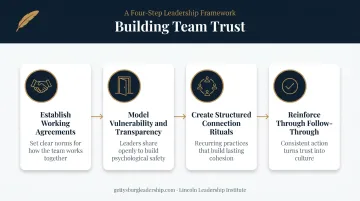
Step 1: Establish How You'll Work Together Before Starting
Before a new team dives into a project, the best ones have what author Michael Bungay Stanier calls a Keystone Conversation: a deliberate discussion covering strengths, communication preferences, and lessons from past collaborations, both good and bad. The goal is a relationship that's safe, vital, and repairable.
Five questions anchor it:
- What's your best? (strengths and working style)
- What are your practices and preferences?
- What worked in past collaborations?
- What went wrong in past ones, and why?
- How will we fix it when things go wrong here?
This isn't a nice-to-have. Ron Friedman's research for ignite80, published in HBR, found that members of high-performing teams were more than three times as likely to discuss how they'd work together before starting a project, compared to average teams.
Friedman defined "high-performing" strictly: teams that rated both their effectiveness and industry-relative performance a perfect 10 out of 10.
Step 2: Model Vulnerability and Transparency First
Leaders have to go first. Amy Edmondson's foundational research on psychological safety, which surveyed 51 work teams, found that teams willing to acknowledge fallibility and ask questions learned faster and performed better as a result.
A concrete practice: in your next team meeting, share a recent misstep. Not a humble-brag disguised as a mistake, an actual one. Then ask "what did we learn?" instead of assigning blame. That single question reframes error as data instead of a verdict.
Step 3: Create Structured Rituals for Connection and Accountability
Regular huddles or check-ins build clarity on commitments and keep accountability visible over time. But standard icebreakers rarely move the needle much. Trust-fall exercises and trivia nights create pleasant memories, not durable trust.
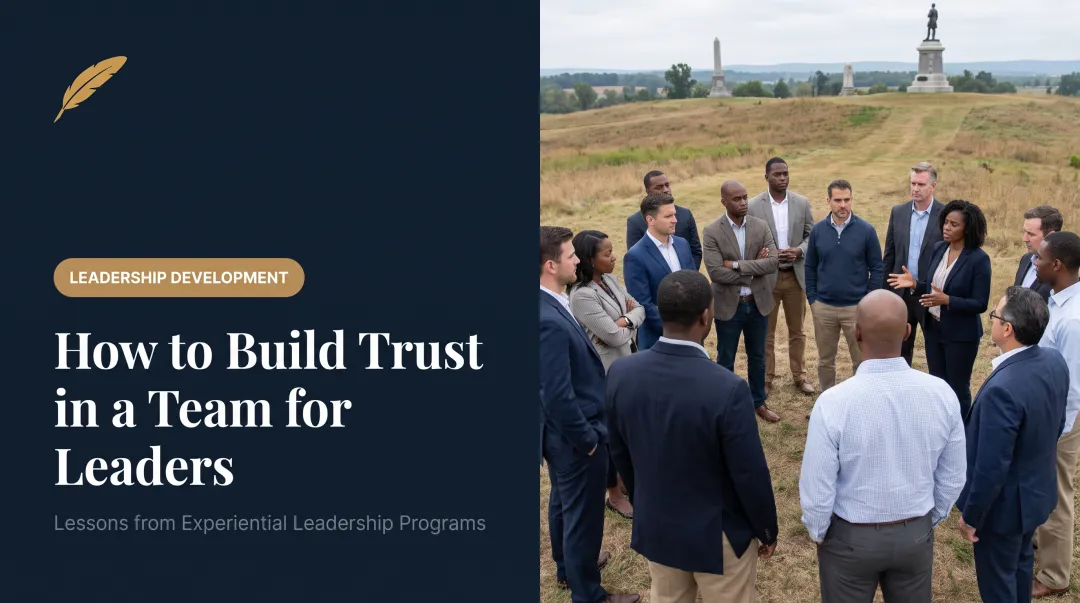
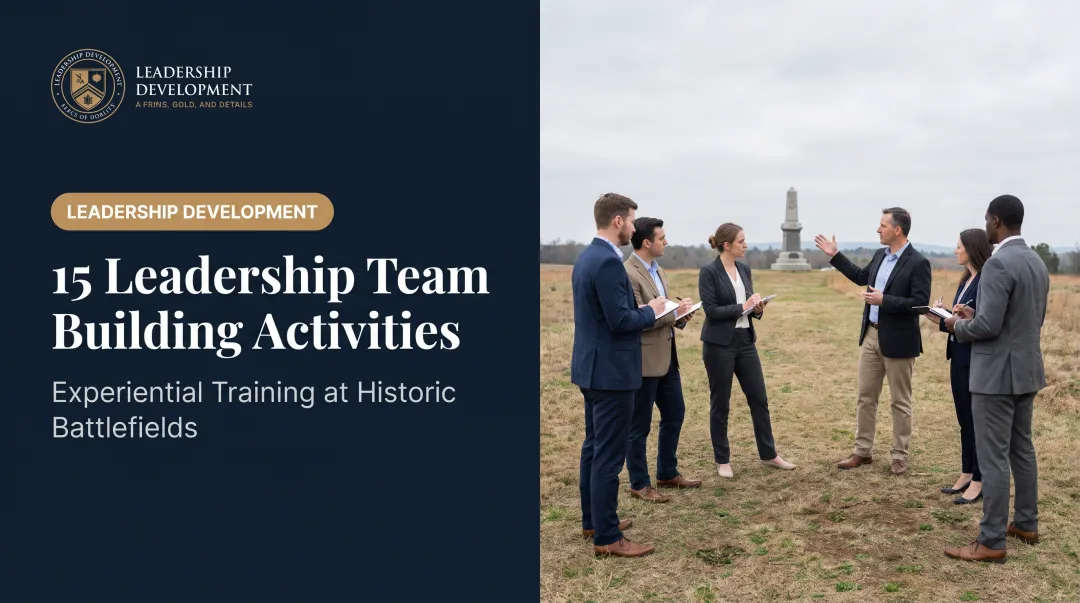
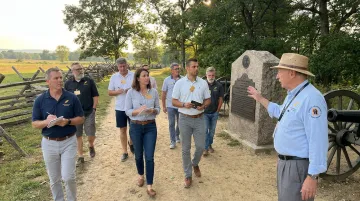
This is where immersive, experiential formats do something different. At Lincoln Leadership Institute, teams work through historic battlefield scenarios at Gettysburg, Normandy, and Pearl Harbor, places where leaders faced incomplete information and irreversible consequences.
Walking a team through those same decision points, under a licensed battlefield guide, compresses months of trust-building into a few days. The stakes feel real, even decades or centuries after the events unfolded.
Step 4: Reinforce Trust Through Consistent Follow-Through
Trust erodes fast when words and actions drift apart. If a deadline slips, say so early and explain why. If plans change, explain the change before someone notices on their own.
Two habits matter here: share credit publicly rather than absorbing it individually, and address tension immediately when something feels off with a colleague, rather than letting it fester.
High-performing teams don't wait for a formal review cycle to clear the air. They reach out the moment something feels wrong.
The Trust Equation: Four Components Every Leader Must Build
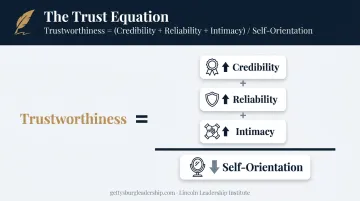
Trust isn't one trait. It's a combination of measurable factors, first laid out in the 2000 book The Trusted Advisor by David Maister, Charles H. Green, and Robert Galford.
The formula: Trustworthiness = (Credibility + Reliability + Intimacy) / Self-Orientation. Some practitioners nickname this the "4 C's," though technically only Credibility starts with a C (the other three are Reliability, Intimacy, and Self-Orientation). Either label works as long as you understand the mechanics.
Credibility
Do people believe you know what you're talking about? Credibility comes from expertise, accurate statements, and a track record teammates can point to.
How to build it: back opinions with evidence or direct experience, and say "I don't know" openly when that's the truth. A manager who admits "I haven't tested this on our legacy systems yet" before a rollout earns more trust than one who bluffs and gets it wrong. Faking competence destroys credibility faster than admitting a gap ever will.
Reliability
Will you actually do what you said you'd do? This is the most transactional of the four, and often the easiest to fix quickly.
How to build it: keep small promises consistently, hit deadlines, and flag delays the moment you see them coming—not the day they arrive.
Intimacy (Connection)
Does it feel emotionally safe to be open with you? This is the component leaders overlook most, mainly because it feels less "businesslike" than the others.
How to build it: use structured personal-sharing exercises, like personal history sharing or "defining moment" discussions, and hold regular emotional check-ins, not just status updates.
Self-Orientation (Care for Others)
Is your attention on yourself or on the team's shared success? This sits in the denominator of the equation, meaning lower self-orientation raises overall trustworthiness.
How to build it: prioritize team wins over individual credit. Ask "how can I help" instead of "what's in it for me," and mean it.
Signs Your Team Needs Active Trust-Building
Trust isn't automatic, even among skilled, experienced professionals. It has to be cultivated deliberately, especially under pressure or change.
Watch for these warning signs:
- Knowledge hiding - teammates evade questions, play dumb, or give partial answers instead of sharing what they know
- Conflict avoidance - disagreements get suppressed rather than debated openly
- Blame-focused reactions - mistakes trigger finger-pointing instead of problem-solving
- Manager dependency - the team can't resolve disagreements without escalating to leadership
Certain moments make trust-building urgent rather than optional:
- New team formation
- Leadership transitions
- Mergers or acquisitions
- Shifts to remote or hybrid work
These transition points test trust fastest, and the data confirms it. Gallup research shows organizational trust in leadership dropped from 24% to 21% between 2019 and 2022. Teams with leaders who communicated clearly, expressed confidence in the future, and actively supported change saw a different outcome: 95% of employees reported full trust. Treat these moments as trust-building checkpoints built into the transition, not decisions to revisit later.
Common Mistakes Leaders Make When Building Trust
Most trust failures aren't dramatic betrayals. They're small, repeated missteps:
- Relying on generic advice ("be authentic," "communicate openly") without translating it into concrete team practices
- Treating trust as an event: a single offsite or team-building day, rather than an ongoing discipline
- Expecting openness without modeling it: asking the team to flag mistakes openly while the leader never admits one of their own
That third one is the most common, and the most fixable. Teams take their cues from what leaders do, not what they say in the all-hands meeting.
How to Repair Broken Trust on a Team
Trust breaks in different ways, and each pattern needs a different fix.
| Problem | Likely Cause | What to Adjust |
|---|---|---|
| Team withholds information | Past mistake led to blame or punishment | Reframe mistakes as learning; ask directly what would rebuild confidence to speak up |
| Team avoids disagreement | A past conflict turned personal or was poorly managed | Reset ground rules for constructive dissent; leader models respectful disagreement openly |
| Team resists new initiatives | History of over-promising, under-delivering | Rebuild credibility through small, visible commitments over time |
For teams where the damage runs deep, incremental fixes sometimes aren't enough. A facilitated, immersive reset can address root causes that internal workshops tend to miss.
LLI offers two paths depending on the timeline:
- Private Team Experience: A customized program for 8 to 20 participants, designed around the organization's actual trust breakdown—ideal for recurring resistance or communication issues.
- Enterprise Partnership: A multi-year model pairing cohort progression with executive coaching, since repair without follow-through fades within months.
Frequently Asked Questions
How to build trust in a high performing team?
Trust builds through consistent collaboration norms, modeled vulnerability, structured connection rituals, and reliable follow-through. One-off exercises alone won't sustain it: the practices need to repeat.
What is the Trust Equation for building trust?
The Trust Equation includes Credibility, Reliability, Intimacy, and Self-Orientation. Raising the first three and lowering self-focus increases overall trustworthiness.
How long does it take to build trust in a team?
There's no fixed timeline. Trust typically develops through repeated positive interactions over weeks or months, though structured, immersive team experiences can meaningfully accelerate that process.
What is the difference between psychological safety and trust?
Psychological safety describes the team's overall climate: whether it feels safe to speak up. Trust describes the behavioral foundation between individuals that makes that climate possible in the first place.
Can trust be rebuilt after it's broken?
Yes. It requires consistent transparency, directly addressing the root cause, and rebuilding credibility through small, visible commitments over time rather than one grand gesture.
Why do high-performing teams need more trust than average teams?
High-stakes decisions, tight collaboration, and rapid iteration demand deeper trust than average teams require. Without it, teams hesitate to take risks and withhold honest feedback, which slows recovery from mistakes.