Introduction
Most C-suites are not really teams. They're a group of talented individuals who report to the same CEO, defend their own department's turf, and rarely trust each other with the hard truths.
That gap has a cost. Research from the Center for Creative Leadership found that 65% of senior leaders say their leadership team experiences a clash between functional and enterprise-wide accountabilities.
Only 18% rated their own team as "very effective" in its executive responsibilities, even though 97% agreed greater team effectiveness would improve results (CCL, 2020).
Hiring "star" leaders and sending them to individual coaching doesn't fix this. Organizations need dedicated, ongoing development of the executive team as a unit. This article covers what that looks like, the core capabilities behind high-performing teams, and why immersive, real-world experiences accelerate results faster than another conference room.
Key Takeaways
- Executive leadership team development builds shared trust and decision rights, not individual skills
- High-performing teams share five capabilities: role clarity, structured communication, healthy conflict, psychological safety, and EQ
- Effective teams need ongoing investment and measurement, not a one-time offsite
- Immersive, high-stakes learning builds trust and faster decisions better than classroom training
What Is Executive Leadership Team Development?
Executive leadership team development is the deliberate, ongoing process of building a senior team's collective ability to set strategy, make high-stakes decisions, and execute together. It's different from developing any single executive's skills. The unit of change is the whole group, not the individual.
Here's the mindset problem most organizations run into: executives often identify more strongly with their functional department than with the executive team itself. A CFO thinks like a finance leader first, a team member second. A CMO defends marketing's budget before thinking about the enterprise.
That's exactly what CCL's research shows. 65% of leaders report a clash between functional loyalty and enterprise responsibility (CCL, 2020). That clash erodes trust every time a decision gets litigated through a departmental lens instead of a company-wide one.
Closing that gap isn't optional. It's foundational. A team that can't agree on whether a decision belongs to "the company" or "my department" will never move fast, no matter how smart its individual members are.
Executive Team Development vs. Individual Executive Coaching
These two disciplines solve different problems, and confusing them is where most organizations waste their development budget.
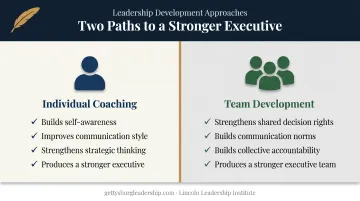
- Individual coaching strengthens one leader's self-awareness, communication style, or strategic thinking, and produces a stronger executive
- Team development strengthens shared decision rights, communication norms, and collective accountability, and produces a stronger executive team
Most companies over-invest in the first and under-invest in the second. The result: a room full of highly coached, highly capable individuals who still can't make a fast decision together.
Why Executive Leadership Team Development Matters
A misaligned executive team doesn't just feel uncomfortable in meetings. It shows up in the business.
- Slower strategic execution, as decisions bounce between silos instead of moving forward
- Inconsistent messaging that cascades through management layers and confuses employees
- Weaker culture at every level, since teams take their cues from how the top team behaves
The data backs this up. McKinsey analyzed 354 executives across 28 top teams and found that companies with aligned, effectively functioning top teams were almost twice as likely to achieve above-median financial performance than those without (McKinsey, 2025).
Within those top teams, the traits most strongly linked to performance were role definition, shared purpose, communication, and psychological safety. None of those are individual skills. They're team-level properties.
There's also a personal payoff. Executives on cohesive teams make decisions faster, with less political maneuvering and less burnout. Fewer meetings become battlegrounds. Fewer decisions get re-litigated in the hallway after the meeting ends. That alone is worth the investment for most leadership teams.
Core Pillars of a High-Performing Executive Team
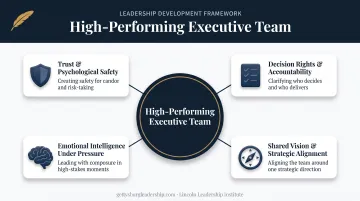
Regardless of industry, research consistently points to a handful of capabilities separating high-performing executive teams from dysfunctional ones. These are measurable, trainable behaviors, not soft skills.
Trust and Psychological Safety
Amy Edmondson's foundational research defines team psychological safety as a shared belief that the team is safe for interpersonal risk-taking. Her study of 51 work teams found that psychological safety predicted learning behavior, which in turn predicted team performance (Edmondson, 1999).
Without it, healthy task conflict about strategy curdles into relationship conflict. Four behaviors tend to drive that shift:
- Criticism that attacks a person rather than the idea
- Defensiveness that shifts blame instead of owning it
- Stonewalling that shuts down the conversation entirely
- Contempt that signals outright disrespect
An executive team that lets these patterns take root stops debating ideas and starts avoiding each other.
Decision Rights, Roles, and Accountability
Top teams need explicit rules for which decisions require full-team input and which belong to one leader alone. Without that clarity, every decision becomes a negotiation, and every negotiation slows the organization down.
Informal, unscheduled conversation matters just as much. The hallway chat or quick call between meetings often moves information faster than the formal weekly meeting ever will.
Decision rules only work when each executive also understands how their role interlocks with their peers'. That means:
- Clear performance expectations tied to enterprise goals, not just departmental metrics
- Visible follow-through when commitments are made in a meeting
- Shared understanding of where one leader's authority ends and another's begins
Emotional Intelligence Under Pressure
Self-awareness and emotional regulation are strong predictors of how well an executive team holds together when the stakes get high. Structured tools like the EQ-i 2.0 and EQ 360 assessments can surface blind spots before they derail team dynamics.
Dr. Jared Peatman, Lincoln Leadership Institute's Director of Curriculum, is certified to administer both instruments. Validated on large normative samples with strong reliability scores, they give teams a credible starting point for harder conversations about how people actually behave under stress.
Shared Vision and Strategic Alignment
A cohesive team operates from one clearly communicated vision, not five department-specific agendas competing for airtime. When priorities aren't shared, every resourcing decision becomes a turf battle instead of a strategic choice. Shared vision shows up in practice when leaders make the same tradeoffs visible, explain them in the same terms, and hold the enterprise goal above any single function's win.
Proven Strategies to Build and Develop Your Executive Team
Building a cohesive executive team isn't a one-time event. It's a practical, ongoing framework you apply consistently over time.
Establish a Regular Meeting Cadence and Ground Rules
Schedule dedicated strategic meetings, separate from operational status updates. These sessions need explicit ground rules for how decisions get made and who has final say. Without that clarity, even well-intentioned meetings drift into status reporting and stall real progress.
Invest Deliberately in Team-Level Development
Teams don't become cohesive by accident. That requires:
- Dedicated time and budget set aside specifically for team development
- Facilitated experiences such as offsites, simulations, and immersive learning (not another slide deck)
- Leadership buy-in that treats this as strategic work, not optional
Build Structured Feedback Loops
360-degree assessments and regular team-effectiveness check-ins surface blind spots before they become crises. Research on team debriefs found they improve effectiveness by roughly 20-25% compared to teams that skip them (Tannenbaum & Cerasoli, 2013). The habit of pausing to ask "how did that go, and why" matters more than most teams realize.
Address Common Obstacles Head-On
Every executive team hits the same roadblocks:
- Senior-level resistance from executives who see development as beneath them
- Time constraints from packed calendars that push team development to "someday"
- The insight-to-behavior gap, when offsite breakthroughs evaporate by Monday morning
Action-learning projects and accountability partners help bridge that last gap by tying insights to a real business problem the team has to solve together.
Measure Progress with Leading and Lagging Indicators
Track both to justify continued investment:
- Leading indicators: engagement survey trends and 360 feedback improvement
- Lagging indicators: retention rates and business performance metrics
Review these on a set cadence so the team can course-correct before small issues compound.
The Experiential Advantage: Why Immersive, Real-World Learning Accelerates Executive Team Development
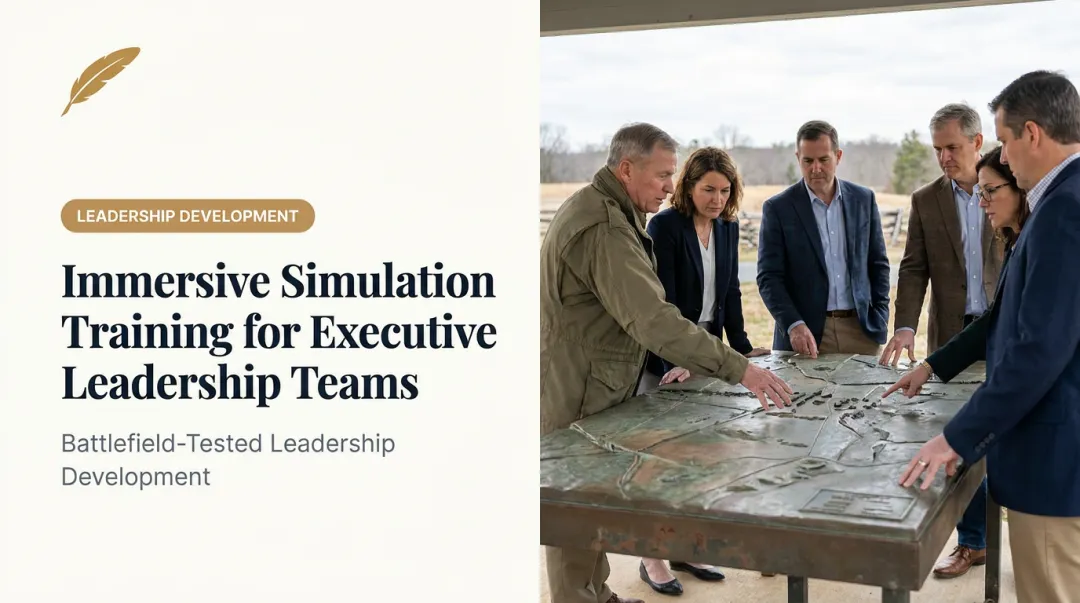
Teams retain and apply lessons more effectively when they're placed in high-stakes, immersive scenarios that mirror the pressure and ambiguity of real leadership decisions than when they're sitting in a conference room reviewing slides.
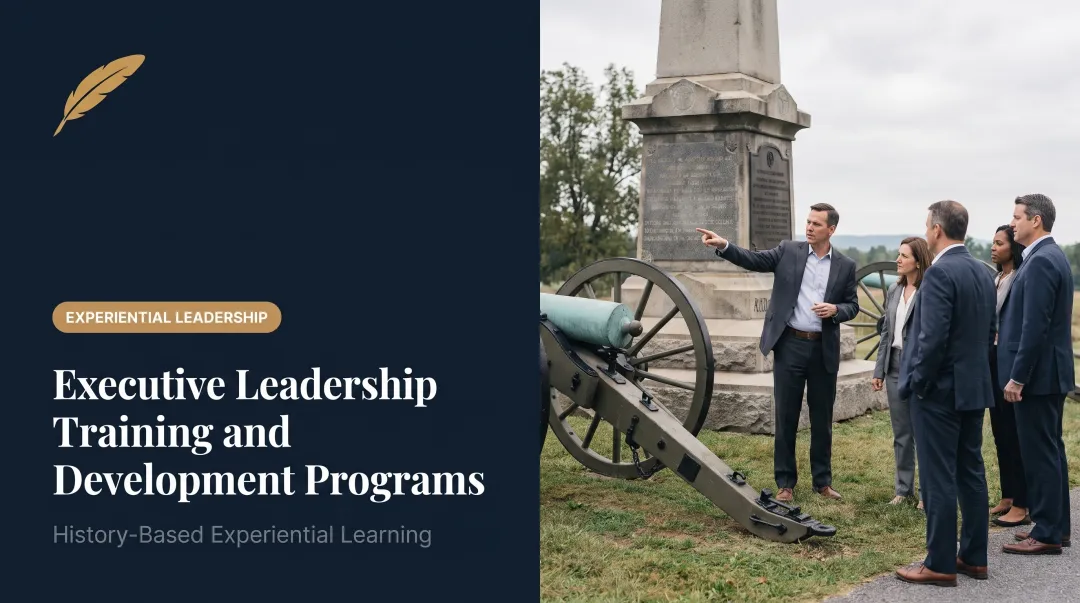
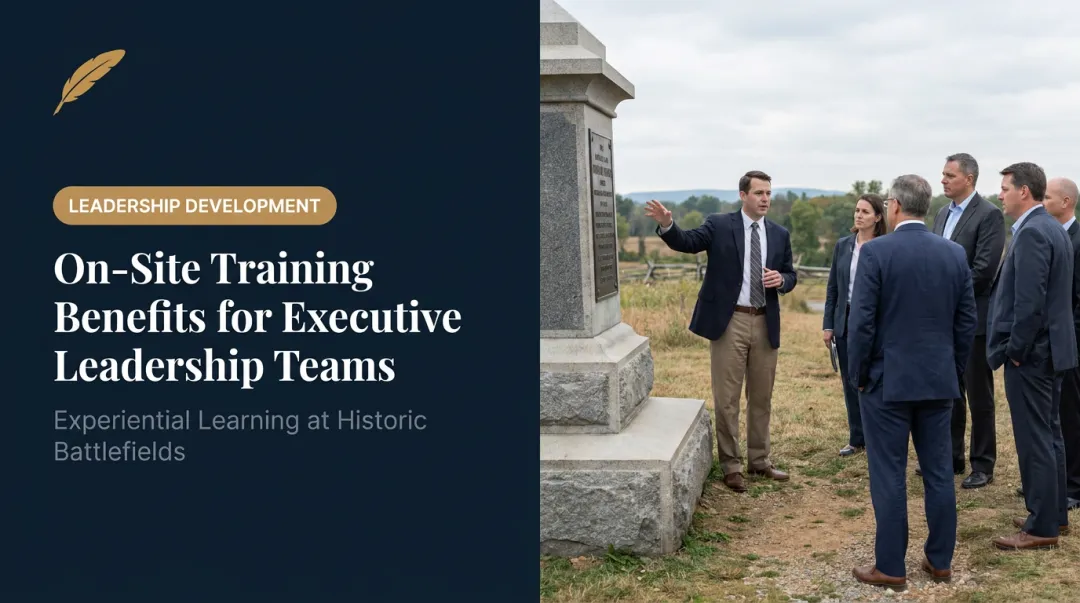
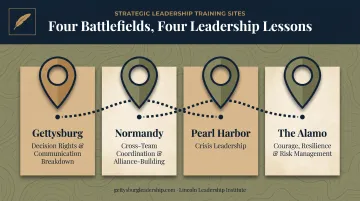
This is the principle behind Lincoln Leadership Institute's approach. Instead of another hotel ballroom, executive teams travel to the actual sites of historic high-stakes decisions:
- Gettysburg — Pickett's Charge as a failed negotiation (~7,500 casualties) and a case study in decision rights and communication breakdown
- Normandy — the largest amphibious invasion in history, used to practice cross-team coordination and alliance-building
- Pearl Harbor — decisive leadership calls in the middle of a catastrophic, unfolding crisis
- The Alamo — courage, resilience, and risk management when the odds look impossible
Faculty guiding these sessions include retired military leaders like Admiral Scott Moore and Colonel Mark Erwin, Navy SEAL Dave Cooper, and historians such as Dr. Jared Peatman and Dr. Judy Morley. Standing on the ground where a decision actually happened forces a different kind of engagement than reading about it in a case study.
That immersion builds trust, communication, and decision-making under pressure faster than a conventional classroom. The setting is historical, but the stakes feel real.
Teams that want to formalize the learning can add the Leadership Excellence Certificate Program, offered in partnership with Purdue University Global, and turn the experience into an accredited credential.
Frequently Asked Questions
What are the 5 C's of leadership development?
There's no single universal framework, but one widely cited version highlights character, communication, competence, collaboration, and commitment. Each supports executive team cohesion by reinforcing trust, clarity, and shared accountability.
What are the 5 stages of team development?
Tuckman's model describes forming, storming, norming, performing, and adjourning. Executive teams cycle through these stages repeatedly whenever membership or strategy shifts, not just once at formation.
How is executive team development different from individual leadership coaching?
Coaching builds one leader's individual skills. Team development builds shared trust, decision rights, and communication norms across the entire senior team: a group-level outcome, not a personal one.
How long does it take to build a high-performing executive team?
Timelines vary by team. Consistent investment through regular meetings, structured feedback, and periodic immersive experiences over months to a few years produces measurable gains in cohesion and performance.
What is the ROI of investing in executive leadership team development?
Organizations typically track improved retention, faster strategic execution, and stronger succession pipelines as the primary measurable returns, alongside qualitative gains in trust and decision speed.
How often should executive teams participate in dedicated development experiences?
A blend works best: weekly or monthly strategic meetings paired with deeper immersive experiences once or twice a year. That rhythm sustains and deepens team cohesion over time.