The problem usually isn't a lack of effort. It's a lack of structure. Many organizations schedule one-off workshops, bring in a motivational speaker once a year, and call it "leadership development." Without a connected framework tying those activities to business outcomes, budgets get spent and leaders still show up unprepared for the moment that matters.
This article breaks down what a leadership development framework actually is, the components that make one work, how popular models compare, and a step-by-step process for building your own. We'll also look at why experiential learning has become a critical piece of the puzzle.
Key Takeaways
- 90% of organizations operate below full leadership-development maturity, per Brandon Hall Group research
- Frameworks tie leadership growth directly to business strategy, not generic skill-building
- Strong frameworks unite competencies, levels, assessments, methods, and metrics into one system
- Less than 30% of trained skills get applied on the job without deliberate reinforcement
- Experiential, high-pressure learning builds decisiveness lectures rarely produce
What Is a Leadership Development Framework?
A leadership development framework is a structured, organization-wide roadmap for building leadership capability, not a single training event. It identifies what your organization needs from its leaders now and in the future, then builds a system to get them there.
A solid framework typically weaves together five elements:
- Defined leadership competencies (the skills that matter)
- Leadership levels or tiers (emerging, mid-level, senior, executive)
- Assessment tools to benchmark ability
- Development pathways (coaching, training, stretch assignments)
- Success metrics to track progress
Framework vs. Strategy vs. Program
These three words get used interchangeably, and that's where confusion creeps in.
- Framework: the blueprint—the structural system of competencies, levels, and pathways.
- Strategy: the overarching plan for how the organization will use that framework to meet business goals.
- Program: a specific initiative run inside the framework, such as a coaching series or a three-day immersive experience.
A framework without a strategy is just a chart on a slide. A program without a framework is an isolated event with no lasting connection to the next one.
Generic, off-the-shelf frameworks tend to underperform because they aren't tied to a specific business context: digital transformation, market expansion, culture change, or whatever your organization is actually navigating.
That disconnect matters more than most people realize. Less than 30% of learning gets applied on the job, according to the Association for Talent Development. The rest is wasted training spend.
A good framework also isn't static. It's a living document, revisited and adjusted as business needs shift and feedback rolls in, not something built once and shelved.
Why a Leadership Development Framework Matters
A framework does three things a scattered training calendar cannot.
It aligns leadership growth with business priorities. Instead of generic skill-building, every development dollar maps to a specific performance outcome the organization actually needs.
It creates consistency across the organization. Whether a leader sits in headquarters or a satellite office, a framework ensures they get the same quality of development. That consistency supports fairness and broader DEI goals rather than leaving growth to chance or manager preference.
It builds an internal pipeline that reduces succession risk. Harvard Business Review's analysis found that external CEO hires received 15% more pay and had an 84% greater chance of turnover within their first three years compared to internal promotions. Across 17 years of data on U.S. public firms, only 39% of outsider CEO hires outperformed a theoretical insider.
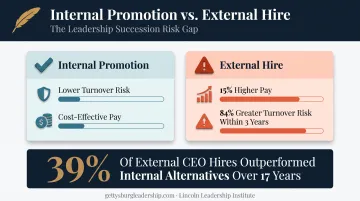
Outside hires can still make sense. HBR's own data shows they add value when a company is genuinely struggling. But for organizations performing reasonably well, betting the top job on an external unknown is a costly gamble compared to growing your own bench.
Core Components of an Effective Leadership Development Framework
Leadership Competencies
Competencies define the specific, observable behaviors leaders need: strategic thinking, emotional intelligence, decision-making, communication. DDI's leadership competency framework insists these be written as measurable actions, not abstract values. They should also be used consistently across hiring, promotion, and development decisions rather than siloed into a training binder.
Leadership Levels
Not every leader needs the same development. Frameworks typically segment leaders into tiers:
- Emerging leaders (new or first-time managers)
- Mid-level leaders (managing managers)
- Senior leaders (functional or divisional heads)
- Executive leaders (enterprise-wide accountability)
Each tier applies the same core competencies differently. Communication matters to a frontline supervisor and a CEO, but the stakes and audience change completely.
Assessment Methods
You can't develop what you haven't measured. 360-degree feedback and validated psychometric tools benchmark where a leader stands today. Emotional intelligence assessments like the EQ-i 2.0 and EQ360 are common choices here. Lincoln Leadership Institute's Dr. Jared Peatman, for example, is certified to administer both, giving organizations a clear read on emotional intelligence gaps before they design a development path.
Blended Development Methods
No single method builds a leader. Effective frameworks blend:
- Coaching: one-on-one guidance tied to real challenges
- Mentoring: relationship-based knowledge transfer
- Formal training: structured skill-building sessions
- Stretch assignments: real responsibility beyond current comfort
- Immersive experiential learning: high-stakes, decision-forcing simulations
Metrics and ROI Tracking
Frameworks need KPIs: promotion rates, retention, engagement scores, leadership-readiness scores. A 2015 peer-reviewed study of 191 middle managers across eight county human-service agencies found mean self-efficacy scores rose from 21.91 to 23.16 over 12 months. Fully 83.2% of participants reported improved leadership performance after a structured, multi-method program that combined training days, 360 feedback, coaching, and follow-up.
Career Pathways and Succession Integration
Once competencies and levels are defined, they become the backbone of succession planning. Clear pathways let organizations identify who's ready for what role and when, turning development from a nice-to-have into a pipeline strategy.
Popular Leadership Development Models to Draw From
The 70-20-10 Model
The Center for Creative Leadership's research suggests leadership growth breaks down roughly as:
- 70% challenging on-the-job experience
- 20% developmental relationships (coaching, mentoring, peer learning)
- 10% formal coursework and training
CCL frames this as a guideline, not a rigid budget. Classroom learning alone won't build a leader — real experience and relationships have to carry most of the weight. That experience-heavy mix is why immersive programs — including history-based fieldwork — often outperform lecture-only curricula when the goal is lasting behavior change.
The Current-to-Future State Approach
Rather than a single named model, many frameworks use a straightforward needs-assessment logic: map where leaders stand today, define where the business needs them to be, and build the bridge between the two. This typically plays out across three lenses:
- Preparing emerging leaders for new roles
- Sharpening current leaders' immediate capabilities
- Equipping leaders for strategic shifts ahead
Competency-Tiered Frameworks
Competency-tiered models define the observable skills and behaviors expected at each leadership level — front-line, mid-level, and executive — so development targets stay concrete. Providers such as DDI popularized this approach; many L&D teams adapt the idea with their own leveled competency maps.
Most organizations don't adopt one model wholesale. They blend elements — 70-20-10's experience ratio, leveled competencies, and a current-to-future gap analysis — around their leadership bench and business context. Fit beats purity: choose the pieces that close your specific capability gaps.
How to Build a Leadership Development Framework: A Step-by-Step Process
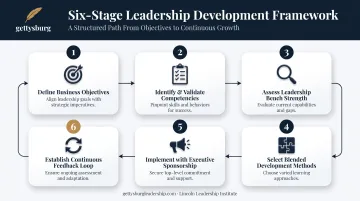
A durable framework follows a clear sequence, not a stack of disconnected programs. Use these six steps to tie leadership development to business outcomes from day one.
- Define the business objectives. Specify the performance outcomes the framework must serve—growth, innovation, or transformation—before you touch any training content.
- Identify and validate leadership competencies and levels. Bring in HR, business-unit leaders, and senior executives to confirm what strong leadership looks like at each tier.
- Assess current leadership bench strength. Run 360-degree feedback or a training needs analysis so you prioritize real gaps, not assumed ones.
- Select a blended mix of development methods. Match coaching, mentoring, formal training, and experiential immersion to the specific gaps you found in step three.
- Implement with visible executive sponsorship. Communicate the plan clearly and fold the framework into existing performance and succession processes so it never sits as a side initiative.
- Establish a continuous feedback loop. Track progress against your KPIs, review results with sponsors on a set cadence, and refine the framework as business needs shift.
Beyond the Classroom: Why Experiential Learning Strengthens Leadership Frameworks
Traditional classroom and e-learning frameworks struggle with one thing: converting concepts into behavior under real pressure. That's the same gap behind the earlier statistic: most training never gets applied on the job. Reading about decisiveness in a slide deck doesn't build it.
Immersive, experiential learning closes that gap differently. Placing leaders in high-stakes, decision-forcing scenarios where information is incomplete and outcomes matter builds resilience and character in ways a lecture can't replicate.
Lincoln Leadership Institute has built its entire methodology around this idea for more than 25 years. Its flagship Gettysburg Leadership Journey puts participants on the battlefield for 2.5 days, working through historical scenarios that force decision-making under pressure, crisis communication, and team alignment when priorities collide.
The Pearl Harbor program runs three days in Honolulu. Using the USS Arizona Memorial and the events of December 7, 1941, it builds rapid problem-solving and calm under chaos.
| Program | Location | Duration | Core Focus |
|---|---|---|---|
| Gettysburg Leadership Journey | Gettysburg, PA | 2.5 days | Decisive leadership, crisis communication |
| Pearl Harbor Immersion | Honolulu, HI | 3 days | Crisis management, rapid decision-making |
| Lincoln Leadership Live | Virtual | Varies | Remote strategic leadership development |
Faculty include retired Navy Rear Admiral Scott Moore, U.S. Navy SEAL Dave Cooper, and Ph.D.-level historians—people who've made high-stakes decisions, not just studied them.
The Institute has trained more than 40,000 leaders and 25,000+ Fortune 1000 and public-sector clients, including Pfizer and GE. Its Leadership Excellence Certificate, delivered with Purdue University Global, gives participants a credential they can verify and display professionally.
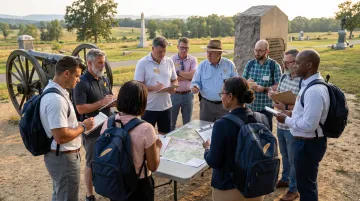
For organizations building their own frameworks, the takeaway isn't necessarily "go to a battlefield." Experiential components with real stakes, real pressure, and real feedback need a seat at the table alongside coaching and formal training.
Frequently Asked Questions
What is a leadership development framework?
It's a structured roadmap that combines leadership competencies, defined levels, assessments, and development methods, all aligned to business strategy. It replaces one-off training events with a connected system.
What are the 5 phases of leadership development?
There's no single universal standard, but common progressions include self-awareness, foundational skill-building, practical application, feedback and coaching, and mastery or mentoring others. Specific phases vary by organization and model.
What are the 5 C's of leadership development?
Cited versions vary. One common framing includes character, competence, communication, commitment, and courage. Other models use different terms, so treat this as a helpful lens rather than a fixed standard.
What is the difference between a leadership development framework and a training program?
A framework is the overarching structure — competencies, levels, pathways, metrics. A training program is one specific initiative delivered inside that structure, like a workshop or coaching series.
How do you measure the ROI of a leadership development framework?
Track promotion rates, retention, engagement scores, and leadership-readiness assessments, then tie those numbers to business outcomes like revenue or turnover cost. Rising readiness or confidence scores over time signal real progress.
What is experiential leadership development?
It's immersive, real-world or simulated learning — such as programs at historic battlefields — that forces practical decision-making under pressure rather than passive absorption of concepts. It builds behavior change that classroom training often can't achieve alone.