Yet most programs still miss the mark. Only 7% of senior managers surveyed by Ashridge Business School said their companies developed global leaders effectively, a gap McKinsey has pointed to for years as evidence that generic, disconnected training rarely moves the needle (McKinsey, 2014).
This guide walks through the exact steps for building a results-driven leadership development strategy for 2026: the must-have elements, the mistakes that sink programs before they start, and how to measure whether it's actually working.
Key Takeaways
- Anchor your strategy to a specific business priority — growth, retention, risk, or digital transformation — not generic skill-building
- Use a blended approach guided by the 70-20-10 model: real experience, coaching, and formal training
- Experiential, immersive learning builds decisiveness and resilience faster than passive classroom instruction
- Measure success at three levels: learner experience, on-the-job behavior change, and business impact
Why Leadership Development Strategy Matters More in 2026
The leadership pipeline is thinner than most executives realize. DDI's 2025 Global Leadership Forecast surveyed nearly 11,000 leaders and over 2,000 HR professionals across 2,014 organizations. Only 20% of HR respondents expressed confidence in their leadership bench (DDI Global Leadership Forecast, 2025).
That leaves roughly four out of five organizations unsure they can fill critical leadership roles when the need arises.
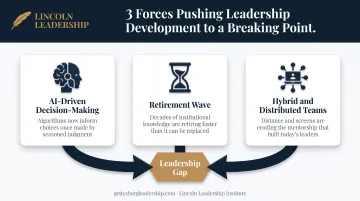
Three forces are pushing this problem to a breaking point in 2026:
- AI-driven decision-making: Leaders must interpret machine-generated insights, redesign human-AI workflows, and exercise judgment when data is incomplete
- A retirement wave: A large cohort of senior leaders is hitting retirement age, and succession benches aren't ready
- Hybrid and distributed teams: Building trust across screens requires communication skills most managers never trained for
Organizations that combine several development methods, not a single annual workshop, report stronger leadership capability across their bench. One event a year can't keep pace with how fast the demands on leaders are shifting.
How to Create a Leadership Development Strategy in 2026: Step-by-Step
A structured, sequential process—not a string of ad hoc training events—is what separates a strategy that delivers business results from one that gets cut from next year's budget. Here's the process broken into six steps.
Step 1: Align the Strategy with a Core Business Priority
Before you pick a single training format, get clear on what business problem the strategy needs to solve:
- Is the goal increasing revenue through faster market expansion?
- Are you trying to cut costs by reducing turnover among managers?
- Is risk mitigation the priority, given regulatory or safety concerns?
- Is digital transformation the driver, requiring leaders who can manage AI-augmented teams?
Bring C-suite executives into this conversation early. Their sponsorship is more than a formality. It secures budget, gives the initiative a clear mandate, and signals to participants that leadership development is a real priority, not an HR side project.
A useful real-world pattern: companies pursuing an innovation strategy often build a cascade-style program, where senior executives complete the experience first, then personally introduce it to the next level down. That structure keeps the innovation goal tightly linked to every cohort that follows.
Step 2: Define Leadership Competencies for Every Level
A single competency list for your entire organization won't work. Frontline supervisors, mid-level managers, and executives face fundamentally different challenges.
Build a tiered framework, such as:
- Frontline leaders: decisiveness, accountability, problem-solving under time pressure
- Mid-level managers: cross-functional influence, change management, coaching direct reports
- Executives: strategic vision, enterprise-wide judgment, crisis communication
For 2026, layer in capabilities that didn't matter as much five years ago: AI fluency, adaptability to constant change, and the ability to communicate clearly during a crisis. Avoid pulling a generic competency list off the internet — it won't reflect your culture, your industry's specific pressures, or the actual behaviors that get rewarded (or punished) inside your organization.
Step 3: Assess Current Leadership Capabilities and Identify Gaps
You can't design a curriculum until you know where the gaps actually are. Establish a baseline using:
- Employee and manager surveys to capture perceived leadership effectiveness
- 360-degree feedback from peers, direct reports, and supervisors
- Performance data tied to team retention, productivity, and engagement
- Structured interviews with HR and business unit leaders
Segment the results by leadership level. A gap in executive strategic thinking carries a different level of business risk than a gap in frontline communication. Prioritize accordingly.
Ask a harder question too: will your culture and processes actually support new leadership behaviors once people are trained? A program that teaches collaborative decision-making means little if the culture still rewards top-down command.
Step 4: Design a Blended, Experiential Learning Curriculum
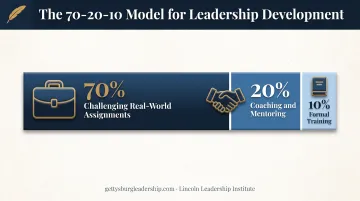
This is where most strategies either become memorable or forgettable. The 70-20-10 model, developed through research at the Center for Creative Leadership, offers a useful guideline:
- 70% — challenging, real-world assignments and stretch projects
- 20% — coaching, mentoring, and developmental relationships
- 10% — formal coursework and structured training
A peer-reviewed meta-analysis spanning 335 independent samples found that leadership training built around practice, feedback, and realistic scenarios produces meaningfully stronger transfer to the job and better organizational results than passive, lecture-based formats (Lacerenza et al., 2017).
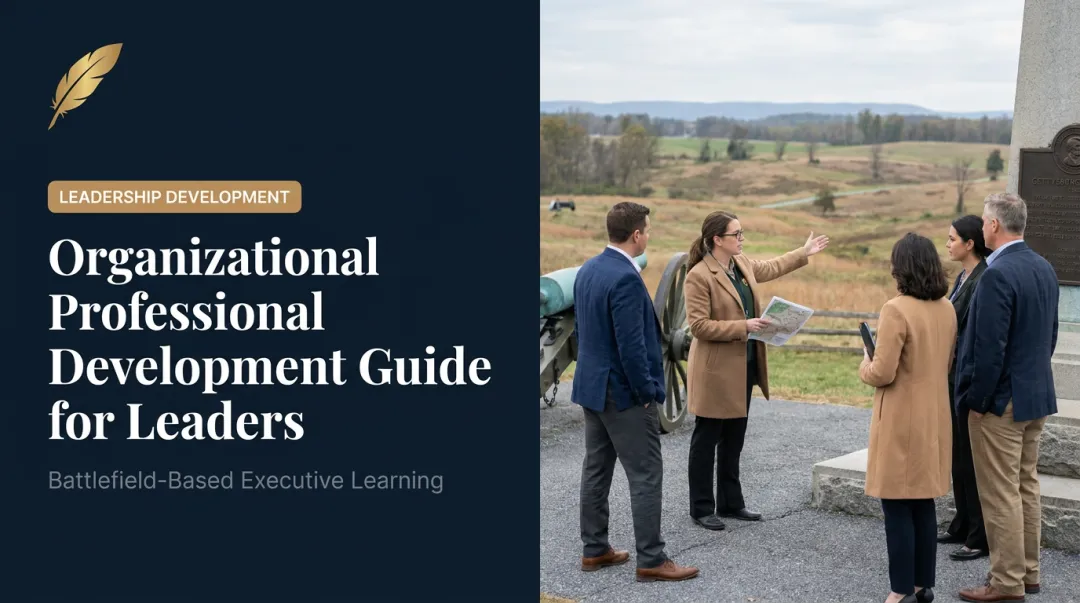
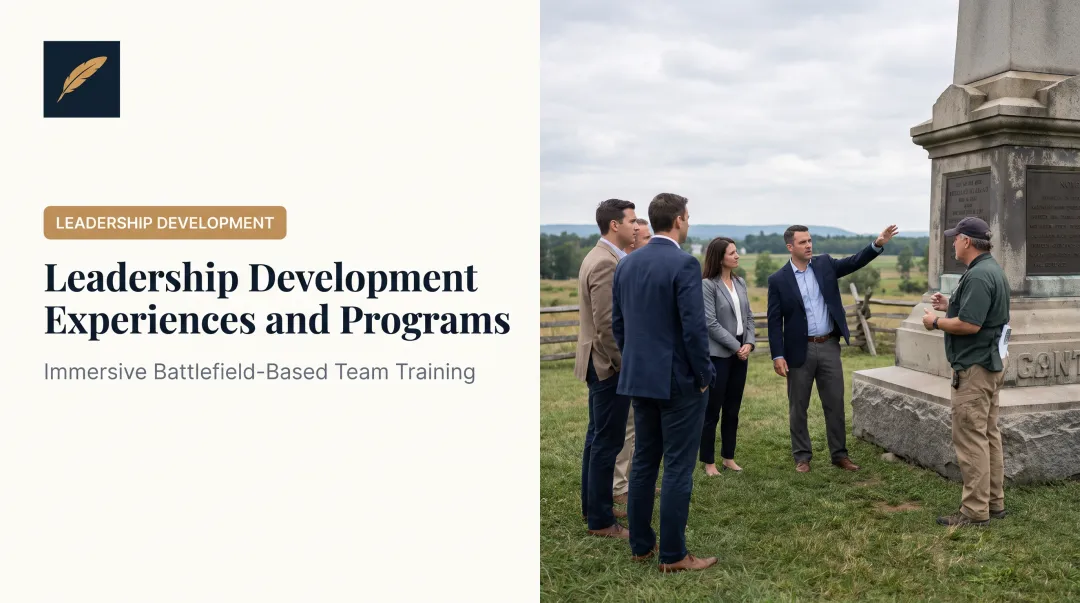
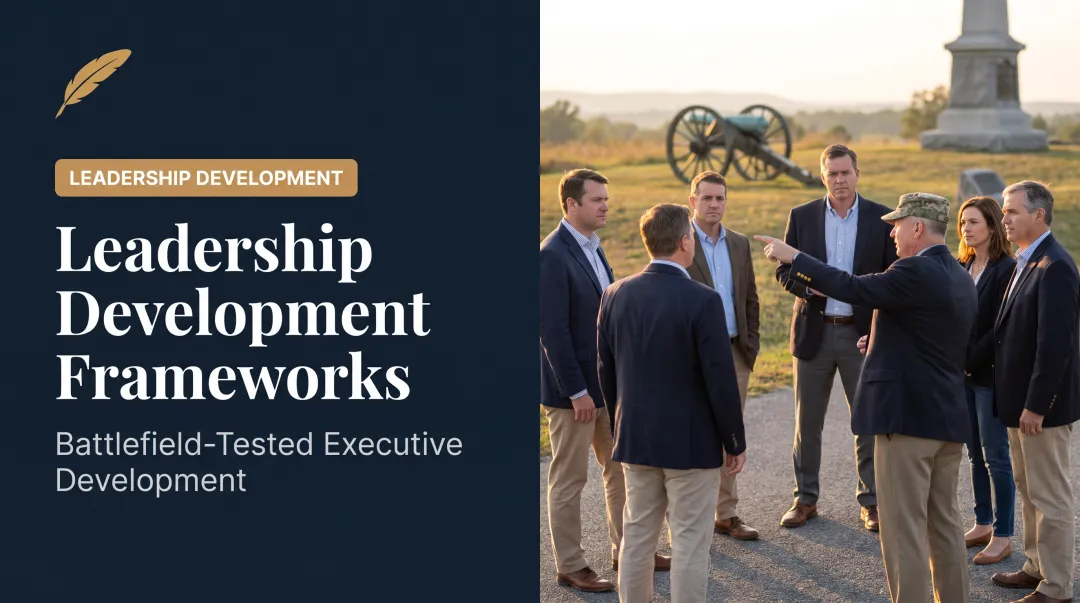
That's the exact principle behind Gettysburg Leadership's battlefield-based programs. Instead of a conference room, participants spend 2.5 days immersed on the actual Gettysburg battlefield. They work through historical scenarios built around incomplete information, competing priorities, and high-stakes decisions—the same pressures leaders face when a product launch goes wrong or a crisis hits before all the facts are in.
Faculty, including retired military leaders like Admiral Scott Moore and Colonel Mark Erwin alongside licensed battlefield guides and organizational psychologists, guide participants through the analysis rather than lecturing at them.
Build emotional intelligence into the curriculum as well. Leaders who can read tension in a room and communicate under pressure transfer training gains more reliably than those who only master technical frameworks.
Step 5: Secure Executive Sponsorship and Plan Implementation
Executive involvement can't stop at signing off on the budget. Senior leaders who show up as active teachers and mentors, not just names on an approval email, boost program credibility and participant buy-in.
Practical steps for rollout:
- Position senior leaders as mentors, not just sponsors: have them co-facilitate sessions or share real decisions they've made under pressure
- Choose delivery formats that minimize friction for time-strapped leaders, whether that's a one-day summit, a multi-day immersive experience, or a virtual format
- Pilot with a smaller cohort first. A group of 8-20 participants is enough to catch logistical issues before a full enterprise rollout
This mirrors how enrollment models typically scale: smaller open-enrollment groups of 3-5 leaders work well for testing a format, while private team experiences of 8-20 participants allow full customization once you know what works.
Step 6: Measure, Evaluate, and Iterate
Collect data at three points: baseline, midpoint, and post-program. Track three things together, not in isolation:
- Participant engagement and satisfaction
- On-the-job behavior change (are leaders actually doing things differently?)
- Downstream business metrics (retention, promotion rates, team performance)
Use what you learn to refine the next cohort. A leadership development strategy isn't a one-time deployment. It's a cycle that should get sharper with every group that goes through it.
Key Elements Your Leadership Development Strategy Must Include
Before launch, confirm your strategy has these three foundational pieces in place:
- Clear goals and success metrics spanning learner experience, on-the-job performance, and business impact — not just a satisfaction survey at the end
- Dedicated budget, time allocation, and executive-level approval secured before the first session, not negotiated mid-program
- Defined target audience segmentation specifying which leadership levels go first and what cohort sizes make sense — a 20-person private team experience serves a different purpose than a multi-year enterprise partnership with progressive cohorts
Skipping any one of these tends to surface later as scope creep, budget disputes, or a program that quietly fizzles after one cohort.
Common Mistakes to Avoid When Building Your Leadership Strategy
Even well-funded programs fail for predictable reasons:
- Treating it as a one-off event. A single workshop rarely changes behavior. Build an ongoing process with reinforcement over months, not one afternoon.
- Applying one-size-fits-all content. The same curriculum for frontline supervisors and C-suite executives ignores different challenges and learning formats at each level.
- Failing to involve executives as active mentors. When senior leaders only approve budgets instead of participating, credibility drops fast. People notice when leaders don't model the priority they set.
How to Measure ROI and Success of Your Leadership Development Strategy
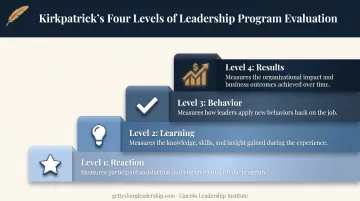
Measure success at four levels using the widely used Kirkpatrick model:
- Reaction — Did participants find the experience relevant and engaging?
- Learning — Did they gain the intended knowledge, skills, or confidence?
- Behavior — Are they applying new behaviors back on the job?
- Results — Is the organization seeing measurable outcomes?
Pair those levels with hard business metrics:
- Retention rates among leaders who completed the program
- Internal promotion rates versus external hires for leadership roles
- Employee engagement scores for teams led by program graduates
- Productivity or revenue impact tied to specific business units
Organizations that track these outcomes see the payoff. In ATD's research on organization-wide leadership development, 68% of respondents reported improved learner job performance and nearly 79% reported improved organizational culture (ATD, 2025).
Don't stop measuring at graduation. Run follow-up surveys 3–6 months after the program ends. Immediate post-session reactions capture excitement, not sustained change.
Watch qualitative signals as well: Are leaders making decisions more confidently? Has turnover-related cost on their teams dropped? Those indicators often appear before the hard numbers do.
Frequently Asked Questions
What are the C's of leadership development?
Commonly referenced C's include competence, character, communication, and commitment. In practice, they mean skill mastery, ethical decision-making, clear messaging, and follow-through on promises.
What is the 70-20-10 rule for leadership?
It's a guideline splitting development into 70% challenging on-the-job experience, 20% coaching and mentoring relationships, and 10% formal training. It's a proportion to aim for, not a rigid formula.
What is a leadership development strategy?
It's a structured, business-aligned plan for building leadership capability across an organization, distinct from a standalone training event. It ties directly to a specific business priority and includes measurement built in from the start.
How long does it take to build an effective leadership development strategy?
Initial design typically takes a few weeks to a few months, depending on organizational complexity. Full implementation and measurable results usually unfold over 6-12 months or longer.
How much should organizations budget for leadership development in 2026?
Budgets vary widely based on organization size, program depth, and delivery format. Scope budget against expected ROI and the business priority driving the initiative—not an industry average.
Who should own the leadership development strategy within a company?
HR and L&D typically lead the design and day-to-day execution. But lasting impact requires strategy ownership and active sponsorship from senior executives — not delegation alone.