Most sales leaders respond to a slump by tightening the metrics: raise the quota, tweak the incentive, mandate more CRM logging. Those levers help at the margins, but they rarely fix the deeper issue — how the team behaves when nobody's watching. It's a real problem: 67% of sales professionals didn't expect to hit their 2024 quota, and 84% had already missed it the year before, according to Salesforce's State of Sales report. Hard skills alone haven't closed that gap.
This article breaks down what a high-performance sales culture actually looks like, why leadership behavior — not policy — drives it, and a practical framework you can start applying this quarter, along with the pitfalls that quietly undo the effort.
Key Takeaways
- Shared accountability beats individual heroics and leaderboard pressure alone
- Leadership behavior shapes results more than comp plans or quotas
- Toxic culture drives turnover faster than pay gaps—treat culture as retention strategy
- Build it with a repeatable loop: assess, define values, coach, recognize, adapt
- Skipping accountability or coaching for "experienced" reps stalls progress fast
What Is a High-Performance Sales Culture?
Sales culture is the shared values, habits, and unwritten rules that shape how a team communicates, competes, and recovers when a deal falls through. The mission statement on the wall matters far less than what actually happens on a Tuesday afternoon when a rep loses a six-figure deal.
A lot of leaders confuse this with a "happy family" culture that avoids friction at all costs. A high-performance culture welcomes direct conversations about missed numbers and weak pipeline.
Think of it like a professional sports team, not a family reunion. Every player has a clearly defined role. Everyone agrees on what winning looks like. Nobody gets a pass for coasting because the team's success is bigger than any one person's stats.
The Defining Traits
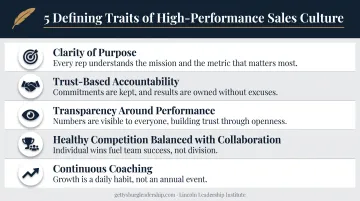
High-performance sales cultures consistently show:
- Clarity of purpose: reps know exactly what winning means and why it matters
- Trust-based accountability: people call out weak deals without fear of retaliation
- Transparency around performance: numbers are visible, not hidden or spun
- Healthy competition balanced with collaboration: reps compete for results but still share what's working
- Continuous coaching: feedback is a weekly habit, not a once-a-year event
The payoff shows up in the numbers. Gallup's most recent workplace meta-analysis, covering more than 3.3 million employees, found that business units in the top quartile of engagement posted 18% higher sales productivity and 23% higher profitability than those in the bottom quartile.
| Signal | Healthy Sales Culture | Toxic Sales Culture |
|---|---|---|
| Turnover | Low, predictable | High, frequent surprise exits |
| Knowledge sharing | Reps share tactics openly | Reps hoard scripts and contacts |
| Feedback | Direct, frequent, two-way | Rare, or only during formal reviews |
| Losses | Discussed openly for lessons | Blamed on leads, market, or tools |
| Recognition | Spread across the team | Concentrated on a few "stars" |
That gap between the two columns isn't cosmetic. It shows up in quota attainment, retention, and how buyers describe working with your team.
Why Leadership Behavior Drives Sales Culture More Than Any Policy
Most performance problems trace back to the leadership environment, not rep ability. Unclear expectations, inconsistent recognition, and reactive communication create disengagement long before the numbers slip. By the time a rep starts missing quota, the culture damage is usually months old.
Psychological Safety Is the Foundation
Reps need room to challenge a weak deal, admit a mistake, or ask for help without being punished for it. Google's Project Aristotle studied 180 internal teams, including 65 sales pods, looking for what separated high performers from the rest. The answer wasn't experience or sales skill. Psychological safety mattered more than any other factor in predicting team effectiveness.
Teams with strong psychological safety weren't just more pleasant to work on. They also:
- Kept people longer
- Surfaced more varied ideas and deal risks earlier
- Earned higher effectiveness ratings from leadership
Decisive, Values-Based Leadership Under Pressure
Sales leaders make calls with incomplete information constantly: which deal to walk away from, which rep to put on a stalled account, when to hold the line on discounting. That bind is not new. Historic commanders faced the same pressure with fragmented intelligence and no time to deliberate—the same conditions sales leaders hit every quarter.
Lincoln Leadership Institute puts corporate leaders on the ground at Gettysburg to walk those decisions in place. The lesson translates directly: leaders who wait for perfect information lose the moment.
Leaders who act decisively, on values rather than guesswork, keep their teams moving forward.
Trust Compounds Through Consistency
Incentives can spike short-term effort, but they don't build trust. Trust comes from a leader who follows through on commitments and gives honest feedback even when it's uncomfortable. Over a few quarters, that consistency compounds into faster performance gains than any spiff or contest ever will.
Building This Skill Takes Practice, Not Just Time in the Seat
Composure under pressure and values-based decision-making aren't traits people absorb by sitting in the role longer. Experiential learning consistently outperforms classroom-only instruction on behavior change. Slides and webinars transfer information. They rarely change how someone behaves under pressure—so build the skill the way the job demands it: practiced decisions, real stakes, and honest debriefs.
The Business Case for a High-Performance Sales Culture
Culture isn't a soft metric anymore. It shows up directly in the numbers finance cares about.
The Performance Gap Is Real
Sales organizations with stronger process adoption and enablement maturity outperform lower-maturity peers on win rate and quota attainment. CSO Insights benchmarking has long shown double-digit gaps between the two groups. Teams with clearer structure and standards keep winning that comparison.
Turnover Costs More Than a Comp Gap
Sales leaders often assume reps leave over money. Culture is usually the bigger driver. A large-scale analysis of employee reviews found that a toxic workplace culture was 10.4 times more powerful than compensation in predicting whether an employee would quit.
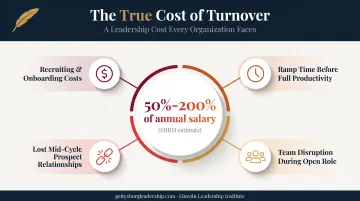
Replacing a sales rep isn't cheap either:
- Recruiting and onboarding costs before the seat produces
- Months of ramp time before full productivity
- Lost mid-cycle relationships with active prospects
- Team disruption while the role sits open
SHRM estimates replacing an employee can run 50% to 200% of their annual salary, depending on seniority. For a sales role, that ramp time alone often erases a full quarter of pipeline.
Culture Is Now Part of the Buyer's Experience
Buyers increasingly judge a vendor by what it's like to work with the sales team, not just the price sheet. A rep who's disengaged or defensive about losses reads as a warning sign to a prospect evaluating a long-term partner. That culture shows up in every buyer conversation—and it becomes part of the pitch.
A Step-by-Step Framework to Build a High-Performance Sales Culture
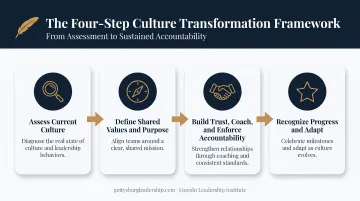
Fixing sales culture takes more than a one-time offsite. Treat it as a sequence you revisit every few quarters.
Step 1: Assess Your Current Culture Honestly
Start with qualitative signals, not just dashboards:
- Exit interview themes from the last 12 months
- How top performers talk about wins and losses: do they credit the team, or just themselves?
- Whether reps share tactics openly or guard them like trade secrets
Ask direct questions in your next team meeting: "What does winning look like here today?" and "Where is our culture helping performance, and where is it getting in the way?" The answers are often more revealing than the CRM.
One warning: if a star performer has a shortcut that works, resist copying it team-wide before understanding what problem it's solving. Sometimes a workaround compensates for a broken process. Copy the shortcut, and you inherit the broken process too.
Step 2: Define Shared Values and Purpose
Skip the vague slogans. Write three to five explicit behavioral values, stated as actions. For example: "celebrate effort, not just results" or "flag a weak deal before it wastes a quarter."
Connect individual quotas to the bigger picture. A rep hitting 110% of quota feels different when they understand how that number supports a larger company milestone, not just their own commission check.
None of this matters if leaders don't model it visibly. Teams mirror what leadership does, not what's printed on a poster in the break room.
Step 3: Build Trust, Coach Consistently, and Enforce Accountability
Run one-on-ones that go beyond pipeline review. Ask growth-oriented questions: "What's the hardest part of your job right now?" and "What skill do you want to build this quarter?"
Track both sides of the culture ledger:
- Leading indicators: coaching frequency, peer deal reviews, participation in debriefs
- Lagging indicators: win rate, retention, quota attainment
Accountability has to apply evenly. Letting one underperformer slide while holding everyone else to standard erodes trust faster than any policy misstep. The rest of the team notices immediately.
Step 4: Recognize Progress and Keep the Culture Adaptive
Structure competition around personal bests and team milestones, not just a leaderboard that always rewards the same three people. That keeps mid-pack performers engaged instead of checked out.
Recognition doesn't need a budget. A specific callout in a team channel, a handwritten note, or a mention in the all-hands is enough. Consistent, genuine recognition helps keep strong performers from walking.
Culture also has to evolve. What worked for a six-person team often breaks at thirty. Revisit rituals like stand-ups, deal reviews, and recognition formats every time the team scales meaningfully.
Common Pitfalls That Undermine Sales Culture
A few mistakes show up again and again, even in teams that start with good intentions.
- Toxic rivalry: Healthy competition pushes people to improve; rivalry makes reps withhold account intel or undercut each other on splits. When top performers stop naming peers positively, treat it as a warning.
- Skipping coaching for veterans: Assuming a ten-year rep doesn't need coaching stalls culture change fast. Senior reps often need tighter feedback loops—they've had more time to lock in bad habits.
- Outputs over inputs: Revenue and activity matter, but they're lagging. Track the behaviors—coaching cadence, deal reviews, peer feedback—that sustain results over time.
All three are fixable if leaders spot them in daily behavior—before they show up in the quarterly numbers.
Why Experiential Leadership Development Strengthens Sales Culture
Decisiveness, trust-building, composure under pressure — these traits are hard to build from a slide deck. They're built through practice, ideally practice with real stakes attached, which is why more organizations are turning to immersive, experiential leadership development instead of another webinar series.
Lincoln Leadership Institute takes this literally. Sales leaders walk the actual ground at Gettysburg, Normandy, or Pearl Harbor, studying decisions commanders made with fragmented information and no time to second-guess themselves. A retired Navy Rear Admiral or a former U.S. Army Special Operations Chief of Staff on faculty doesn't lecture about pressure. They've led people through it.
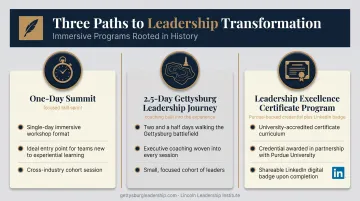
Formats fit different team needs:
- One-day summits for focused skill sprints
- 2.5-day Gettysburg Leadership Journey with coaching sessions built into the experience
- Leadership Excellence Certificate Program (with Purdue University Global)—battlefield coursework plus an academically backed certificate and a verifiable LinkedIn badge
That coaching piece matters for sales leaders specifically: coaching is a behavior built through repetition, not a concept absorbed once and remembered forever.
None of this replaces sales training. It builds the leadership layer underneath it: the composure and consistency that make coaching, accountability, and trust actually stick once the team is back at their desks.
Frequently Asked Questions
What is a high-performing sales culture?
A high-performing sales culture is one where reps and leaders share accountability for collective results, not just individual quotas. Clarity, trust, and continuous coaching matter more than pressure alone.
What are the 6 characteristics of a high-performance culture?
They are clear shared purpose, trust and psychological safety, accountability, open communication, recognition, and adaptability. Teams missing even one of these tend to plateau.
What are the 5 elements of high performance teams?
Clear goals, defined roles, mutual trust, open communication, and shared accountability for outcomes. These overlap heavily with sales culture traits, since a sales team is a team first.
What is the 70/30 rule in sales?
The common version says reps should listen 70% of the time and talk 30%. Call analytics show top performers lean slightly more toward listening overall, so use it as a guideline—not a hard rule.
How long does it take to build a high-performance sales culture?
Culture change is gradual. Most organizations need several consecutive quarters of coaching, accountability, and recognition before the shift holds without constant leadership push.
How can leadership development programs help build a stronger sales culture?
Structured, experiential programs build the trust, coaching habits, and decision-making instincts sales leaders need to sustain culture change. That's a more durable foundation than relying on incentives alone.