Individual brilliance doesn't guarantee collective performance. Many senior leaders excel at running their own function, then struggle the moment true cohesion is required across silos, competing priorities, and bruised egos.
This guide breaks down the building blocks of a genuinely high-performing executive team, the mistakes that quietly sabotage most team-building efforts, and why immersive, history-based leadership development is accelerating results in ways traditional workshops rarely do.
Key Takeaways
- Winning teams need shared vision, trust, and accountability—not just talent.
- Leaders set team culture through how they communicate and model values.
- Gettysburg's battlefield decisions offer direct lessons for modern executive choices.
- Lasting transformation demands deliberate, experiential investment beyond typical off-sites.
Why Building a Winning Team Is Different at the Executive Level
A misaligned decision at the front line costs a department a bad quarter. A misaligned decision in the C-suite can cost the entire company its market position. That's the fundamental difference: executive dysfunction doesn't stay contained. It cascades through every layer of the organization it touches.
Top-team cohesion is more fragile than most leaders assume. When tension among senior leaders goes unaddressed, turnover at the top tends to follow, and every departure resets institutional knowledge and momentum the organization can't easily rebuild.
Standard team-building tactics also tend to break down at this level. Consider what executive teams are actually dealing with:
- Established hierarchies that reward deference over dissent, even when dissent is exactly what's needed
- Competing functional priorities, since the CFO's incentives rarely align neatly with the CMO's
- Strong individual egos, often earned through real achievement, that resist being challenged
- Political history between leaders who've competed for the same promotions for years
A trust fall exercise doesn't dissolve any of that.
Executive teams need alignment around a shared strategic vision that cuts across silos and functional boundaries, not more interpersonal harmony. Two executives can respect each other personally and still pull the organization in opposite directions if they aren't genuinely aligned on where the company is headed and why. That alignment, not likability, is what eventually shows up in the bottom line.
The Essential Building Blocks of a Winning Team
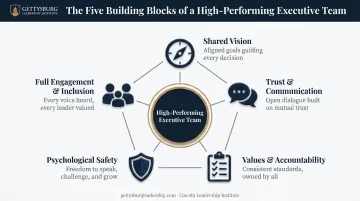
Leadership researchers don't always agree on methodology, but they converge again and again on the same five building blocks separating high-performing executive teams from the rest.
Establish a Compelling Shared Vision
A revenue target motivates a sales team for a quarter. It rarely inspires an entire executive team through a multi-year transformation. The strongest teams build a shared vision that functions like a legacy goal: a story about the kind of organization they're building and why it matters beyond the next earnings call.
The best executive teams translate that vision into a narrative each function can see itself inside. A CFO needs to understand how the mission changes what gets funded, while a COO needs to understand how it changes what gets measured.
When the CEO can articulate the same three or four priorities that other leaders independently repeat back, the organization has genuine alignment, not just a slogan on a slide.
Build Trust Through Transparent, Frequent Communication
Trust isn't a soft metric. A meta-analysis published in the Journal of Applied Psychology examined 112 independent studies covering 7,763 teams and found a meaningful, above-average correlation between intrateam trust and team performance, one that held up even after accounting for trust in the leader.
For executive teams, trust gets built through frequency and transparency, not grand gestures:
- Explaining the why behind a decision, not just announcing the what
- Creating regular two-way forums where pushback is expected, not just tolerated
- Following through visibly when a team member raises a concern
Executives who withhold context to manage their teams usually get compliance. They rarely get genuine buy-in, and without buy-in, decisions that looked settled in the boardroom quietly unravel once leaders return to their own departments.
Define Clear Values, Ground Rules, and Accountability Structures
Even well-intentioned executive teams drift into politics without a few explicit ground rules. One of the most important: no triangulation. If a disagreement exists between two leaders, it gets resolved between those two leaders, not litigated through side conversations and hallway alliances that quietly erode trust.
Ground rules only work when paired with structured accountability:
- Assign a clear, named owner for every strategic priority
- Set realistic timelines with specific checkpoints, not vague quarterly reviews
- Review progress openly, including where a priority has stalled
Without this structure, even a team with a strong shared vision defaults back to old habits the moment pressure hits.
Foster Psychological Safety and Support Calculated Risk-Taking
Innovation stalls the moment a team learns that mistakes get punished rather than examined. Executive teams that reward learning, asking what went wrong instead of who's to blame, free their people to take the calculated risks that strategic growth actually requires.
Psychological safety isn't built through reassurance alone, though. It's built through practice: making real decisions with incomplete information, in a setting where the consequences are developmental rather than career-ending.
That kind of pressure-tested repetition is where decisive leadership actually gets learned, which is why the strongest executive development programs move leaders outside the boardroom and into scenarios with real stakes.
Drive Full Engagement and Inclusion at Every Level
The fastest way to slow down decision-making is to let only the loudest voices in the room shape it. High-performing executive teams build structured ways to pull in perspective from across the organization, not just from within the C-suite.
In practice, that looks like open-door policies that actually function, structured listening sessions with leaders two or three levels down, and actively soliciting dissenting views before a decision gets finalized rather than after.
Teams that build these habits solve problems faster and catch blind spots earlier. The person closest to a problem often sees it before the executive team does.
Timeless Leadership Lessons from History: What Gettysburg Teaches Modern Executives
Classrooms teach frameworks. Battlefields teach judgment. History's most consequential decisions were made by leaders working with incomplete information, under extreme time pressure, facing enormous consequences for getting it wrong: conditions no PowerPoint deck can replicate.
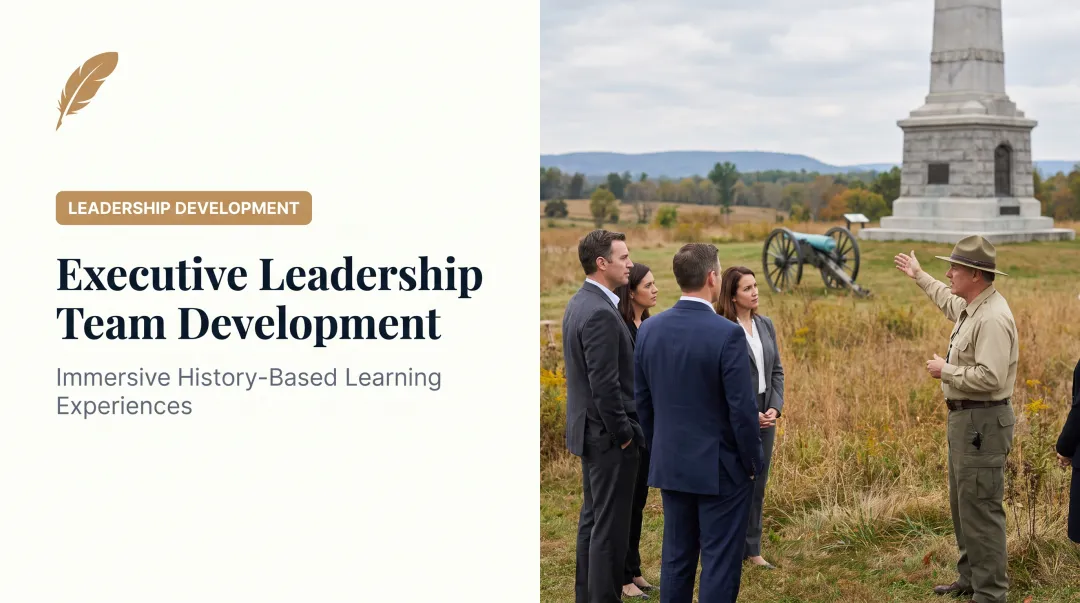
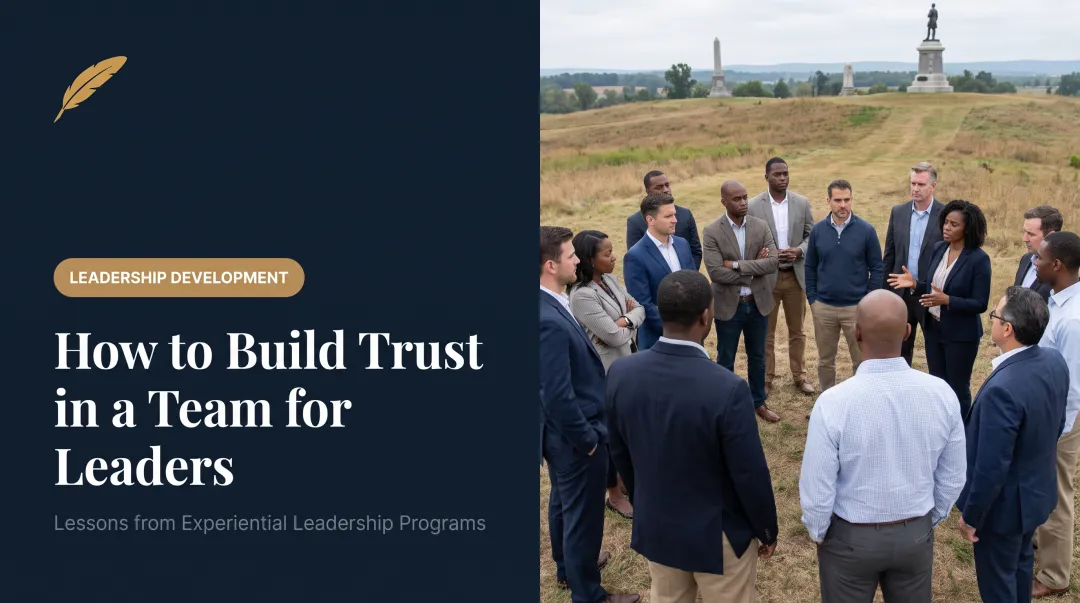
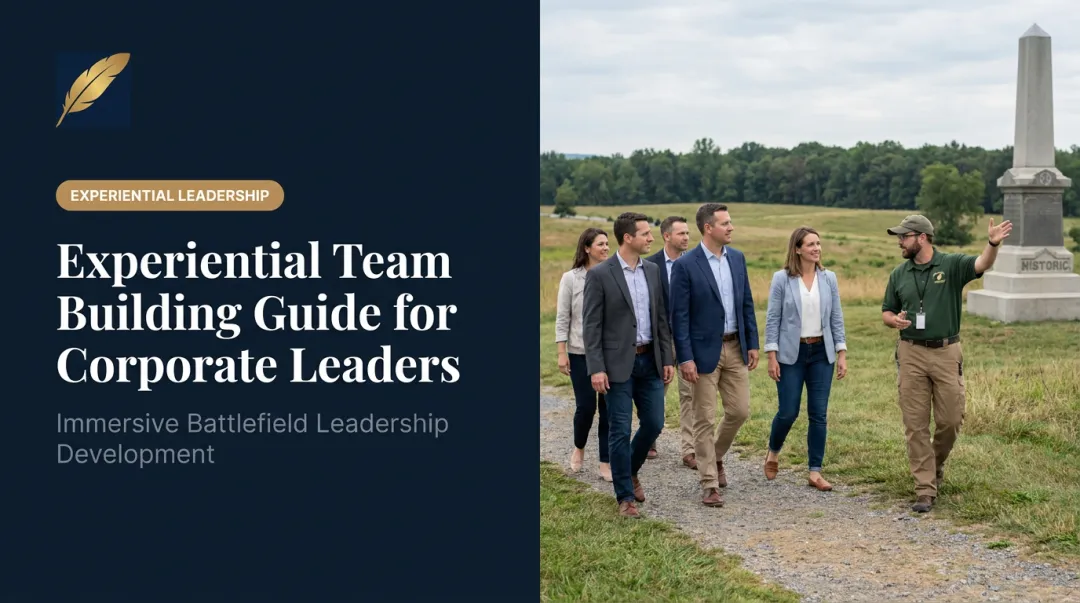
Gettysburg offers a uniquely concentrated case study. Over three days in July 1863, Union and Confederate commanders made decisions that determined the battle's outcome and the war's course, in minutes, with fragmented reports, and without knowing what the enemy would do next.
Studying those moments on the ground where they happened forces executives to confront the same core tension they face in volatile markets: acting decisively before all the information arrives.
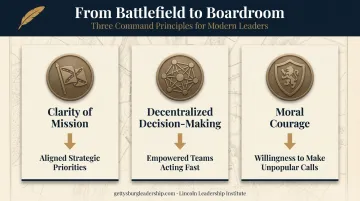
A few principles show up again and again on the field, and they map directly onto modern executive decision-making:
- Clarity of mission: commanders who understood the intent behind their orders adapted successfully when circumstances changed
- Decentralized decision-making: subordinate officers trusted to act on their own judgment within a clear mission often produced the decisive moments of the battle
- Moral courage: several turning points came down to one officer's willingness to make an unpopular call and own the consequences
Faculty who've actually lived it
At Lincoln Leadership Institute, these lessons aren't delivered by historians alone. Our faculty pairs Ph.D. historians and licensed battlefield guides with retired generals, a Navy Rear Admiral, and a Navy SEAL who has served since 1988.
These are leaders who've made real decisions under real pressure, and they translate battlefield judgment into corporate frameworks with a credibility a case study alone can't match.
The research backs this approach. A meta-analysis of 335 independent leadership-training samples found that programs combining information, demonstration, and hands-on practice produced substantially stronger effects on learning, and on transferring that learning into actual on-the-job behavior, than information-only instruction. Standing on the ground at Gettysburg and working through a live scenario isn't a novelty. It's the format the research says works.
Common Mistakes That Undermine Team-Building Efforts
Most executive teams don't fail because they lack talent. They fail because of a few repeatable, avoidable patterns.
Spending all their time on tasks, none on team. Executive meetings default to status updates and decisions. Few teams protect time to talk about how they're working together, whether trust is intact, whether conflict is being handled directly, or whether the team is genuinely aligned versus just avoiding disagreement.
Tolerating triangulation. When two leaders resolve a conflict by talking to everyone except each other, it doesn't disappear. It spreads. Side conversations and hallway alliances become the real decision-making process, while formal meetings turn into theater.
Skipping the retrospective. Most executive teams never pause after a major decision to ask what worked, what didn't, and why. Without that habit, the same misalignments resurface project after project, and the team never actually improves at working together. It just gets more experienced at working around each other.
How Lincoln Leadership Institute Turns These Principles into Practice
Every principle above is easier to describe than to install. That's why Lincoln Leadership Institute built its programs around direct experience instead of another off-site workshop.
Our multi-day immersive programs take executive teams to the actual ground where history's highest-stakes decisions were made: Gettysburg, Normandy, Pearl Harbor, and the Alamo. Teams work through real historical scenarios, guided by faculty who blend academic rigor with lived command experience.
Before they leave the site, they translate what they've learned into frameworks built for their own organization.
That immersive work doesn't stand alone, and none of it is theoretical. It's reinforced by:
- A credentialed path: Our partnership with Purdue University Global offers a Leadership Excellence Certificate Program, pairing a university-backed credential with the experiential work.
- Built-in self-awareness: Faculty certified to administer the EQ-i2.0 and EQ360 Emotional Intelligence Assessments help executive teams spot their own communication blind spots before and after the immersive experience.
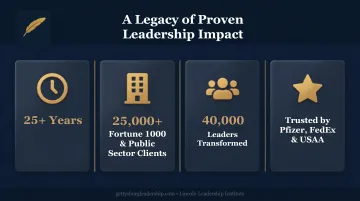
- A proven track record: 25+ years, 25,000+ Fortune 1000 and public sector clients (including Pfizer, FedEx, and the Department of Defense), and over two million leaders transformed.
If your executive team has the talent but not yet the cohesion, explore our private team and enterprise partnership programs to see what a Gettysburg-based experience could do for the leaders steering your organization.
Frequently Asked Questions
How do you build a winning team?
Align around a shared vision, build trust through transparent communication, establish clear accountability, and drive full engagement across every level of the team. Talent alone won't get you there.
What are the key characteristics of a high-performing executive team?
High-performing executive teams share a clear vision, defined roles, and mutual accountability. They also trust each other enough to disagree directly rather than manage conflict through side conversations.
How long does it take to build a strong team culture?
Culture-building is ongoing, not a single event. Multi-day immersive programs, like a battlefield experience at Gettysburg, accelerate trust and alignment far faster than traditional workshops by forcing real decisions under real pressure.
What is experiential leadership training and how does it help build teams?
Experiential training immerses leaders in realistic, high-stakes scenarios instead of lectures, such as walking Gettysburg's ridgelines to study a commander's decision. Combining instruction with hands-on practice produces stronger learning and behavior change than classroom instruction alone.
How can historical leadership lessons apply to modern business challenges?
Leaders throughout history made high-stakes decisions with incomplete information, much like executives navigating volatile markets today. Walking the ground at Gettysburg or Normandy, where those decisions played out, offers transferable lessons in clarity, adaptability, and moral courage.
How do you measure the success of team-building initiatives?
Look for improved communication survey results, faster decision-making, stronger retention among senior leaders, and tangible business outcomes tied directly to the initiative rather than just participant satisfaction.