Introduction
Here's a scenario every HR leader knows well: your best individual contributor just got promoted. Great news for her — until she realizes the job now includes setting goals for other people, giving feedback that lands well, and having conversations she never had to have before.
Nobody trained her for any of it.
Organizations struggle with this gap every day. DDI's Frontline Leader Project analyzed data from more than 23,000 frontline leaders and found the average person steps into their first management role at age 36, yet doesn't receive formal leadership coursework until age 40. That's a four-year gap where managers lead people with no formal skill-building behind them.
This guide covers what real performance management training looks like: the core skills managers need, the "5 C's" and "5 pillars" frameworks, the 70-20-10 development rule, and why practice under pressure beats another slide deck.
Key Takeaways
- Most managers lead people for years before receiving formal performance management training
- Clarity, Communication, Consistency, Coaching, and Courage are the human skills training must build
- Skills fade fast without reinforcement; one-time workshops rarely stick
- 70-20-10 budgeting favors on-the-job experience and coaching over classroom time alone
- Scenario-based practice, not lecture, is what makes managers ready for real conversations
What Is Performance Management Training for Managers?
Performance management training is often confused with rolling out a new appraisal form or a software platform.
Real performance management training builds the skills managers need to set expectations, monitor progress, coach employees, and evaluate performance on an ongoing basis, not once a year. SHRM frames performance management as a continuous cycle of planning, monitoring, developing, and evaluating work against organizational goals, not a single event.
That means effective training has to cover two very different skill types:
- Technical process skills — goal-setting, documentation, ratings, and how the review cycle actually works
- Human skills — feedback delivery, difficult conversations, reading emotional cues, and staying calm when a conversation gets tense
Most training programs only teach the first category. That's the mistake.
The 5 Pillars of Performance Management
Manager training should map to every stage of the performance cycle, not just the review meeting. Based on SHRM's process framework, the core activities break down into five areas:
- Planning and goal-setting — translating business objectives into individual, measurable expectations
- Monitoring — tracking progress through regular check-ins, not just year-end surveys
- Developing — coaching employees toward growth, not just correcting mistakes
- Rating — evaluating performance fairly and consistently against agreed standards
- Rewarding — connecting outcomes to recognition, pay, or advancement
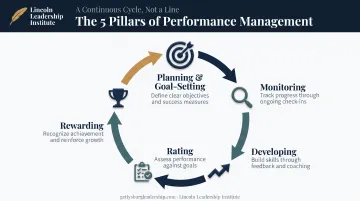
Managers often get trained on step four — the rating conversation — and nothing else. Training that skips planning, monitoring, and development leaves managers reactive instead of proactive.
Why Traditional Performance Management Training Falls Short
Most manager training still looks the same: a single workshop or an e-learning module focused on how to fill out the form correctly. It's compliance training wearing a leadership hat.
The bigger problem is what that format can't teach. Classroom sessions rarely simulate the pressure, emotion, or ambiguity of a real difficult conversation. Reading a script about how to tell someone their performance is slipping is nothing like sitting across from that person and saying it out loud.
And even when training content is good, it doesn't survive contact with time. A widely cited meta-analysis in Human Performance, covering 189 data points across 53 studies, found that skill decay accelerates the longer a skill goes unused — with retention loss ranging dramatically depending on how much practice follows the initial training.
The takeaway is simple:
- A single workshop builds awareness, not capability
- Without coaching, practice, and repetition, most of what managers "learned" fades within weeks
- Skills that go unused decay fastest; skills that get practiced regularly stick
Without on-the-job reinforcement, training fades into a memory instead of becoming lasting capability.
The 5 C's of Performance Management Every Manager Should Master
One practical framework breaks performance management training into five human skills: Clarity, Communication, Consistency, Coaching, and Courage.
- Clarity: Translate broad business goals into specific expectations an employee can act on tomorrow morning. Vague goals produce vague performance.
- Communication: Keep feedback timely, specific, and focused on behavior—not personality. "You missed the deadline on the Q3 report" lands very differently than "you're disorganized."
- Consistency: Apply the same standard across the team. Few things erode trust faster than uneven rules.
- Coaching: Stop handing out answers. Ask questions that help employees find their own solutions—a mindset shift, not a script.
- Courage: Have the tough conversation on time, not three months late. That takes emotional resilience most managers were never taught to build.
Four of these five skills are almost entirely about human interaction, not process knowledge. That is why classroom-only training falls short here. You can explain courage in a slide deck, but you cannot build it there.
How to Train Managers on Performance Management: A Practical Framework
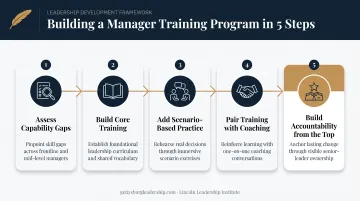
Building real capability takes a structured approach, not a single event. Here's a five-step framework HR teams can use:
- Assess capability gaps first. Use surveys, 360-degree feedback, or skills assessments before designing any content. Training aimed at the wrong gap wastes everyone's time.
- Build core training around fundamentals. Cover SMART goal-setting, ongoing feedback habits, and documentation as an ongoing rhythm, not a single annual event.
- Add scenario-based practice. Role-play and simulations let managers rehearse a difficult conversation before they face it live. A meta-analysis of 117 behavior-modeling training studies found that transfer to actual job behavior was strongest when practice used realistic, trainee-generated scenarios rather than generic examples.
- Pair training with coaching. Regular check-ins from HR or senior leaders reinforce new habits after the workshop ends . Habits change behavior; slide decks don't.
- Build accountability from the top. When senior leaders model and reward good performance management behavior, it signals the skill is a genuine priority, not a checkbox.
Applying the 70-20-10 Rule to Manager Development
The Center for Creative Leadership's 70-20-10 model suggests development happens roughly:
- 70% through challenging on-the-job experience
- 20% through coaching, mentoring, and peer feedback
- 10% through formal training and coursework
This isn't a scientific formula to follow to the decimal . CCL itself frames it as a conceptual guide, not a fixed recipe. But it's a useful gut-check for performance management specifically, since the hardest parts of the job are learned by doing.
A practical example: pair a half-day workshop on feedback fundamentals (the 10%) with a mentor who shadows the new manager's first three feedback conversations (the 20%), then let the manager run their own check-ins solo with coaching support available on request (the 70%). The workshop matters less than what happens after it.
Why Experiential Learning Builds Better Performance Managers
Here's the honest problem with performance management training: knowing the process isn't hard. Knowing you should give timely, specific feedback isn't news to most managers. The hard part is having the composure and courage to say it out loud when it's uncomfortable. That skill is nearly impossible to build sitting in a conference room.
This is where experiential learning earns its keep. At the Lincoln Leadership Institute, managers don't role-play a difficult conversation in a hotel ballroom. They work through leadership scenarios immersed in the actual terrain at Gettysburg, Normandy, and the Alamo.
There, the stakes of decisive communication and courage under pressure were once measured in lives, not quarterly reviews. That kind of environment forces a different level of engagement than a PowerPoint ever will.
The faculty behind these programs bring a dimension most HR trainers simply can't:
- Retired Navy Rear Admiral Scott Moore (30+ years, Naval Special Warfare): performing under extreme pressure while holding team cohesion
- Dave Cooper, US Navy SEAL since 1988 and Command Master Chief: mission-critical decision-making and team accountability
- Colonel (Ret.) Mark Erwin, former Chief of Staff, US Army Special Operations Command: high-stakes decisions under uncertainty
These are practitioners who've had to give hard feedback and hold people accountable when the outcome genuinely mattered, not theorists describing it secondhand.
The Institute also uses the EQ-i2.0 and EQ360 Emotional Intelligence Assessments, delivered by certified faculty member Dr. Jared Peatman. Managers map their own emotional triggers before they coach someone else through a hard conversation. Knowing your reaction pattern under stress is a prerequisite most performance talks skip entirely.
Not every organization can send managers on a multi-day immersion. Programs are also available as one-day summits and through Lincoln Leadership Live, a virtual format, so pressure-tested skill-building stays accessible regardless of budget or schedule.
How to Measure the Success of Your Manager Training Program
Training without measurement is a guess dressed up as a strategy. Establish baselines before rollout, then review the same metrics at 30, 90, and 180 days. Indicators worth tracking:
Leading indicators:
- Frequency of manager-employee check-ins
- Completion rate of structured goal-setting conversations
Behavior change indicators:
- Employee engagement scores before and after training rollout
- 360-degree feedback trends for trained managers versus untrained peers
Downstream business indicators:
- Voluntary turnover on trained managers' teams
- Internal promotion rates from those teams (a signal managers are developing people)
The stakes here are real. DDI's 2024 analysis, covering 1,826 HR professionals and 13,695 leaders worldwide, found that high-potential employees without an effective manager-coach were twice as likely to say they intend to leave.
Organizations with a strong coaching culture were nearly 3 times more likely to report they could retain top talent — and 1.5 times more likely to land in the top 10% for financial performance.
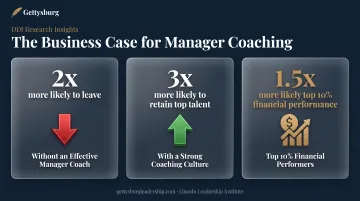
Manager coaching skill isn't a soft metric. It shows up on the balance sheet.
Frequently Asked Questions
How do you train managers on performance management?
Combine a practical framework (goal-setting, feedback, and coaching) with real scenario practice and ongoing reinforcement from HR or senior leaders. A single workshop won't build lasting skill; follow the five-step framework outlined above for a sustainable approach.
What are the 5 C's of performance management?
Clarity, Communication, Consistency, Coaching, and Courage. Together they describe the human skills managers need to set expectations, deliver feedback, and have hard conversations fairly and on time.
What is the 70-20-10 rule for employee development?
It's a development model suggesting roughly 70% of learning comes from on-the-job experience, 20% from coaching and mentoring, and 10% from formal training. Use it as a guide rather than a strict formula.
What are the 5 pillars of performance management?
Planning and goal-setting, monitoring, developing, rating, and rewarding. Manager training should address every stage, not just the annual rating conversation.
How long does manager performance management training take to show results?
Foundational skills can be introduced in a single session, but real behavior change typically takes several months of ongoing coaching and reinforcement to stick. Treat it as a habit-building process, not a one-time event.
What's the difference between performance management training and performance appraisal training?
Appraisal training focuses narrowly on the review event itself: filling out forms and delivering ratings. Performance management training covers the full ongoing cycle: goal-setting, feedback, coaching, and development, all year long.