Introduction
AI adoption, remote work, and flatter org charts are dismantling the old command-and-control playbook. Managers who once controlled every decision now oversee distributed teams making calls without them in the room.
The math doesn't work anymore. McKinsey found that executives spend almost 40% of their time on decisions, and most of them say that time is poorly used. Meanwhile, employees stuck waiting on approvals disengage, and managers become the bottleneck slowing everything down.
This article breaks down what employee empowerment actually means, why it improves engagement and retention, and how to build a training framework that works. You'll also see real training activities, the pitfalls that derail most rollouts, and how experiential leadership training builds managers who can let go.
Key Takeaways
- Empowerment means real authority and accountability, not just reassigned tasks
- Empowered employees drive measurably higher engagement, productivity, and retention
- Effective training assesses culture, sets clear boundaries, coaches managers, and builds feedback loops
- Scenario simulations, project ownership, and mentorship build empowerment skills fastest
- Immersive leadership training builds the manager trust required to step back
What is Employee Empowerment?
Employee empowerment is a management model that gives people real autonomy and authority over decisions affecting their day-to-day work. SHRM defines it as a philosophy that pairs autonomy with resources, support, and accountability, not just permission to act independently.
It's the direct counter to micromanagement. When employees can act without escalating every choice, leaders finally get bandwidth for strategic work instead of babysitting approvals.
Employee Empowerment vs. Delegation
These two terms get used interchangeably, but they aren't the same thing.
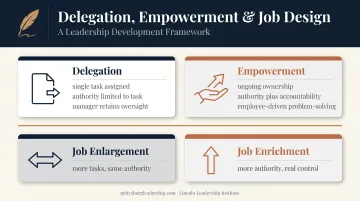
- Delegation assigns a specific task or outcome along with the authority to complete it. SHRM notes many managers were never trained to do this well
- Empowerment is broader: trusting an employee with ownership from start to finish, including reporting, accountability, and problem-solving
Think of delegation as handing someone a single project. Empowerment is handing them the authority to run their corner of the business without checking in first.
Common Forms of Empowerment in the Workplace
Empowerment shows up in a few recognizable structures:
- Self-managed teams that plan their own workflows and priorities
- Decision-making authority on budgets, vendors, or client issues
- Idea implementation ownership, where employees can test and launch their own suggestions
- Schedule and workplace autonomy over how and when work gets done
Job design theory draws a useful line here. Job enlargement expands the breadth of someone's tasks horizontally: more duties, same authority level. Job enrichment expands authority vertically, adding real planning and control responsibility.
Enrichment is the version that actually builds empowerment; enlargement just adds more to the plate.
Empowerment still requires managers to give up some traditional control. That shift is why training has to cover both employees and managers.
Why Employee Empowerment Matters: Key Benefits
Improved Engagement and Morale
Autonomy fuels ownership. When people control how they approach their work, they invest more of themselves in it. Gallup's 2024 Q12 meta-analysis, spanning more than 183,000 business units, found top-quartile engagement units posted 23% higher profitability and 18% higher sales productivity than bottom-quartile units. Empowerment is one of the clearest levers behind that engagement gap.
Increased Productivity and Innovation
Employees closest to the work usually see problems and fixes managers miss. When they have room to act on those instincts, they:
- Tailor their approach to their own strengths instead of a rigid process
- Surface creative solutions that would otherwise never reach a manager's desk
- Move faster on small decisions instead of waiting in an approval queue
Stronger Retention and Loyalty
Gallup's study of 717 recent voluntary leavers found 42% believed their manager or employer could have prevented their exit.
Nearly half had no proactive conversation about their satisfaction or future in the three months before they quit. Empowerment training gives managers a structured reason to hold those ownership conversations before someone starts job hunting.
Enhanced Customer Satisfaction
Customer-facing employees with real authority resolve problems on the spot instead of escalating them twice. A customer with a billing issue doesn't want to wait for three layers of approval; they want it fixed now. Empowered staff can make that call.
Stronger Leadership Pipeline
Every employee who practices ownership and decision-making is already rehearsing for a leadership role. Deloitte reports 86% of leaders call succession planning urgent, yet only 14% feel confident they're doing it well. Empowerment training closes that gap by giving future leaders live practice, not just theory.
How to Train Employees for Empowerment: A Step-by-Step Framework
Rolling out empowerment without structure usually backfires. Either managers cling to control, or employees freeze without clear boundaries. Here's a framework that avoids both traps.
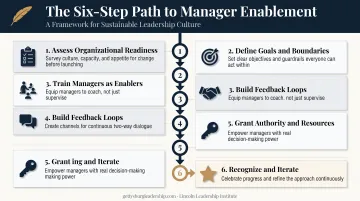
Assess organizational readiness. Run culture surveys measuring trust, communication, and psychological safety before you launch anything. If people don't feel safe raising concerns, empowerment training will stall before it starts.
Define clear goals and decision-making boundaries. Set specific objectives such as agility, succession planning, and faster innovation, and spell out exactly what employees can decide without approval. Ambiguity here creates more problems than it solves.
Train managers to become enablers, not gatekeepers. Managers need explicit coaching in delegation and trust-building; most were never taught it. Immersive, experiential leadership training (like the scenario-based exercises used in programs at Lincoln Leadership Institute) accelerates a manager's confidence in stepping back and letting a team make the call.
Build structured feedback loops. Schedule regular check-ins—weekly or biweekly—so employees can flag challenges early. Keep the focus on support and course-correction, not a backdoor for micromanagement.
Grant real decision-making authority and resources. Autonomy without budget, tools, or information is just a title. Give employees what they need to actually act on the authority you're handing them.
Recognize progress and iterate. Publicly celebrate empowerment wins to build buy-in across the organization, and use both successes and struggles to refine the approach as you scale.
Employee Empowerment Training Activities and Common Challenges
Examples of Employee Empowerment Training Activities
Empowerment sticks through practice, not presentations. The activities that work best include:
- Scenario-based decision simulations or role-plays that force independent judgment under pressure
- Project ownership assignments where employees run a task end-to-end, including stakeholder updates and reporting
- Cross-training and job shadowing to build the skills and confidence needed for expanded responsibility
- Mentorship and coaching pairings that support employees as they take on more autonomy
Common Challenges to Overcome
Even well-designed empowerment programs run into predictable friction:
- Micromanagement fear. Managers often claw back control when stakes rise. Start with low-risk decisions to build trust before anything high-stakes.
- Unclear boundaries. Employees hesitate when they don't know what they own. Document decision rights, and keep a "no permission needed" list for common calls.
- Inconsistent application. Embed empowerment behaviors in manager performance reviews so accountability doesn't hinge on personal style.
How Lincoln Leadership Institute Builds Empowered, Decisive Leaders
Most empowerment training fails at step three: teaching managers to actually let go. That is the step Lincoln Leadership Institute focuses on.
Instead of classroom theory, LLI places executives and high-potential leaders in immersive, high-stakes historic environments at Gettysburg, Normandy, Pearl Harbor, and the Alamo that mirror the pressure and ambiguity of real business decisions. Standing where history's biggest calls were made under incomplete information builds a different kind of confidence than a workshop ever will.
The faculty roster reflects that same intensity:
- Admiral Scott Moore, a retired Navy Rear Admiral with 30+ years in Naval Special Warfare, teaches decision-making under extreme pressure
- Dave Cooper, a US Navy SEAL since 1988, brings decades of special operations team leadership
- Dennis Owens, a 15-time Emmy Award winner, teaches communication under pressure drawn from decades covering political crises
For organizations wanting a credentialed path, LLI's Leadership Excellence Certificate Program, delivered in partnership with Purdue University Global, gives managers a structured, recognized way to build the skills that make empowerment sustainable rather than a one-off retreat.
Over more than 25 years, LLI has worked with over 40,000 leaders across 25,000+ Fortune 1000 and public sector clients, including Pfizer, FedEx, and the Department of Defense. That track record comes from developing leaders who can empower others in practice.

Frequently Asked Questions
What is employee empowerment?
Employee empowerment is a management approach that gives employees real autonomy and authority to make decisions about their own work. It goes beyond simple task delegation by including ongoing accountability and support.
How do you train employees for empowerment?
Start by assessing culture and trust levels, then train managers to coach and delegate rather than micromanage. Provide the resources employees need, and build feedback and recognition loops to sustain it.
What are some examples of employee empowerment activities?
Common examples include project ownership assignments, scenario-based decision simulations, mentorship pairings, and cross-training exercises. Each builds confidence and judgment in a different way.
What is the difference between empowerment and delegation?
Delegation assigns a specific task and the authority to complete it. Empowerment is broader — it grants ongoing authority, trust, and accountability for outcomes, not just one assignment.
How do you measure the success of employee empowerment training?
Track decision-making speed, employee engagement scores, retention rates, and how often issues get escalated to managers unnecessarily. Compare these metrics before and after training rollout.
Can employee empowerment work in highly regulated industries?
Yes. Empowerment can operate inside compliance boundaries by giving employees autonomy to find efficient, compliant solutions within clearly defined rules. Regulated settings such as hospitals often use this bounded approach to improve outcomes without loosening required protocols.