Introduction
A leader with the right strategy still loses the room if they freeze during a crisis call. Most leadership failures aren't about missing knowledge. They happen when composure, communication, and judgment get tested under real pressure.
Corporations know this. They pour money into leadership frameworks, certifications, and workshops every year.
Yet a 2023 CIPD survey of over 1,100 L&D and HR practitioners found that only 8% prioritized accelerating learning transfer into actual job performance. Nearly half couldn't even say what their organization spent per employee on training. The data points to a measurement and transfer problem, not just a content problem.
This article breaks down what behavioral skills training (BST) actually is and the specific behaviors corporate leaders need most. It also lays out a step-by-step framework for building them — including why immersive, real-world practice beats another afternoon in a conference room.
Key Takeaways
- Behavioral Skills Training (BST) builds practiced, observable behavior through four steps: instruction, modeling, rehearsal, and feedback
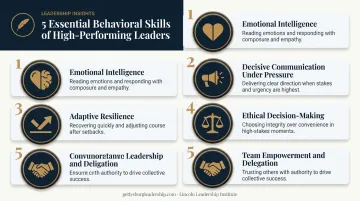
- Corporate leaders most urgently need emotional intelligence, decisive communication, resilience, and ethical judgment
- Lecture-based training rarely produces lasting change; realistic rehearsal under pressure does
- Success is measured by behavior change on the job, not satisfaction surveys or attendance
What Is Behavioral Skills Training for Corporate Leaders?
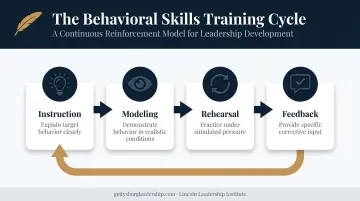
Behavioral skills training is an evidence-based methodology built around one goal: changing what leaders actually do, not just what they know. It runs on a four-part cycle:
- Instruction – Explain the target behavior clearly
- Modeling – Demonstrate it in realistic conditions
- Rehearsal – Have the leader practice it themselves
- Feedback – Provide specific, corrective input
This structure comes from applied behavior analysis research, and it matters for leadership because most leadership failures are behavioral, not informational. A manager who understands the theory of difficult conversations can still stumble badly when they're actually having one.
McKinsey has documented this gap. US companies spend roughly $14 billion annually on leadership development, yet only 7% of senior managers believe their organizations develop leaders effectively. The firm points to decontextualized training and weak feedback loops as recurring culprits.
Why Traditional Training Falls Short
Slide decks and one-off workshops transfer knowledge well. They rarely change behavior under pressure. Here's the core issue:
- Knowledge retention decays quickly without repeated use
- Passive learning doesn't require the leader to act, only to absorb
- Role-play in a conference room rarely mirrors real stakes or ambiguity
Effective BST needs a safe-but-realistic environment where leaders can rehearse high-stakes behaviors without real-world consequences attached to failure. Some organizations take this further by moving practice out of the boardroom entirely and into environments built to simulate genuine pressure.
Realistic conditions alone aren't proof of progress, though. Unlike vague "soft skills" workshops, BST is measurable. Organizations track proficiency using validated pre- and post-program assessments — including emotional intelligence evaluations like EQ-i2.0 and EQ360, which measure specific, scoreable dimensions of self-awareness and interpersonal skill rather than relying on gut feel.
The Top Behavioral Skills Every Corporate Leader Needs
Technical skills vary by industry — a hospital executive and a manufacturing plant manager need different domain expertise. But a consistent set of behavioral competencies separates strong leaders across every sector.
Emotional Intelligence and Self-Awareness
Emotional intelligence underpins nearly every other leadership behavior on this list. A cross-cultural meta-analysis found leader emotional intelligence correlates with subordinate task performance at rho=.48, a substantial relationship across cultures. Tools like EQ-i2.0 and EQ360 assessments give leaders a concrete baseline and measurable growth target instead of a vague sense of "needing to work on people skills."
Communication and Composure Under Pressure
Leaders don't get to wait for perfect information before they speak. In high-stakes, high-ambiguity moments, clarity and confidence matter more than certainty.
Crisis communication (delivering hard news or unclear updates without losing credibility) is the sharpest test of this skill. The same composure applies when circumstances shift rapidly: judgment needs to stay clear and mission focus intact. Gallup surveys of nearly 19,000 US workers found 95% of employees trust leaders who communicate clearly and inspire confidence, proof that composure functions as a trust mechanism, not just a soft skill.
Resilience, Accountability, and Team Empowerment
Three additional behaviors round out the list, each building durable, high-performing teams:
- Adaptive resilience: Recovering fast, recalibrating, and refocusing the team on the mission instead of the failure. It's a practiced skill, not brute toughness.
- Accountability and ethical decision-making: Owning outcomes, including the difficult ones, and making values-based calls even when the easier answer would be popular. Research links this behavior to higher follower trust and fairness perceptions across sectors.
- Team empowerment and delegation: Building trust through delegation instead of simply offloading tasks. Empowering leadership styles correlate with stronger team performance and creativity.
How to Implement Behavioral Skills Training: A Step-by-Step Framework
The four-step BST cycle adapts directly to corporate leadership development. Here's how each stage works in practice.
Step 1: Instruction
Leaders need a clear, concise explanation of the target behavior, tied to a real organizational scenario, not abstract theory. Instead of "communicate effectively during crises," instruction should specify: how to deliver difficult feedback to a direct report, how to address a team after a missed deadline, or how to respond to a public setback in real time. The more specific the scenario, the faster leaders connect the skill to their own role.
Step 2: Modeling
Leaders need to see the desired behavior demonstrated under realistic, high-stakes conditions. Video-only modeling works for simple tasks, but complex behaviors (the kind involving judgment, tone, and timing) land harder through live demonstration or case-based scenarios.
- Historical leadership decisions, such as Robert E. Lee's choices at Gettysburg, give leaders a concrete example without the risk of critiquing a current colleague
- Faculty who've lived high-stakes leadership firsthand (retired military commanders, crisis communicators) add credibility a slide can't match
- Watching a decision unfold in context beats reading a summary of it
Step 3: Rehearsal and Practice
This is where knowledge becomes behavior. Leaders rehearse the target skill themselves, in a controlled but realistic setting, with immediate coaching. Some degree of simulated pressure or ambiguity should be present: a time constraint, incomplete information, or a scenario that shifts mid-exercise.
- Practice should mirror actual conditions leaders face, not a sanitized version of them
- Coaching during rehearsal, not just after, helps correct behavior before it becomes habit
- Repetition matters more than a single perfect attempt
Step 4: Feedback and Reinforcement
Effective feedback is specific and timely. It highlights genuine strengths and one or two improvement areas, not a laundry list that overwhelms the leader. Then comes continued practice to lock the behavior in.
Follow-up coaching after leaders return to their roles matters just as much as the initial session. Without it, even well-rehearsed behaviors can fade back into old habits within weeks.
Behavioral Skills Training in Action: A Real-World Example
Picture a mid-level manager preparing to handle a product recall announcement to their team — a genuinely high-pressure crisis communication scenario. Here's how the four BST steps would apply:
- Instruction – The manager learns the specific structure for crisis messaging: acknowledge the problem directly, state what's known and unknown, and give a clear next step.
- Modeling – A faculty member with real crisis communication experience demonstrates the delivery, showing tone, pacing, and how to handle a hostile follow-up question.
- Rehearsal – The manager delivers the same announcement live, facing simulated pushback and a tight time limit, with a coach observing in real time.
- Feedback – The coach flags one strength (the manager stayed calm) and one gap (they buried the key message in too much preamble). The manager then repeats the exercise with that correction applied.
The real payoff shows up weeks later: the manager leads an actual difficult conversation without freezing, hedging, or losing the room, because they've already lived through it once under pressure, not just read about it.
Why Experiential, Immersive Training Outperforms Traditional Corporate Leadership Programs
The modeling and rehearsal stages of BST work best when leaders step outside familiar office settings entirely. ATD and i4cp research found that high-performing organizations were about three times more likely than lower performers to use experiential learning for both frontline and senior leaders — a meaningful signal that unfamiliar, realistic environments change how well training sticks.
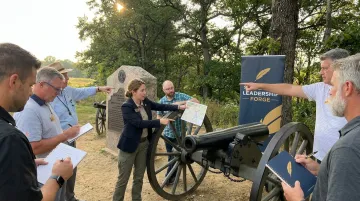
This is the philosophy behind the Lincoln Leadership Institute's approach. Rather than running exercises in a hotel conference room, LLI takes leaders to the historic battlefields of Gettysburg, Normandy, Pearl Harbor, and the Alamo, studying real historical decisions made under genuine, life-or-death pressure.
Faculty leading these sessions include retired military generals and admirals, a US Navy SEAL, and an Emmy Award-winning crisis communicator, each bringing direct experience commanding under pressure. Each battlefield anchors a distinct leadership lesson:
- Gettysburg examines how commanders communicated with clarity amid incomplete information
- Pearl Harbor shifts the focus to decisive action and composure in catastrophic, unexpected crisis
- Normandy puts alliance-building and adaptive planning under uncertainty center stage
- The Alamo anchors lessons in courage and risk assessment under impossible odds
This battlefield-specific curriculum has scaled significantly over the Institute's 25-year history. LLI has trained more than 40,000 leaders and served over 25,000 Fortune 1000 and public sector clients, including Pfizer, FedEx, GE, and the US Treasury. That scale doesn't prove any single program works for every organization, but it reflects sustained demand from companies choosing immersive practice over another classroom cycle.
For organizations wanting to formalize this development, LLI's Leadership Excellence Certificate Program, delivered in partnership with Purdue University Global, turns the experience into a verifiable, LinkedIn-shareable credential that gives leaders a tangible marker of behavior change rather than a simple attendance certificate.
Frequently Asked Questions
How do you do behavioral skills training?
Follow the four-step cycle: instruction, modeling, rehearsal, and feedback. Effectiveness improves significantly when rehearsal happens in a realistic, high-pressure simulated environment rather than a passive classroom setting.
What is an example of behavioral skills training?
A common example is crisis communication training: leaders learn the message structure, then watch an experienced communicator model it. They rehearse under simulated pressure and receive specific feedback before repeating the exercise.
What are the top five behavioral skills for leaders?
Emotional intelligence, decisive communication under pressure, adaptive resilience, ethical decision-making, and delegation/team empowerment consistently separate high-performing leaders across industries.
What's the difference between behavioral skills training and traditional leadership training?
Traditional training relies on lectures and slides to transfer knowledge. Behavioral skills training instead drives observable behavior change through rehearsal, live feedback, and repetition.
Can behavioral skills training be delivered virtually?
Virtual formats can effectively deliver instruction and some modeling components. Rehearsal under realistic pressure is harder to replicate remotely, which is why many organizations use hybrid models or in-person immersive programs for the practice stage.
How long does it take to see results from behavioral skills training?
Initial behavior shifts can appear within weeks of practice. Many organizations report measurable improvement around the four-month mark, though sustained change typically requires ongoing coaching and periodic refreshers.