Many leaders can quote Lincoln's principles but struggle to apply them when a real crisis hits their desk. Turning "be humble" or "communicate clearly" into a repeatable leadership habit takes more than a biography.
Here, we'll break down Lincoln's core leadership traits and show how experiential programs, including those run by Lincoln Leadership Institute (operating as Gettysburg Leadership), translate those traits into frameworks teams can use back at the office.
Key Takeaways
- Lincoln's mix of humility, decisiveness, and moral courage maps directly to modern business challenges
- Lincoln-based leadership advisory spans coaches, consultants, and experiential learning providers
- Gettysburg Leadership has delivered battlefield-based programs for Fortune 1000 and public sector clients for 25+ years
- Choose partners on methodology, faculty depth, and measurable results—not historical storytelling alone
What Does "Lincoln Leadership Advisory" Mean Today
The phrase doesn't point to one company or discipline. It describes any advisor, coach, or training organization that uses Abraham Lincoln's decisions and character as a leadership curriculum.
This space includes two very different approaches:
- Traditional executive coaching firms that reference Lincoln in books, keynotes, or one-on-one coaching sessions
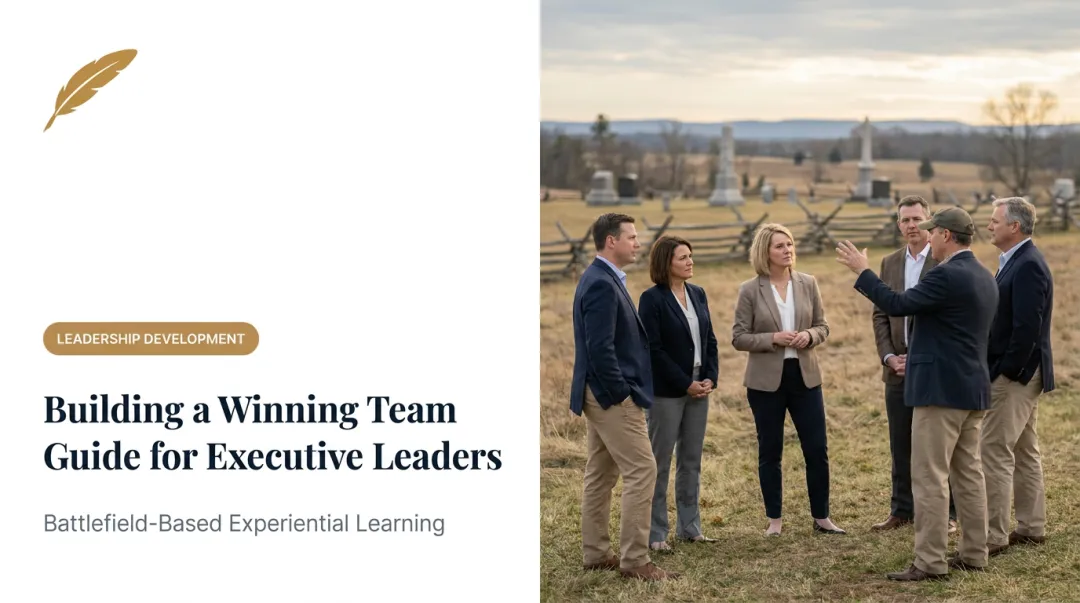
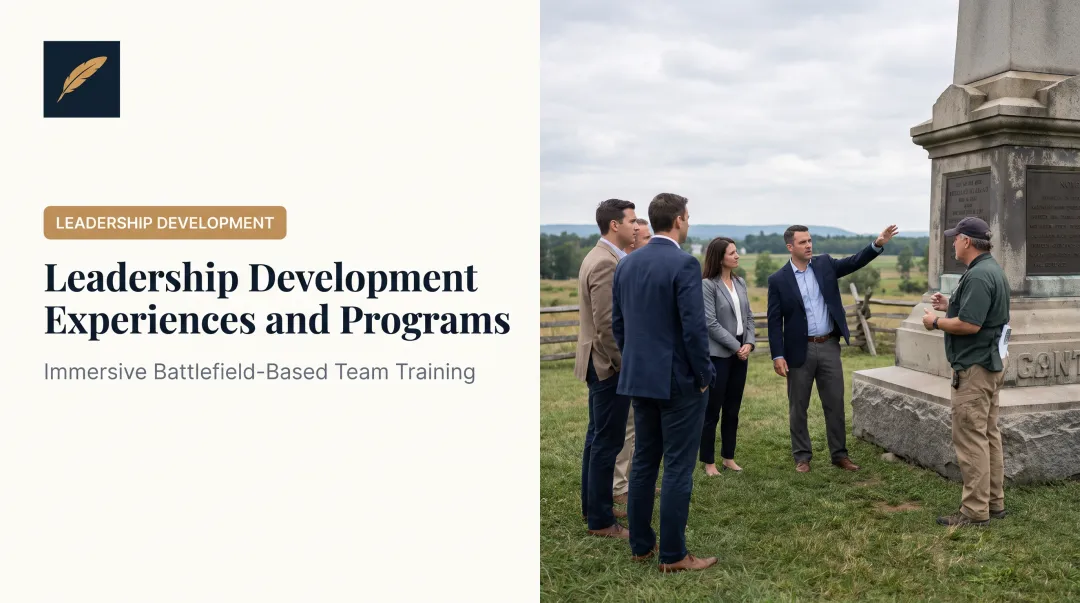
- Experiential learning providers that physically place leaders in the historic settings where Lincoln-era decisions were made
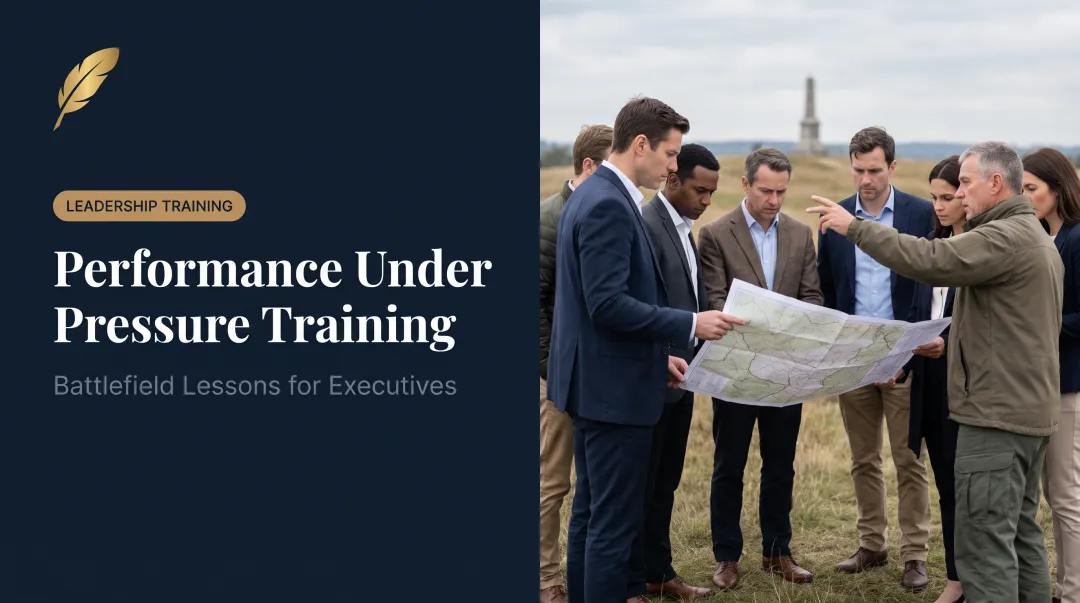
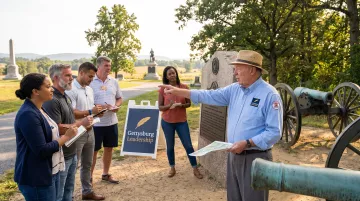
The difference in engagement is significant. A slide deck about the Emancipation Proclamation can inform. Standing where Pickett's Charge happened, while a retired military officer breaks down decision-making under fire, forces leaders to grapple with pressure, incomplete information, and consequence in real time.
Why the Setting Changes the Learning
McKinsey's research on experiential learning found that leadership training often fails to change behavior when it stays abstract and disconnected from real tasks. In a poll of more than 500 executives, only 11% strongly agreed their leadership development programs achieved and sustained results.
Programs classified as successful were four to five times more likely to require ongoing application in new settings, not a single workshop.
That distinction is central to how Lincoln Leadership Institute operates. Based in Gettysburg, Pennsylvania, and doing business as Gettysburg Leadership, the Institute has spent over 25 years building programs around historic decision points leaders can walk, question, and apply. Its mission is to equip leaders "to perform and produce in rapidly changing, stressful environments, using timeless battlefield principles to drive real results."
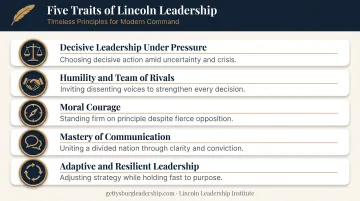
Abraham Lincoln's Leadership Style: Timeless Principles for Modern Leaders
Lincoln never ran a business, but his wartime decisions read like a model in executive judgment. Five traits stand out.
Decisive Leadership Under Pressure
On March 27, 1861, Lincoln faced a genuine no-win scenario at Fort Sumter. General Winfield Scott recommended abandoning the fort. Secretary of State William Seward opposed resupplying it. The cabinet was split.
Lincoln made the call himself: send provisions only, and send arms and men only if the mission met resistance. This calibrated middle path, documented by Longwood University's Civil War history project, let Lincoln act without overcommitting early.
Modern leaders face the same structure constantly: incomplete data, conflicting advice, and a deadline that won't wait for certainty. Lincoln's approach favored a scaled response that preserved his options—not reckless speed.
Humility and the "Team of Rivals" Approach
Lincoln appointed three men who ran against him for the 1860 Republican nomination to his cabinet: William Seward, Salmon Chase, and Edward Bates. He called them "the strongest men in the country."
Historian Doris Kearns Goodwin, interviewed by the National Archives, notes that Lincoln shared credit, accepted blame, and gave his rivals genuine access and respect. The payoff: Seward, once a skeptic, wrote that "the President is the best of us."
That's a direct lesson for any executive tempted to hire agreeable people. Dissent, managed well, sharpens decisions instead of slowing them down.
Moral Courage and Values-Based Decision-Making
Lincoln drafted the Emancipation Proclamation by mid-1862, against real political risk. Seward worried about diplomatic fallout. Postmaster General Montgomery Blair predicted it would cost Lincoln the next election.
Lincoln waited for the right moment (issuing it after the Union's showing at Antietam) but he didn't abandon the principle. The Library of Congress's archival record shows a leader balancing timing with conviction, not compromising the goal itself.
Executives facing ethical trade-offs—layoffs, product recalls, whistleblower complaints—meet a smaller version of the same test.
Mastery of Communication
The Gettysburg Address ran 272 words across 10 sentences and took roughly two to three minutes to deliver, according to a linguistic analysis hosted by the University of Pennsylvania. Edward Everett, the event's featured speaker, talked for two hours before him.
Lincoln's speech outlasted Everett's in memory because it was purposeful. It moved from founding principle to present crisis to a direct call to action, using repetition and rhythm to make abstract stakes feel personal. That's a communication lesson few executives apply: shorter and more structured beats longer and more comprehensive.
Adaptive and Resilient Leadership
Lincoln cycled through multiple Union generals—McClellan, Burnside, Hooker—before finding Ulysses S. Grant in 1864. Each change came from a clear-eyed read of results, not stubbornness or panic.
What stayed constant was the objective. The Library of Congress notes that Lincoln's purpose expanded over the war, from preserving the Union to also securing liberty for enslaved people, but the through-line of resolve never wavered. Leaders steering organizational change need both: willingness to change personnel and strategy, paired with an unshakeable long-term goal.
How Lincoln Leadership Institute Brings Lincoln's Lessons to Life
Reading about Lincoln's decisions is one thing. Standing where they happened is another.
Gettysburg Leadership's methodology puts executives on the actual ground: Gettysburg, Normandy, Pearl Harbor, and the Alamo. Each site maps to a distinct leadership theme.
- Gettysburg — decisive leadership, communication, and moral courage under pressure
- Normandy — strategic planning, alliance-building, and adaptability across complex teams
- Pearl Harbor (a three-day program including the USS Arizona Memorial) — crisis leadership and rapid decision-making
- The Alamo — resilience, courage, and leadership under extreme adversity
Faculty: Historians and Operators
The Institute's teaching roster mixes historians and operators:
- Dr. Jared Peatman, Director of Curriculum — Ph.D. from Texas A&M, author of The Long Shadow of Lincoln's Gettysburg Address, and Hay-Nicolay Dissertation Prize winner for Civil War scholarship
- Admiral Scott Moore — 30+ years in Naval Special Warfare
- Colonel (Ret.) Mark Erwin — former Chief of Staff, U.S. Army Special Operations Command
- Dennis Owens — 15-time Emmy-winning political journalist who teaches crisis communication
Program Formats for Different Needs
Not every organization can send a team to Normandy for a week. Gettysburg Leadership offers:
- One-day summits — condensed Gettysburg or Alamo experiences for busy teams
- The 2.5-day Gettysburg Leadership Journey — full immersion with lodging, meals, and coaching included
- Multi-day international programs — Normandy and Pearl Harbor experiences for deeper strategic work
- Lincoln Leadership Live — a virtual, facilitator-led program for remote teams
- Leadership Excellence Certificate Program — developed with Purdue University Global, pairing experiential training with an academic credential
Across 25+ years, the Institute has worked with 25,488+ Fortune 1000 and public sector clients and transformed more than 40,000 leaders. Named clients include Pfizer, FedEx, GE, the Department of Defense, and the U.S. Treasury.
Those programs are led in part by President Steven B. Wiley, whom ABC News called "the best speaker you've never heard of."
Who Should Work With a Lincoln-Inspired Leadership Advisor
This approach isn't for every team, but it fits several groups particularly well.
- C-suite executives and high-potential leaders who need sharper decision-making under real pressure, not theoretical case studies
- HR and L&D professionals tasked with proving measurable culture and retention improvements from a training budget
- Public sector, defense, healthcare, and financial services organizations in high-accountability environments where mistakes carry outsized consequences
Gallup's 2025 CHRO survey found that 59% of HR leaders now say employee development is among their toughest struggles, up 16 points from the year before. That gap is where experiential, historically grounded programs outperform standard classroom training—especially when leaders must show culture and retention results, not just completion rates.
What to Look for When Choosing a Leadership Development Partner
Not every "Lincoln leadership" provider offers the same depth. Before committing budget, check for these four things.
- Experiential over lecture-based methodology: Ask whether the program involves real immersion or just a themed presentation.
- Academic accreditation or university partnerships: Look for a certificate tied to an accredited institution (like Purdue University Global); it carries more weight internally.
- Faculty diversity and depth: Look for a mix of military, journalism, historical, and organizational psychology backgrounds, not a single generalist speaker.
- Documented client outcomes: Request case studies or testimonials showing actual performance or retention improvements, not just satisfaction scores.
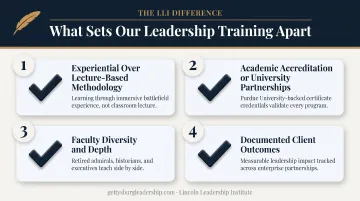
A quick gut check: if a provider can't name specific historic sites, specific faculty credentials, or specific client outcomes, it's likely offering inspiration without infrastructure.
Frequently Asked Questions
What was Abraham Lincoln's leadership style?
Lincoln's leadership blended decisiveness under uncertainty, humility (surrounding himself with rivals and dissenting voices), moral courage on issues like emancipation, and clear, purposeful communication.
What is Lincoln Leadership Institute?
Lincoln Leadership Institute, operating as Gettysburg Leadership, is an experiential leadership development organization based in Gettysburg, Pennsylvania. It uses historic battlefields, including Gettysburg, Normandy, Pearl Harbor, and the Alamo, to teach leadership principles.
How long are Lincoln Leadership Institute's programs?
Formats range from one-day summits to the 2.5-day Gettysburg Leadership Journey, multi-day international experiences at Normandy and Pearl Harbor, and the virtual Lincoln Leadership Live sessions.
Is the Leadership Excellence Certificate Program accredited?
Yes. The program is offered in partnership with Purdue University Global, which issues a formal Certificate of Leadership and a verified digital badge for LinkedIn and professional profiles.
Can teams attend Lincoln Leadership Institute programs virtually?
Yes. Lincoln Leadership Live is a facilitator-led virtual program that delivers battlefield-based leadership lessons to remote participants without requiring on-site travel.
What types of organizations use Lincoln-inspired leadership training?
Fortune 1000 companies, government agencies, and organizations in defense, healthcare, and financial services use these programs. Named clients include Pfizer, FedEx, GE, the Department of Defense, and the U.S. Treasury.