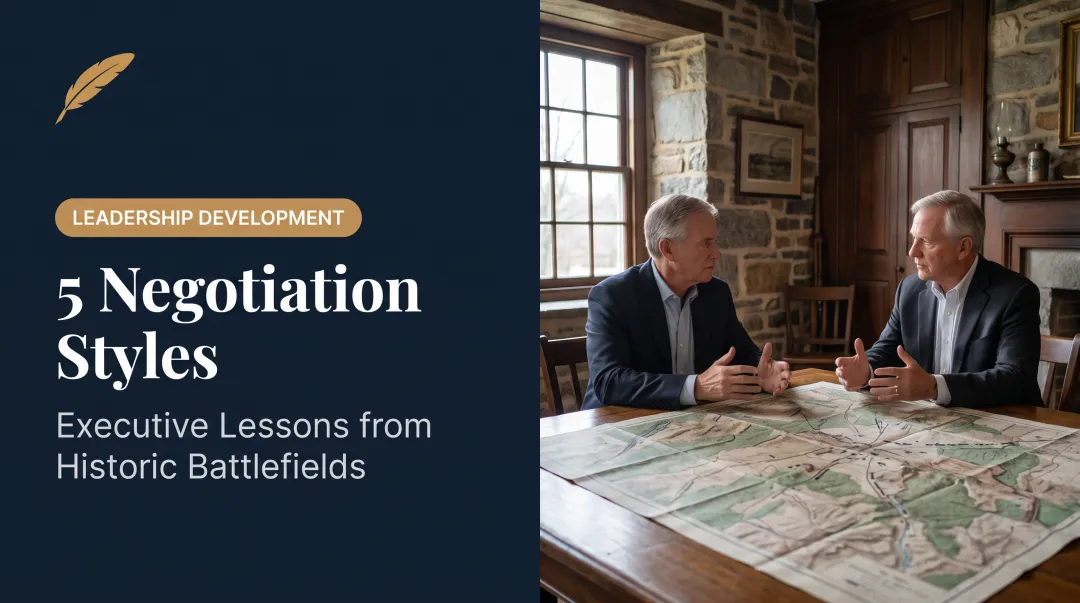
This scene plays out in offices everywhere, every single day. Conflict isn't a sign something's broken in your organization — it's a sign your organization is full of people who care about outcomes.
But unmanaged conflict has a price tag. A widely cited CPP Global Human Capital Report found that US employees spent an average of 2.8 hours per week dealing with workplace conflict, translating to roughly $359 billion in paid working hours lost in a single year.
This guide breaks down the types and causes of workplace conflict, the five proven management styles, the negotiation process step by step, and how leaders actually build these skills when the stakes are real.
Key Takeaways
- Moderate conflict sharpens decision-making, but poorly managed conflict erodes trust and morale
- Three core conflict types exist: intrapersonal, interpersonal, and intergroup
- Five conflict-handling styles exist, with collaboration winning most complex disputes
- Strong negotiators always know their BATNA before negotiations begin
- Mediation and arbitration offer paths forward when direct negotiation stalls
Understanding Conflict in Organizational Behavior
Organizational conflict is a process that begins when one party perceives that another party has negatively affected, or is about to negatively affect, something the first party cares about. It centers on incompatible goals, interests, or values between people who depend on each other to get work done.
That interdependence matters. Two strangers who never interact can't have organizational conflict. Two coworkers sharing a budget, a deadline, or a reporting line can.
Types of Conflict in the Workplace
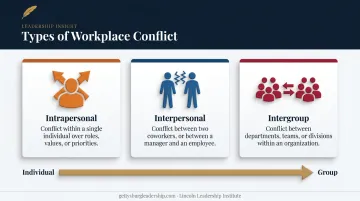
Conflict shows up in three distinct forms, and each requires a different response.
Intrapersonal conflict happens inside one person, often triggered by role ambiguity or role conflict. A marketing manager reporting to both a regional VP and a global brand director, with each giving contradictory instructions, is living intrapersonal conflict daily.
Interpersonal conflict occurs between two or more individuals, such as coworkers, a manager and a direct report, or peers competing for the same promotion. Conflict touches nearly every employee at some point, making it one of the most common friction points in any organization.
Intergroup conflict plays out between departments, unions, or divisions. For example, in 2019, CNN agreed to pay more than $70 million to settle a labor dispute that had dragged on for roughly 15 years. More than 200 camera operators and technicians alleged the network restructured subcontracting arrangements to sidestep union obligations.
Common Root Causes of Conflict
Most workplace conflict traces back to a handful of structural triggers:
- Organizational structure issues: matrix reporting lines that leave employees answering to two or more bosses
- Limited resources: competing for the same budget, headcount, or equipment
- Task interdependence: one team's output is another team's input, creating built-in friction points
- Incompatible goals: departments optimizing for different metrics that pull against each other
- Communication breakdowns: assumptions, missed context, or simply talking past each other
Is Conflict Always Bad? The Functional vs. Dysfunctional Debate
Here's where it gets interesting. Studies on team dynamics reveal a curvilinear, inverted-U relationship between task conflict and team innovation. Teams with moderate levels of task conflict actually outperformed teams with very low or very high conflict.
The logic makes sense once you see it. Too little disagreement breeds complacency: nobody challenges the plan, so weak ideas sail through. Too much disagreement creates overload: teams get stuck relitigating the same disputes instead of moving forward.
That said, this benefit applies specifically to task conflict, disagreement about ideas and approaches. Relationship conflict, the personal, emotional kind, tends to hurt performance and satisfaction regardless of how much or how little there is.
Conflict Management Styles: Choosing the Right Approach
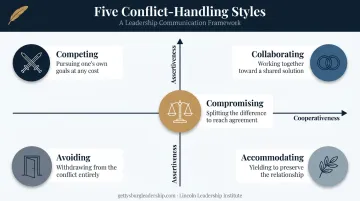
The Thomas-Kilmann Conflict Mode Instrument maps five conflict-handling styles across two dimensions: assertiveness (how much you push for your own concerns) and cooperativeness (how much you consider the other party's concerns).
| Style | Assertiveness | Cooperativeness |
|---|---|---|
| Avoiding | Low | Low |
| Accommodating | Low | High |
| Compromising | Moderate | Moderate |
| Competing | High | Low |
| Collaborating | High | High |
Avoiding works when an issue is genuinely trivial or when you need time to cool off. Use it too often, though, and important problems just fester under the surface until they erupt.
Accommodating means yielding your position to preserve a relationship you value more than the immediate outcome. It's the right move when the issue matters far more to the other party than it does to you.
Compromising splits the difference. LVMH's 2020 negotiation with Tiffany illustrates this well: litigation forced both sides to renegotiate the original $135-per-share deal down to $131.50, saving LVMH roughly $430 million while still closing the sale. Neither side got everything, but both got the deal done.
Competing is a forceful, assertive stance, and it's justified when the situation demands quick, decisive action or when a matter of principle or safety is non-negotiable.
Collaborating seeks a genuine win-win by digging into what each party truly needs, not just what they're demanding. Collaboration is the most broadly effective style for complex, high-stakes conflicts — though it takes more time and trust than the other four combined.
Negotiation in the Workplace: Types, Stages & Strategies
Negotiation is a process where two or more interdependent parties, who have some conflicting interests, seek to reach an agreement they can both accept. It's related to conflict resolution but narrower: negotiation is a specific tactic, not the entire process of managing disagreement.
Distributive vs. Integrative Negotiation
Distributive negotiation treats the outcome as a fixed pie. Whatever one side gains, the other side loses. Haggling over the price of a used car is the textbook example — every dollar off the price is a dollar out of the seller's pocket.
Integrative negotiation looks for ways to expand the pie before dividing it. Say two departments are fighting over shared conference room time. Instead of splitting hours evenly, an integrative approach might uncover that one team needs morning slots for client calls while the other only needs afternoon availability, creating a trade that satisfies both sides without anyone losing ground.
The Five Stages of the Negotiation Process
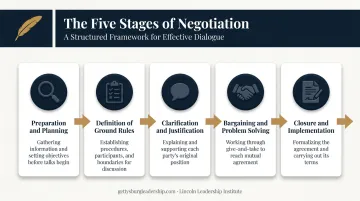
Every effective negotiation, whether it's a salary discussion or a multi-million-dollar merger, moves through the same five stages:
- Preparation and planning: Define your goals, gather information, and understand the other party's likely position before you ever sit down.
- Definition of ground rules: Establish who's negotiating, where, on what timeline, and what topics are on the table.
- Clarification and justification: Each side explains and supports its original demands.
- Bargaining and problem solving: The real give-and-take happens here, where concessions and trade-offs get worked out.
- Closure and implementation: Formalize the agreement and set up the process for follow-through.
Skipping stage one is the most common mistake leaders make. Walking in without a clear sense of your position, or theirs, puts you at an immediate disadvantage.
Understanding Your BATNA
Roger Fisher and William Ury coined the term BATNA, Best Alternative to a Negotiated Agreement, in their 1981 book Getting to Yes. It's your fallback plan if the current negotiation falls apart.
Knowing your BATNA does two things: it tells you when to walk away, and it gives you leverage at the table, because you're not negotiating from desperation. A negotiator with a strong BATNA can hold firm; one without any alternative often accepts terms they'll regret.
Common Negotiation Challenges and Third-Party Resolution
Not every negotiation goes smoothly, even with good preparation. Personality plays a bigger role than most people expect.
High emotional intelligence tends to build trust and rapport with a counterpart, even when it doesn't directly boost the size of the deal. Machiavellian tendencies, by contrast, can produce short-term economic wins, particularly in face-to-face settings, but often at the cost of the relationship and future goodwill.
Cultural differences add another layer of complexity, especially as teams go global and remote. Attitudes toward directness, the pace of concessions, and the importance of relationship-building before business all vary widely across cultures.
This variation matters more each year. As distributed teams become the norm, employees are spending more time managing workplace conflict than they did a decade ago, making cross-cultural negotiation skills a growing priority.
Watch for these classic negotiation traps:
- Winner's curse: Winning the deal but overpaying because the desire to win overrode sound judgment
- Fixed-pie assumption: Treating the negotiation as purely zero-sum and missing value-creating trades
- Overconfidence: Trusting your own read on the situation so much that you stop seeking new information
- Escalation of commitment: Doubling down on a losing position because of what's already been invested
When to Bring in a Third Party
When direct negotiation stalls, an outside party can break the deadlock:
| Process | Role | Who decides? |
|---|---|---|
| Mediation | Facilitates dialogue toward a settlement | The parties themselves |
| Conciliation | Advises on facts, rights, and likely outcomes | The parties themselves |
| Arbitration | Hears both sides and renders a decision | The arbitrator |
Mediation and conciliation preserve the relationship because both sides retain control of the outcome. Arbitration sacrifices some of that control in exchange for a final, binding answer.
Building Real Conflict & Negotiation Capability as a Leader
Most corporate training on conflict and negotiation happens in a conference room or on a laptop screen. It's low-stakes by design. Nobody's career, reputation, or team morale is actually on the line during the role-play exercise. That's exactly why so many leaders freeze the first time real conflict hits.
Lincoln Leadership Institute takes a different approach. Rather than teaching negotiation theory in a classroom, LLI's programs put leaders on the actual ground where history's highest-stakes decisions were made: Gettysburg, Normandy, Pearl Harbor.
Faculty bring real high-pressure experience into the room, including:
- Retired Navy Rear Admirals and career Navy SEALs who've led through genuine crises
- Federal executives who've navigated high-stakes government negotiations
- Dr. Jared Peatman, certified to administer the EQ-i2.0 and EQ360 emotional intelligence assessments
The historical grounding isn't decorative. LLI's own case studies include an analysis of Pickett's Charge as a broken negotiation between Generals Lee and Longstreet. These studies show participants exactly what happens when communication and negotiating positions fail under pressure, and what it costs.
For organizations specifically targeting negotiation skills, LLI's High-Impact Negotiations Workshop covers conflict resolution, professional communication, and win-win bargaining strategies through exercises built around historic and modern negotiations alike.
This isn't a fringe experiment. LLI has trained more than 40,000 leaders and served over 25,488 Fortune 1000 and public sector clients, including organizations like Pfizer, FedEx, GE, and the Department of Defense.
Investing in this kind of development signals something to high-potential talent: the organization is serious about their growth, not just checking a training box. If you're weighing how to build this capability in your own leadership pipeline, reaching out directly is a reasonable next step.

Frequently Asked Questions
What is the difference between conflict management and negotiation in organizational behavior?
Conflict management is the broader process of addressing any disagreement, using tools like avoiding, accommodating, or collaborating. Negotiation is one specific tactic within that process, aimed at reaching a mutually acceptable agreement.
What are the five conflict-handling styles in organizational behavior?
They are avoiding, accommodating, compromising, competing, and collaborating. Collaboration is generally the most effective for complex, high-stakes issues, though each style has its place depending on the situation.
What is BATNA in negotiation?
BATNA stands for Best Alternative to a Negotiated Agreement, the fallback option if talks fail. It's the standard against which every negotiated deal should be measured before you accept it.
Is conflict always bad for a company?
No. Moderate, task-focused conflict can improve creativity and decision quality by encouraging teams to challenge weak ideas. Personal or excessive conflict, however, consistently harms performance and trust.
What's the difference between distributive and integrative negotiation?
Distributive negotiation divides a fixed resource, so one side's gain is the other's loss. Integrative negotiation looks for trade-offs across multiple issues to create value for both sides.
When should a company use mediation instead of arbitration?
Use mediation when both parties want to preserve their relationship and reach their own solution collaboratively. Use arbitration when you need a final, binding decision from a neutral third party.