Yet plenty of companies pour money into workshops and multi-day retreats and still can't answer a basic question: did it work? Leaders return energized for a few weeks, then old habits creep back in. Retention numbers don't budge. The board asks for ROI, and HR has anecdotes instead of data.
This guide breaks down what executive leadership development actually means, the program formats available, the skills the best programs build, and how to choose one that fits your organization instead of a generic template.
Key Takeaways
- Develops senior leaders and high-potential successors in strategic thinking, decisive action, and influence
- Spans classroom executive education, one-on-one coaching, and immersive experiential learning
- Builds measurable skills: strategic judgment, pressure-tested decisions, communication, and EQ
- Match format and faculty to your organization's challenges—skip one-size-fits-all curricula
What Is Executive Leadership Development?
Executive leadership development is structured training built to sharpen strategic thinking, decision-making, and influence for senior leaders and the people being groomed to replace them. Unlike a single workshop on time management or delegation, these programs assume participants already know how to manage. The goal is to teach them how to lead an entire enterprise.
"Executive" typically means:
- C-suite officers — CEO, COO, CFO, CHRO, and similar roles
- Senior vice presidents with organization-wide P&L or strategic responsibility
- Directors who set enterprise-wide vision and report directly to the board or CEO
This is a different animal from frontline supervisor training or mid-management courses. A frontline program might cover how to run a productive one-on-one. An executive program covers how to communicate a painful restructuring decision to a skeptical board.
General management training focuses on execution: process improvement, team supervision, day-to-day operations. Executive leadership development focuses on enterprise-wide vision, stakeholder communication, and high-stakes judgment made with incomplete information.
The two overlap, but conflating them is why some companies send a promising director to a course built for department supervisors and wonder why nothing changed.
Why Executive Leadership Training Matters More Than Ever
Markets don't hold still anymore. Supply chains snap, competitors reinvent categories overnight, and workforce expectations keep shifting. Leaders who can't adapt in real time become a liability, and that liability has a price tag.
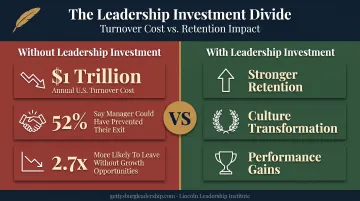
Gallup's research puts the cost of voluntary turnover in the U.S. at $1 trillion annually, with 52% of people who quit saying their manager or organization could have kept them if things had gone differently. For large employers, that points to a leadership-behavior problem with a real P&L cost.
Leadership Investment Signals Commitment
High-potential leaders notice when a company invests in them, and they notice when it doesn't. DDI's research on high-potential talent found that employees who don't receive regular growth opportunities from their manager are 2.7x more likely to intend to leave within a year. Executive development builds skill and doubles as a retention lever for the people you can least afford to lose.
Clients have felt this directly. A Pfizer leader described the Lincoln Leadership Institute's program as a "sustained, transformational leadership experience that has reshaped our culture, repurposed our mission and driven outstanding performance results." That is a culture-and-performance outcome, not a one-off training day.
From Theory to Muscle Memory
Leadership behavior cascades. A team lead who freezes under pressure teaches their team to freeze too. That's why the industry has shifted away from purely theoretical, classroom-based learning toward experiential and practice-based models. Those models build muscle memory for real decisions, not just familiarity with a framework.
Boards and CFOs have taken notice. They're no longer satisfied with "leaders reported high satisfaction." They want measurable outcomes tied to the spend:
- Retention rates
- Promotion pipeline strength
- Performance metrics that move after the program, not only during it
Types of Executive Leadership Training and Development Programs
Program format matters as much as content. A brilliant curriculum delivered in a format that doesn't stick with your leaders is money wasted.
Classroom & Academic-Style Programs
University-affiliated executive education (think Wharton, Harvard, or Stanford executive programs) offers strong academic credibility and structured curricula built by faculty researchers. These programs excel at frameworks: strategic analysis models, case-study discussion, peer networking with executives from other industries.
Their limitation is real-world pressure. A case study about a crisis is not the same as living through one. Leaders can ace the classroom discussion and still hesitate when a real decision has to be made in the next ten minutes.
Executive Coaching & Mentoring
One-on-one coaching pairs a leader with a dedicated coach for individualized development, often built around 360-degree feedback and tied to succession planning. This format is ideal for leaders with a specific gap (say, executive presence or delegation) rather than a broad skill overhaul. It's slower to scale across a large cohort but delivers depth that group programs can't match.
Experiential & Immersive Leadership Programs
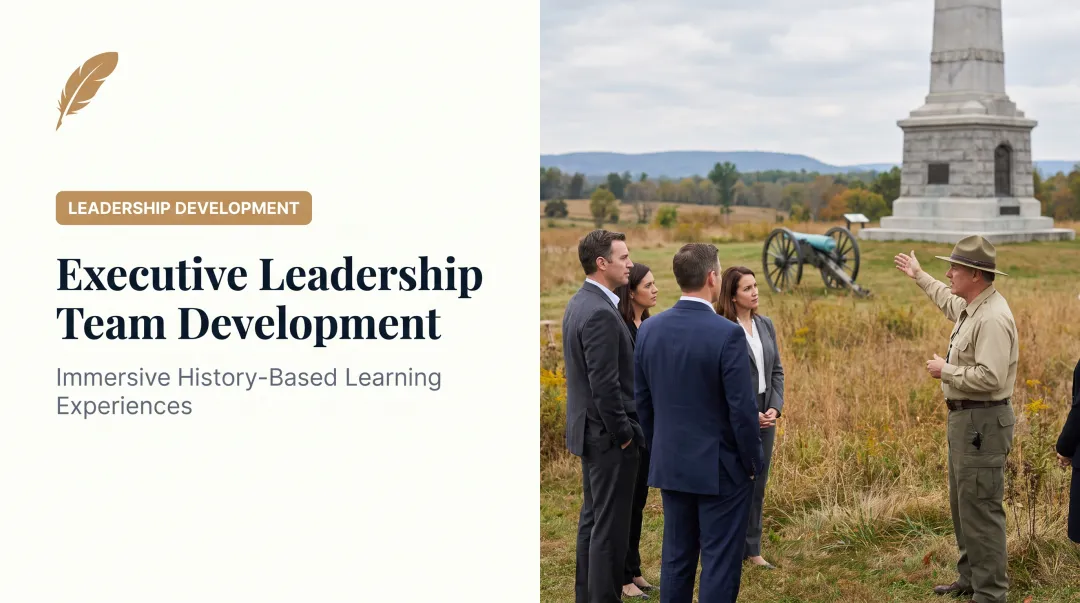
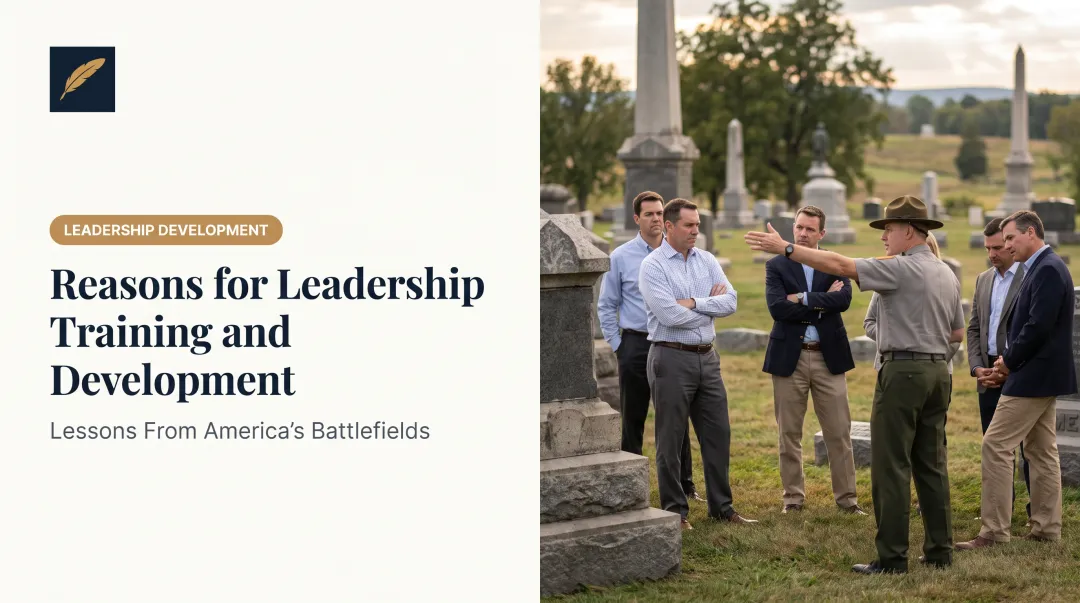
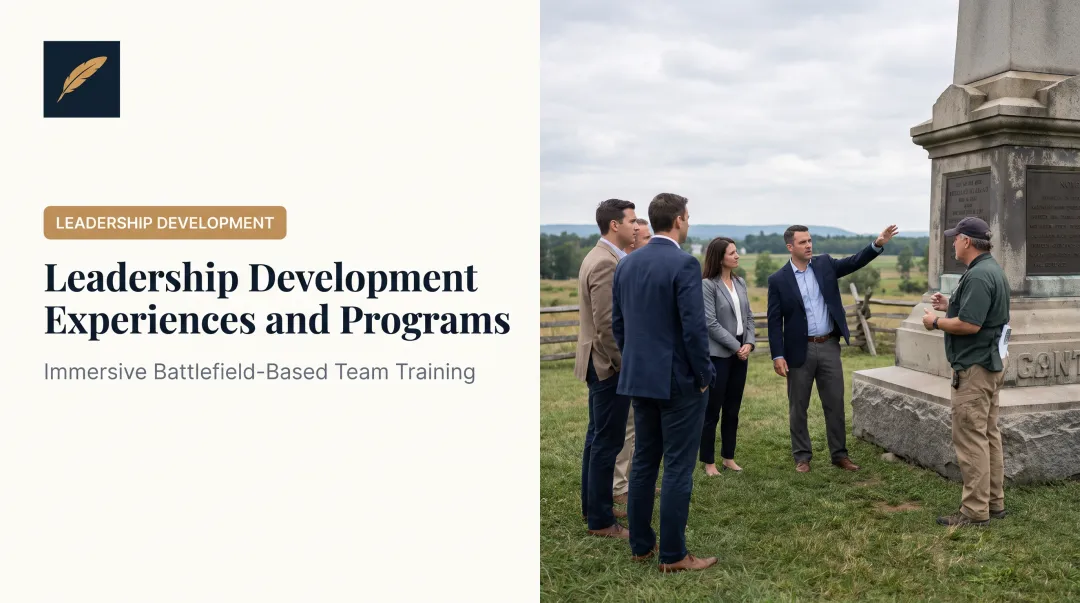
Immersive, scenario-based learning places leaders in high-stakes environments (historical or simulated) to build decisiveness, resilience, and teamwork under real pressure.
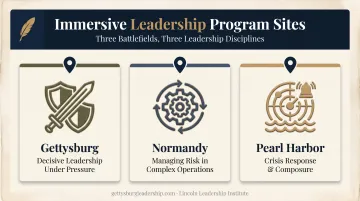
The Lincoln Leadership Institute's battlefield programs are a clear example of this model: multi-day experiences at Gettysburg, Normandy, and Pearl Harbor, led by faculty including retired military commanders, historians, and certified emotional intelligence assessors.
Each site carries a distinct theme:
- Gettysburg: decisive leadership and courageous decision-making under rapidly changing conditions
- Normandy: coordinating complex operations and managing risk when the stakes are existential
- Pearl Harbor: crisis response, situational awareness, and composure during sudden disruption
Hybrid & Virtual Formats
Hybrid and virtual options are expanding for distributed teams. Lincoln Leadership Live, for example, delivers battlefield-inspired lessons through live, facilitator-led virtual sessions. That format fits organizations that can't gather everyone in one place but still want experiential intensity.
Core Skills and Competencies Effective Programs Build
The best programs aren't measured by how many hours leaders sit in a room. They're measured by which skills stick once leaders are back at their desks.
- Strategic thinking and commercial judgment — anticipating risk, weighing trade-offs, and allocating resources toward long-term goals rather than the next quarterly number
- Decision-making under pressure and uncertainty — the ability to act decisively with incomplete information, not paralysis until every fact is confirmed
- Communication and executive presence — translating complex strategy for a board, then translating it again for a frontline team, without losing meaning either way
- Emotional intelligence and self-awareness — increasingly measured through validated tools like the EQ-i 2.0 and EQ360 assessments, which support better conflict resolution and team trust
- Resilience, courage, and values-based decision-making — qualities strengthened far more effectively through pressure scenarios and historical case studies than through lecture slides
Decision-making under pressure is easier to name than to practice. Consider Johnson & Johnson's 1982 Tylenol crisis. When cyanide-laced capsules killed seven people, CEO James Burke had no playbook and no certainty about how the poisoning happened.
He authorized a $100 million recall of 31 million bottles: a decision made fast, with incomplete information, that put customer safety ahead of short-term cost. Market share cratered from 35% to 7%, then recovered fully within about a year. That's decision-making under pressure with real consequences—and exactly the kind of scenario immersive programs recreate before a leader faces their own version of it.
Self-perception gaps are common. Senior leaders often rate their own EQ higher than their teams do. That's why validated 360-degree assessments matter more than self-reported confidence. Programs with faculty certified to administer tools like the EQ-i 2.0, such as Lincoln Leadership Institute's Dr. Jared Peatman, can surface those blind spots with data instead of guesswork.
How to Choose the Right Executive Leadership Program for Your Organization
Not every program fits every organization, and the wrong fit wastes budget and credibility.
- Match the curriculum to your actual challenge. A generic leadership course won't address succession planning, culture change, or post-merger integration. Ask the provider directly how their content addresses your specific situation before signing a contract.
- Evaluate faculty and format together. Look for practitioners with real command experience, such as military leaders, C-suite veterans, or certified coaches, rather than instructors who've only taught theory. Then choose a format that fits your team: a one-day summit, multi-day immersion, or virtual session.
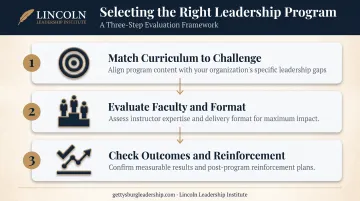
Lincoln Leadership Institute, for example, pairs historic-site immersion with a Purdue University Global-affiliated certificate for teams that want experiential depth plus an academic credential. 3. Check for measurable outcomes and reinforcement. Client testimonials, quantified impact numbers, and follow-up support matter more than a glossy brochure. Ask for specifics before you commit, such as GE's feedback on rethinking strategic planning or a government agency describing direct mission application and ROI.
Organizations choosing between formats often start with an open enrollment cohort for a handful of leaders, then move toward a private or enterprise model once they've seen results firsthand.
Frequently Asked Questions
What is meant by executive leadership?
Executive leadership refers to the top-tier decision-makers who set organizational vision, strategy, and culture. It's distinct from operational or frontline management, which focuses on executing that strategy day to day.
What level is executive leadership?
Executive leadership typically covers C-suite roles, senior vice presidents, and directors who report to the board or CEO. Their decisions shape company-wide strategy, not a single department.
Who is higher, CEO or executive director?
In for-profit corporate hierarchies, the CEO generally sits above an executive director. In nonprofits, however, "executive director" often functions as the top executive role, equivalent to a CEO in structure and authority.
What are the 7 C's of executive presence?
Frameworks vary, but commonly cited elements include confidence, clarity, composure, connection, credibility, courage, and communication. Treat any "7 C's" list as one useful lens—not a universal standard.
How long do executive leadership training programs typically last?
Formats range from single-day intensives and multi-day immersive experiences to multi-month coaching engagements or year-long certificate programs. Choose length based on whether you need a quick catalyst or sustained behavior change.
What kind of ROI can companies expect from executive leadership development?
Measure ROI through retention, internal promotion rates, and performance metrics—not satisfaction surveys alone. Industry analyses have reported returns above 400% for strong programs, with higher retention often showing within a few years.