That gap matters. HR and L&D teams searching for the "components of high-performance teams" usually find a tangle of frameworks — 5 elements here, real-time devices there, mysterious references to "PALs" that don't quite make sense in a corporate context. This article sorts through that confusion.
We'll break down the core components every major framework agrees on, settle which one carries the most weight when stakes are highest, and show how Lincoln Leadership Institute's battlefield-based programs put that answer into practice.
Key Takeaways
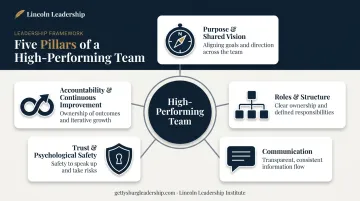
- Five interconnected components drive high-performing teams: purpose, structure, communication, trust, and accountability.
- Trust and communication act as the multiplier that lets the other three components function under real pressure.
- The "too-much-talent effect" shows that star power alone can't replace strong team dynamics.
- Immersive, high-stakes learning builds these components faster than classroom theory alone.
The 5 Core Components of High-Performing Teams
Different organizations label these elements differently. The Center for Creative Leadership uses its "4 Cs" (Context, Composition, Competencies, Change). FranklinCovey talks about high-trust leadership and clarity of goals. Time Doctor lists six key components in one article and four pillars in another.
Strip away the branding, though, and five recurring elements show up across nearly every credible model.
Purpose & Shared Vision
A team without a clear reason for existing drifts. Members optimize for their own tasks instead of a shared outcome, and coordination breaks down the moment priorities compete.
This isn't a new problem. A 2004 FranklinCovey-commissioned survey of over 12,000 U.S. workers found that only 15% could identify their organization's top three goals.
That figure is more than two decades old and comes from a nonprobability online sample, so treat it as a historical benchmark rather than an exact current figure. Most leaders today would still admit purpose clarity hasn't improved dramatically since.
Roles & Structure
Clear roles prevent two failure modes at once: duplicated effort, where three people quietly work the same problem, and talent overshadowing, where your best performer absorbs work that should belong to someone else.
Good structure creates clarity without adding bureaucracy. Teams with clear structure know who owns what; teams without it reinvent the org chart every time a deadline hits.
Communication
Communication is the connective tissue holding everything else together. This includes:
- Regular check-ins and status meetings
- Transparent escalation paths when something goes wrong
- Real-time coordination tools — radios, dashboards, messaging platforms
- Closed-loop confirmation so instructions don't get lost in translation
A 2018 meta-analysis published in the Human Resource Management Review confirmed that communication quality and frequency both relate significantly to team performance, though they operate through slightly different mechanisms.
Trust & Psychological Safety
Trust is what lets a team member admit a mistake before it becomes a crisis, or float an unpopular idea without fear of getting shut down. Under stress, teams without this foundation tend to freeze, hide problems, or fracture into factions.
Military units often call this psychological cover: the assurance that leaders will back subordinates who report problems early rather than punish them for surfacing bad news.
Accountability & Continuous Improvement
Feedback loops keep a team from plateauing. After-action reviews and honest performance conversations turn experience into improvement instead of repetition, provided the team stays focused on results rather than effort alone.
The military's after-action review process, for example, forces teams to name what went wrong within hours of an event, not months later during an annual review.
Which Component Matters Most? The Case for Trust and Communication
All five components matter. But when a team is under real pressure , facing a missed deadline, a crisis, or a decision made with incomplete information, research and expert consensus point to one place: trust and communication are the foundation everything else stands on.
Google's internal Project Aristotle research studied 180 teams and ranked five dynamics driving effectiveness:
- Psychological safety — the top-ranked driver of team performance
- Dependability
- Structure and clarity
- Meaning
- Impact
Purpose without trust becomes a slogan on a wall. Structure without communication becomes a flowchart nobody follows.
What Real-Time Devices and "PALs" Actually Represent
Two terms often surface in searches about high-performance team components, and they deserve a straight answer.
Real-time devices (think radios, live dashboards, instant messaging) map most directly to the Communication component. They exist to close the gap between "something changed" and "the team knows about it," which is exactly what communication is supposed to do.
PALs is trickier. In the medical training world, PALS stands for Pediatric Advanced Life Support, a certification course, not an acronym for peer accountability or feedback.
If you've encountered "PALs" tied to team-component frameworks, it's likely a crossover from clinical training language rather than a standard HR/L&D model. Where the concept does apply to corporate teams, it lines up with the accountability and feedback loop, since peer-based check-ins serve a similar function.
A Battlefield Lesson in Delegated Trust
On July 1, 1863, Union commander George Meade wasn't yet on the field at Gettysburg. He sent General Winfield Scott Hancock ahead as his representative, and Hancock took command of what the National Park Service describes as a chaotic, rapidly shifting situation.
Meade didn't have full visibility. He had to trust that Hancock would communicate clearly and act decisively without waiting for perfect information.
That's the exact dynamic corporate teams face during a product failure, a PR crisis, or a market shift nobody saw coming. Leadership's job isn't to hope trust and communication develop naturally. It's to build them deliberately, before the pressure hits.
Avoid the "Too-Much-Talent" Trap
More star performers should mean better results. Research says otherwise, at least once a certain point is crossed.
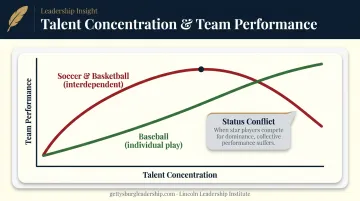
Researchers analyzing FIFA World Cup qualifiers, the NBA, and MLB found that team performance follows a curve, not a straight line, when it comes to concentrated talent:
- In soccer and basketball, sports requiring tight coordination, performance improved with more talent, then declined once elite players dominated the roster.
- In baseball, where play is more individual and less interdependent, more talent kept paying off with no decline.
- The mechanism appears to be status conflict: too many high-status players compete for influence, and coordination suffers as a result.
The lesson for corporate teams: the effect shows up specifically in interdependent work, not in every team. If your team's success depends on tight coordination, piling on stars without addressing cohesion can backfire.
Practical takeaways for leaders:
- Treat top talent as part of a constellation, not a solo act
- Distribute recognition and development opportunities beyond your top 20%
- Watch for status competition among high performers before it undermines coordination
- Select for complementary skills, not just individual brilliance
How Lincoln Leadership Institute Builds These Components Through Immersive History
Classroom training can explain trust and communication. It can't recreate the pressure that actually tests them.
That's the premise behind Lincoln Leadership Institute's approach. Programs held at Gettysburg, Normandy, and Pearl Harbor put teams into historically grounded, high-stakes scenarios. Trust, communication, and decision-making get stress-tested simultaneously. Participants apply these skills in real time, under conditions that mirror real organizational pressure.
These flagship programs vary by location, length, and focus:
| Program | Duration | Focus |
|---|---|---|
| Gettysburg Leadership Journey | 2.5 days | Leading with incomplete information, communicating clearly when priorities compete |
| Pearl Harbor Program | 3 days | Leading through the unexpected |
| Normandy D-Day Experience | Multi-day | Alliance-building and strategic coordination under extreme pressure |
Faculty bring lessons that can't be taught from a textbook:
- Admiral Scott Moore, a retired Navy Rear Admiral with 30+ years in Naval Special Warfare
- Dave Cooper, a US Navy SEAL since 1988, focused on team cohesion in life-or-death situations
- Colonel (Ret.) Mark Erwin, former Chief of Staff of US Army Special Operations Command
- General James Anderson, bringing senior command experience in large-scale strategic leadership
LLI also measures growth in these components through the EQ-i2.0 and EQ360 Emotional Intelligence Assessments, and credentials it through the Purdue University Global-accredited Leadership Excellence Certificate Program, pairing experiential learning with academic rigor.
Frequently Asked Questions
What are the 5 elements of high-performance teams?
Purpose, roles/structure, communication, trust, and accountability. These five elements show up consistently across major frameworks, even when the labels differ from source to source.
Which component of effective high-performance teams is represented by the use of real-time devices?
Real-time devices, such as radios, dashboards, and messaging platforms, represent the Communication component. They enable instant information sharing and coordination when conditions change quickly.
Which component of effective high-performance teams is represented by PALs?
PALs most commonly refers to Pediatric Advanced Life Support, a medical certification, rather than an HR framework term. Where the concept applies to teams generally, it aligns closest with peer accountability and feedback.
What is the single most important component of a high-performing team?
Trust and communication function as the foundation. Without them, purpose, structure, and accountability tend to collapse the moment a team faces real pressure.
Can a team really have too much talent?
Yes, in interdependent work like soccer or basketball. Research shows performance can decline once high-status talent dominates the roster, largely due to status conflict undermining coordination.
How long does it take to build a truly high-performing team?
Timelines vary by organization and starting point. Immersive, experiential development, such as multi-day battlefield programs, tends to accelerate trust and communication building compared to traditional classroom training alone.