Here's the truth: the difference between a forgettable trip and a culture-shifting investment comes down to a handful of decisions made early, not the fancier hotel or the better catering menu. Most retreat advice online is either vague philosophy about "team synergy" or a recycled list of icebreaker games. Neither helps you actually plan the thing.
This guide walks through five concrete steps, in the order they actually need to happen. The core premise is simple: the right retreat is one where the goal, venue, schedule, and activities all point in the same direction.
Key Takeaways
- Define the goal before touching logistics — it determines venue, format, and activities
- Match venue type to purpose: quiet for strategy, shared for bonding, immersive for leadership growth
- Protect unstructured time — real connection happens there
- Measure results two weeks post-retreat, then build a one-page case for next year
Why Corporate Retreats Matter More Than Ever
Remote and hybrid work reshaped how often teams actually see each other in person. In Q1 2024, 22.9% of employed people teleworked for pay during an average week, according to the U.S. Bureau of Labor Statistics (up from 19.6% a year earlier). That's a meaningful chunk of the workforce that isn't sharing a hallway anymore.
When people aren't bumping into each other by default, intentional gathering has to replace accidental connection. That's the whole argument for retreats: intentional gatherings are now a deliberate substitute for the connection distance erodes.
But not every offsite earns that label. There's a real difference between:
- A strategically designed retreat: clear goal, defined outcome, measured afterward
- A generic team outing: nice venue, fun activities, no thread tying it together
Leadership can tell the difference too, usually at budget-approval time. A retreat with a stated goal reads as an investment. One without reads as an expense line someone will question next quarter. The goal you set at the outset should determine every downstream decision: venue, schedule, budget, activities. That's Step 1.
Step 1: Define the Purpose and Goals of Your Retreat
The most common planning mistake is skipping straight to logistics. Booking a venue before deciding why you're gathering is like buying plane tickets before picking a destination. Harvard Business Review notes that a well-run executive retreat should send senior leaders home with clearer direction and renewed cohesion. That only happens when the goal was clear going in.
Common Goal Categories
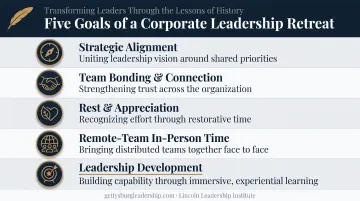
Most retreats fall into one of these categories:
- Strategic alignment or planning — leadership needs uninterrupted time to set direction
- Team bonding and connection — distributed or newly merged teams need to build trust
- Rest and appreciation — recognizing a hard year, preventing burnout
- Remote-team in-person time — the only chance some teammates get to meet face to face
- Leadership development and executive alignment — high-potential talent or a senior team that needs structured skill-building
Organizations investing in high-potential talent, or realigning a senior team that's drifted apart, need more than a social offsite. That calls for an immersive curriculum built by people who've led under pressure—not a trust fall and a group dinner.
Practical tip: If leadership can't articulate the goal, don't guess. Present the categories above and ask them to pick, or survey three or four key stakeholders directly. Whatever they choose cascades into your budget, venue, and activity decisions in Steps 2 through 5.
Step 2: Choose the Right Format
Format should follow from goal, not the other way around:
| Retreat Goal | Typical Format |
|---|---|
| Team bonding | 1-day focused summit or 3-day extended retreat, depending on depth of connection needed |
| Strategic alignment | 1-day intensive session or 3-day working retreat, depending on scope of decisions |
| Leadership development | 1-day skills immersion or 3-day curriculum-based program, depending on learning goals |
| Executive realignment | 1-day reset session or 3-day deep-dive cohort, depending on degree of realignment needed |
Match format to the problem you're solving:
- Team bonding works as a focused 1-day event for quick connection, or a 3-day extended retreat when deeper relationship-building is the goal
- Strategic alignment can be handled in a 1-day intensive when the agenda is tight, or stretched to 3 days when decisions are complex and broad input is needed
- Leadership development scales from a 1-day skills immersion to a 3-day structured program depending on the depth of behavior change required
- Executive realignment fits a 1-day reset when the team needs a focused recalibration, or a 3-day cohort format when deeper cultural and strategic shifts are at stake
Step 3: Choose a Venue That Matches Your Retreat's Goal
A venue should serve the goal, not just look impressive on the calendar invite. Before anything else, confirm the basics:
- Travel time under roughly 2.5 hours from a major airport
- Adequate dedicated meeting space (not a repurposed hotel lobby)
- A weather contingency plan for any outdoor components
Matching Venue to Goal
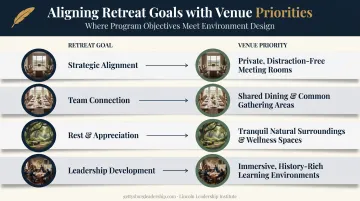
| Goal | Venue Priority |
|---|---|
| Strategic alignment | Quiet, dedicated meeting rooms, minimal distraction |
| Team connection | Shared common areas, group dining, communal spaces |
| Rest and appreciation | Nature access, spa amenities, slower pace |
| Leadership development | Immersive, distraction-free environment built for structured learning |
Experiential Leadership Venues: A Growing Category
Standard resorts and hotel ballrooms work fine for strategy sessions and team dinners. They fall short for leadership development, where the goal is deeper behavior change, not a pleasant few days away.
Experiential leadership venues fill that gap: historic sites and other immersive settings built for leadership learning, not conference rooms with better views.
Lincoln Leadership Institute is a working example of this model. Programs run on the actual grounds where history's highest-stakes decisions played out (Gettysburg, Normandy, Pearl Harbor, and the Alamo) instead of a hotel meeting room.
Faculty include historians, retired generals and admirals, and former Navy SEALs who have faced real decision-making pressure. With 25+ years of experience and more than 40,000 leaders trained, the Institute works with Fortune 1000 and public-sector clients including Pfizer, FedEx, GE, and the U.S. Treasury.
The format pairs standard retreat logistics (lodging, meals, transportation) with a curriculum built around real historic decisions rather than generic case studies.
Before signing any venue contract, whichever category you choose, confirm accessibility needs, dietary accommodations, and group housing arrangements directly with the venue. Don't assume these are included by default. Ask.
Step 4: Design a Schedule and Activities That Reinforce Your Goal
Building a Daily Flow That Doesn't Burn People Out
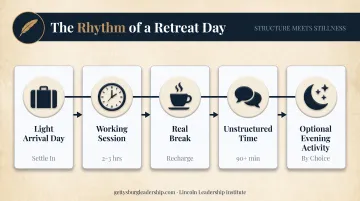
The instinct to fill every hour is understandable and wrong. A packed agenda feels productive on paper and exhausting in practice. Here's a structure that tends to work:
- Light arrival day — travel, check-in, a casual welcome dinner
- One working session, capped at 2-3 hours — anything longer loses focus
- A real break — not 15 minutes between sessions
- Unstructured time, at least 90 minutes — no agenda, no facilitator
- Optional evening activity — low-pressure, not mandatory
That unstructured block isn't filler. It's where organic connection happens and where introverts recharge enough to engage fully in the next session. Cut it to squeeze in one more presentation, and you undermine the goal you built the whole retreat around.
Selecting Activities That Match the Goal
Activities should map directly back to Step 1:
- Strategic-alignment retreats — small-group breakouts, scenario planning exercises
- Team-connection retreats — shared meals, storytelling exercises, low-stakes group challenges
- Leadership-development retreats — immersive, decision-based exercises rather than lecture-style sessions
That last point matters more than it sounds. A 2019 meta-analysis of nearly 90 studies found that experiential learning outcomes came in 0.43 standard deviations higher than traditional instruction.
Separately, active-learning approaches in a large PNAS study lifted exam performance by roughly 6% compared to straight lecturing. People simply retain more when they're working through a real decision than when they're watching slides.
One documented example: Lincoln Leadership Institute frames Pickett's Charge at Gettysburg as "a broken negotiation." Participants examine how General Longstreet's communication breakdown contributed to roughly 7,500 casualties, then connect that failure to modern negotiation and decision-making mistakes. That's a different kind of learning than a lecture on "effective communication skills."
Build in one high-impact memorable moment — a surprise guest, a unique local experience, something specific enough that people describe it to coworkers months later. That moment anchors the retreat's purpose in memory long after the trip ends.
Step 5: Measure Success and Make the Case for Next Year
Don't survey people the day they get home. Send a short, anonymous survey one to two weeks after the retreat, once the glow (or the grumbling) has settled. Ask three things:
- Did we achieve the stated goal?
- What was most valuable?
- What should change next time?
Tie the results back to the goal from Step 1. If retention or alignment was part of the case, include the SHRM finding that replacing an employee typically costs 50% to 200% of their annual salary.
Then produce a one-page recap for whoever approved the budget. Keep it simple:
Goal → Actions taken → Results → What to improve next time
That single page does more to secure next year's budget than any highlight reel from the trip itself.
Frequently Asked Questions
What is a corporate retreat?
A corporate retreat is a planned gathering away from the normal workplace, designed to achieve a specific business or team outcome. Every effective retreat is built around a clear purpose that shapes the agenda and format.
What is the purpose of a corporate retreat?
The purpose varies by organization but generally centers on strategic alignment, team connection, leadership development, or rest and appreciation. The best retreats pick one primary goal rather than trying to accomplish all four at once.
What do you do at a corporate retreat?
Most retreats mix structured working sessions, team activities, shared meals, and unstructured downtime. The exact ratio depends on the stated goal: a leadership program leans more structured, while a bonding trip leans more social.
How long should a corporate retreat be?
Length depends on goal and group size. Executive and leadership-development retreats often run 2-3 nights, while larger team offsites can run 3-5 days depending on travel and objectives.
How is a leadership development retreat different from a standard corporate retreat?
Leadership development retreats use structured curriculum and immersive, experience-based learning (such as historic-site programs) rather than purely social or recreational programming. The goal is measurable skill development, not just team morale.