That urgency doesn't always translate into results. Many leadership offsites fail because they're treated as glorified team-building, built around vague themes like "alignment," or delivered with no follow-through once everyone flies home. The energy fades in a week.
This article breaks down what offsite leadership training actually is, the benefits worth budgeting for, the frameworks that structure good programs, and how to design one that sticks. We'll also look at why immersive, place-based learning models are reshaping how organizations approach this investment.
Key Takeaways
- Leadership development tops HR priorities, yet most managers still feel unprepared for the role.
- Effective offsites run on measurable objectives and structured frameworks, not generic themes.
- Follow-through systems decide whether an offsite creates lasting behavior change.
- Experiential, place-based learning drives stronger engagement than lecture-based formats.
What Is Offsite Leadership Training?
Offsite leadership training is structured leadership development conducted away from a company's regular workplace. A staff meeting moved to a hotel or a conference built around slide decks between coffee breaks does not qualify.
The distinction that matters most: offsite leadership training targets specific, measurable leadership skills. Think decision-making, communication under pressure, and strategic thinking. Generic team-building, by contrast, is usually built around morale and bonding. There's nothing wrong with that goal, but it's a different goal.
A program that delivers real skill gains typically includes:
- A dedicated facilitator who isn't part of the internal reporting chain
- A defined curriculum tied to specific leadership objectives, not open-ended discussion
- Experiential learning components — simulations, case studies, or scenario-based exercises
- A mechanism to measure outcomes, whether through assessments, action plans, or follow-up check-ins
Common Formats of Offsite Leadership Training
Organizations approach this in several ways, depending on budget, group size, and how much time leaders can realistically be pulled away from operations:
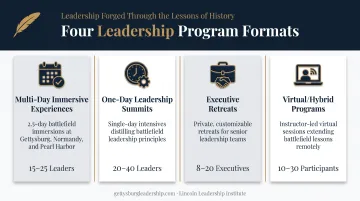
- Multi-day immersive experiences — deep-dive programs, often several days, built around a central challenge or environment
- One-day leadership summits — condensed, high-impact sessions for teams that can't spare more time
- Executive retreats — smaller, strategy-focused gatherings for senior leadership
- Virtual/hybrid programs — live, facilitator-led sessions delivered remotely to distributed teams
A 2023 study comparing virtual and in-person leadership training for physicians found both formats produced statistically significant gains in knowledge and ability. Virtual sessions actually outperformed in-person sessions on several measures, but participants still preferred in-person learning and reported stronger professional networks from it.
Format matters less than design quality. Still, the human connection of in-person training remains hard to replicate on a screen.
Who attends is another design choice. Some programs target C-suite executives; others focus on high-potential emerging leaders being groomed for bigger roles. Many bring intact teams or cross-functional cohorts together to build a shared leadership language.
Why Invest in Offsite Leadership Training? Key Benefits
The business case starts with the priority gap mentioned earlier. Leadership development sits at the top of the HR agenda because organizations know managers can't lead what they haven't been trained to lead.
The data is concrete. Gallup reports that managers in structured development programs improve their own engagement by up to 22% more than nonparticipants. Downstream effects compound:
- Team engagement rises by up to 18% more
- Turnover drops 21% to 28% under trained managers
- High-potential leaders read the investment as a reason to stay
Why does removing leaders from the office matter so much?
Pulling leaders out of daily distractions and normal hierarchy does something a Tuesday afternoon meeting can't: it builds trust and psychological safety. A 2022 management-team study found psychological safety didn't lift task performance on its own. It improved performance indirectly through behavioral integration—how well people share information, collaborate, and decide together.
Retention is easy to underestimate. When a company invests real time and money in a leader, that person notices. The signal is clear: we're building toward something with you here. For high-potential talent weighing other offers, that message carries weight.
Key Leadership Frameworks and Curriculum Elements Taught in Offsite Training
Good offsite programs aren't improvised. They're built around structured frameworks that give the exercises a coherent backbone rather than a loose collection of activities.
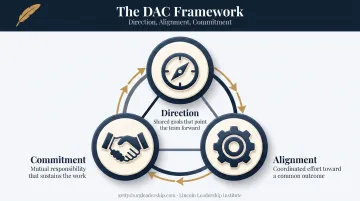
One widely referenced model, developed by the Center for Creative Leadership, is the DAC framework:
- Direction — agreement on the group's overall goals and what it's collectively working toward
- Alignment — coordination between different parts of the group's work so everyone's effort serves that shared direction
- Commitment — mutual responsibility, where the group's success becomes a personal priority for each member
Many programs also reference broader "C" frameworks that emphasize qualities like character, communication, courage, and clarity of purpose. The specific letters vary by provider, but the underlying idea is consistent: leadership is a set of interdependent competencies, not a single trait.
Facilitators turn those competencies into practice through role-plays, scenario walkthroughs, and live decision points rather than lectures.
Emotional Intelligence and Self-Awareness Tools
Before the offsite even begins, many programs administer assessments to identify real gaps rather than guessing at them. Common tools include:
- EQ-i 2.0 and EQ360 — emotional intelligence assessments measuring self-perception and how others perceive a leader's EQ
- DiSC — behavioral style assessments mapping how people handle pace, conflict, and problem-solving
- The Five Behaviors — team-dynamics assessment built on trust and accountability
At Lincoln Leadership Institute, Director of Curriculum Dr. Jared Peatman is certified to administer both the EQ-i 2.0 and EQ360, using pre-offsite results to tailor scenarios to the specific gaps a given team is carrying into the room.
Decision-Making Under Pressure
This is where most programs separate from a standard conference. Business simulations, historical case studies, and crisis-communication scenarios force leaders to make calls with incomplete information, which is frankly what leadership looks like most days.
A 2017 meta-analysis covering 335 leadership-training samples found that combining information, demonstration, and practice produced stronger learning and transfer than any single method alone. Practice-based methods produced significantly stronger effects on organizational results than information-only approaches. That evidence favors scenario-based learning over lecture slides.
Crisis communication now sits in the same track. Leaders often have to speak with limited information while high stakes ride on every word, so strong curricula build those drills into the decision-making work rather than treating them as a side session.
Best Practices for Designing an Effective Leadership Offsite
Most offsite failures trace back to one of three design mistakes. Fix these, and the odds of success improve dramatically.
1. Start with a specific, measurable objective. Goals like "alignment" or "team building" are too fuzzy to drive an agenda. A real objective looks like: "Decide our go-to-market approach for the new product line" or "Resolve the cross-departmental handoff issues slowing project delivery." Vague themes are the single most common reason offsites underdeliver.
2. Bring in an external facilitator. Internal hierarchy suppresses honest conversation. Someone who reports to the CEO isn't going to challenge them in front of the room. A neutral outside facilitator changes the dynamic, letting leaders fully participate instead of managing optics.
3. Build in follow-through mechanisms. This is the difference between a memorable week and lasting change:
- Document specific action items before everyone leaves
- Assign clear owners to each one
- Schedule a 30-day check-in to review progress
Skip this step, and the offsite becomes a great story leaders tell for a month before things quietly return to normal.
Why Historic Battlefield Immersion Outperforms Traditional Offsites
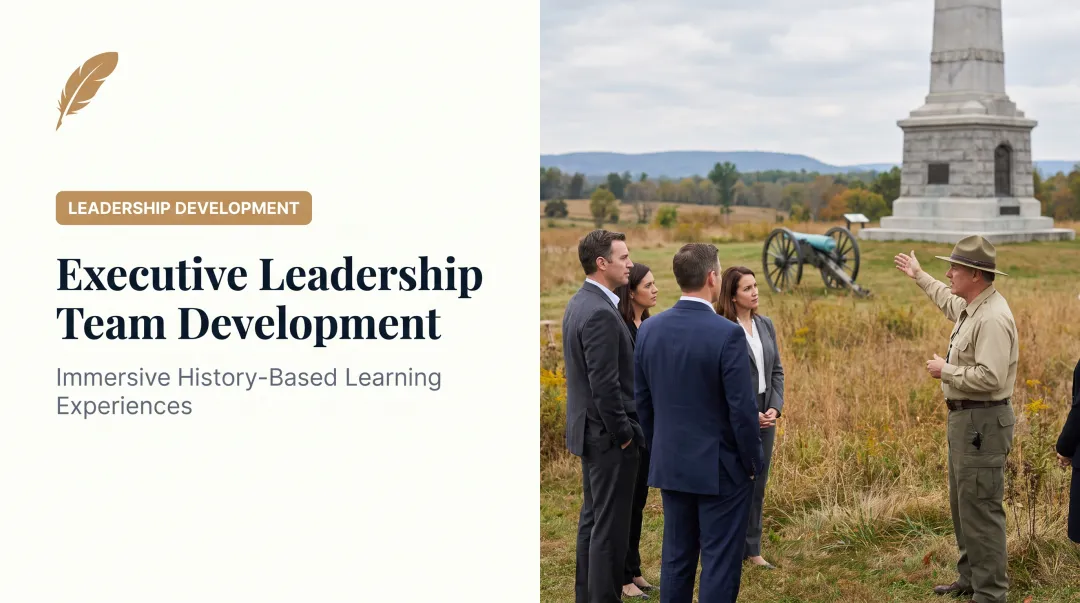
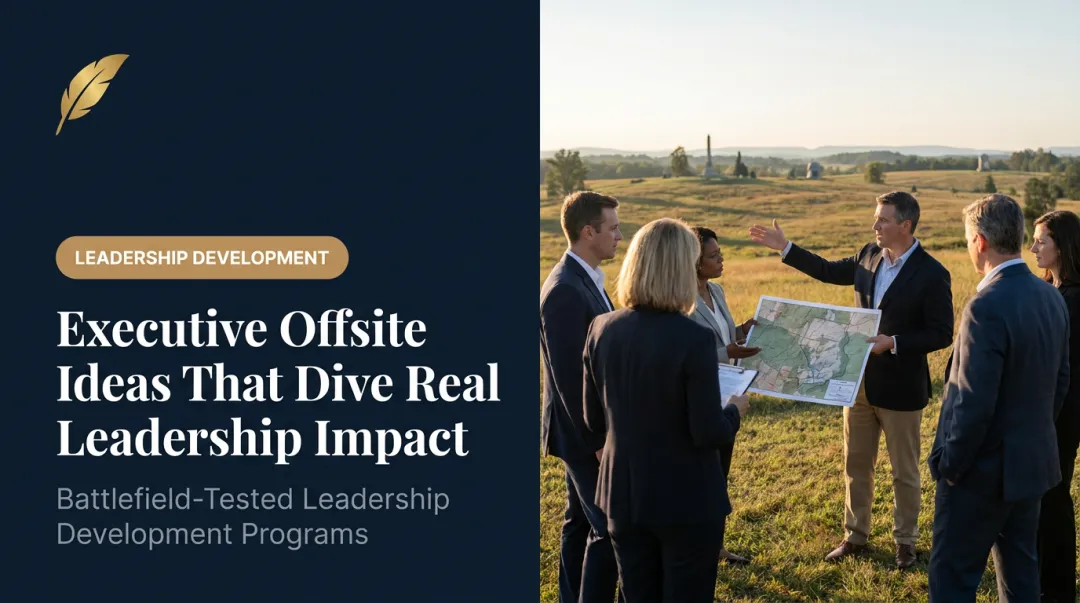
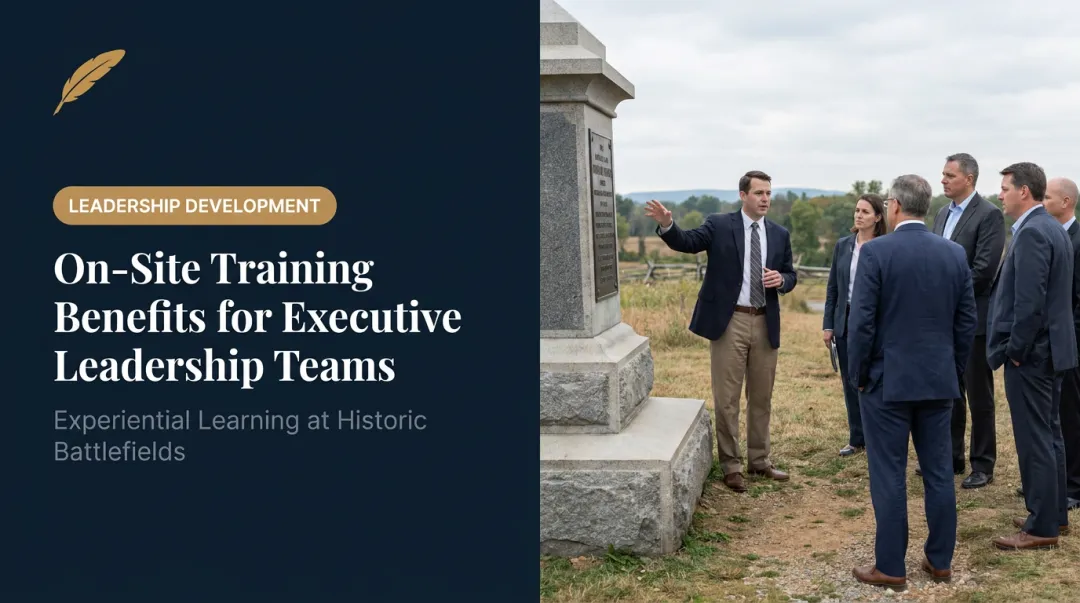
There's a reason a conference room can't replicate what happens when leaders stand on the ground where a real, high-stakes decision was made. Place-based experiential learning puts people in the environment where history's consequences played out. That physical context changes how the lesson sticks and how quickly teams transfer it to work.
Lincoln Leadership Institute pioneered this model over 25 years ago and now delivers programs at Gettysburg, Normandy, Pearl Harbor, and the Alamo. The Institute has served more than 25,000 Fortune 1000 and public sector clients and reports transforming over 40,000 leaders. Client organizations include Pfizer, FedEx, GE, Milwaukee Tool, and the U.S. Department of Defense.
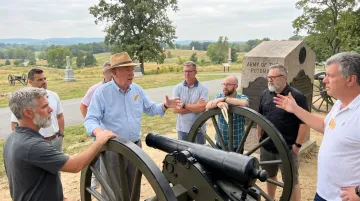
Faculty combine academic depth with people who have lived high-stakes leadership:
- Retired military leaders such as Navy Rear Admiral Scott Moore (30+ years in Naval Special Warfare) and Colonel Mark Erwin, former Chief of Staff of U.S. Army Special Operations Command
- Special operations leadership from Dave Cooper, a U.S. Navy SEAL since 1988, on mission-critical decisions under extreme pressure
- Crisis communication with Dennis Owens, an Emmy Award-winning journalist (15 Emmys) with decades covering high-pressure public moments
- Ph.D. historians including Dr. Jared Peatman, author of The Long Shadow of Lincoln's Gettysburg Address and a Hay-Nicolay Dissertation Prize winner
Programs turn those sites into working case studies, not sightseeing stops:
- Gettysburg Leadership Journey (2.5 days): "Pickett's Charge: A Broken Negotiation" examines General Longstreet's communication breakdown before roughly 7,500 casualties, teaching decisions under incomplete information
- Pearl Harbor Leadership Experience: The December 7, 1941 attack and a visit to the USS Arizona Memorial frame rapid decision-making in unexpected crisis
Teams that want formal recognition can add the Leadership Excellence Certificate Program with Purdue University Global. Participants earn a verifiable digital credential for LinkedIn and internal talent records.
Format flexes to how teams actually operate: multi-day immersions, one-day summits at Gettysburg and the Alamo, and Lincoln Leadership Live for distributed groups that cannot travel.
How to Choose the Right Offsite Leadership Training Provider
Not every provider promising "transformation" can back it up. Here's what to actually check before signing a contract.
Track record. Ask how many years the organization has operated, how many leaders it has trained, and whether its client roster includes companies comparable to yours in size or industry. Providers that have worked with pharmaceutical giants, federal agencies, and manufacturers have almost certainly faced challenges like yours.
Facilitator expertise and curriculum credibility. Look past marketing language for specifics:
- Are facilitators certified in recognized assessment tools?
- Does the curriculum connect to an academic partnership, or is it purely internal?
- Do facilitators bring real-world leadership experience, not just classroom theory?
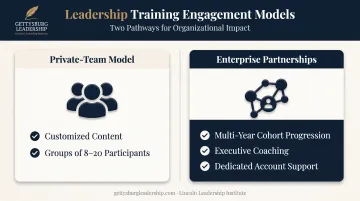
Customization and follow-through support. A provider worth hiring should offer more than a one-size-fits-all agenda. Lincoln Leadership Institute, for instance, scales support by engagement type:
- Private-team model: customizes content around real organizational challenges for groups of 8–20
- Enterprise partnerships: multi-year, cohort-based progression with executive coaching and dedicated account support
Confirm any provider you're evaluating offers a comparable path from a single session to sustained development.
Frequently Asked Questions
What is offsite leadership training?
It's structured leadership development conducted away from a company's regular workplace, focused on building specific skills like decision-making and communication. Unlike routine meetings or social retreats, it's built around measurable objectives.
What leadership frameworks are taught in offsite leadership training?
Programs often use structured models like the Center for Creative Leadership's Direction-Alignment-Commitment framework, or broader "C" frameworks emphasizing communication, character, courage, and clarity. Exact models vary by provider, but the goal is consistent: turning leadership into learnable, practiced skills.
How long does a typical leadership offsite last?
Offsites range from single-day summits to multi-day immersive experiences lasting 2.5 days or longer. The right length depends on your objectives, group size, and how much time leaders can be away from daily operations.
How much does offsite leadership training cost?
Costs vary based on format, duration, facilitator expertise, and location — a one-day domestic summit costs far less than a multi-day international immersion. Most providers require a discovery call to build an accurate, customized quote.
What's the difference between a leadership offsite and a standard team-building retreat?
A leadership offsite targets measurable skills like decision-making, strategic thinking, and communication, often tied to a specific business objective. A team-building retreat is designed primarily around morale and social bonding, without that structured skill focus.
How do you measure the ROI of offsite leadership training?
Common methods include pre- and post-program assessments, team performance and retention tracking, and action-item completion rates from the offsite. Participant and manager feedback also shows whether lessons stick on the job.