That mismatch matters. A well-known replication of Ebbinghaus's forgetting curve found that without reinforcement, retention can fall dramatically within weeks of first exposure to new material — a pattern that helps explain why so many leadership workshops fail to change behavior once leaders return to their desks (PLOS ONE, 2015).
This article breaks down what immersive simulation training actually is, why it matters specifically for senior leadership teams, the different modalities available, a real-world case example, cost considerations, and how to pick the right program for your organization.
Key Takeaways
- Immersive simulation builds judgment through active practice, not passive listening.
- Realistic simulations trigger genuine stress responses that transfer directly to real crises.
- Shared high-intensity experiences build executive team trust in ways individual e-learning cannot.
- Formats range from VR headsets and AI role-play to real-world battlefield immersion.
- The right program starts with clear objectives — not the flashiest technology.
What Is Immersive Simulation Training?
Immersive simulation training is a practice-based methodology that places leaders inside realistic, high-stakes scenarios to build judgment, communication, and composure through lived experience — not passive instruction. Instead of hearing about a crisis decision, participants make one, in real time, with real stakes attached.
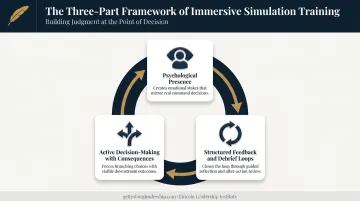
Three elements show up across every credible immersive modality:
- Psychological presence: the sense of genuinely being "in" the scenario
- Active decision-making with consequences: choices that shape what happens next
- Structured feedback and debrief loops: turning the experience into a transferable lesson
Why Presence Changes Behavior
Researcher Mel Slater's work on presence explains why this works. A scenario that delivers both "place illusion" (feeling like you're really there) and "plausibility" (believing the events are genuinely unfolding) triggers real physiological reactions: elevated heart rate, hesitation, authentic decision-making.
Participants react this way even though they know intellectually it's a simulation. That's the mechanism that makes rehearsal under pressure actually stick.
Immersive Doesn't Mean "Headset Required"
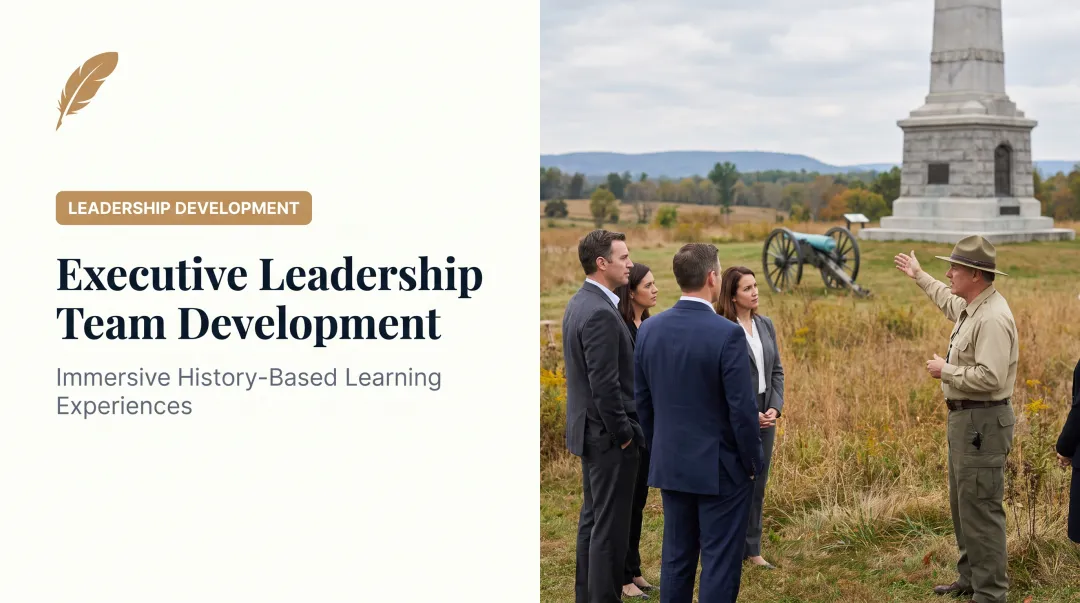
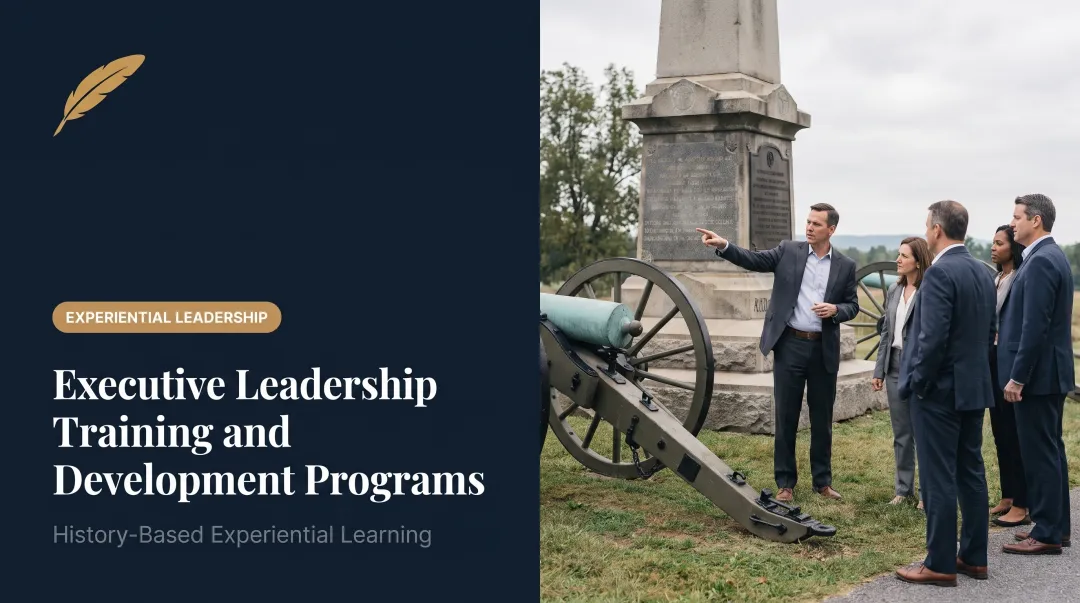
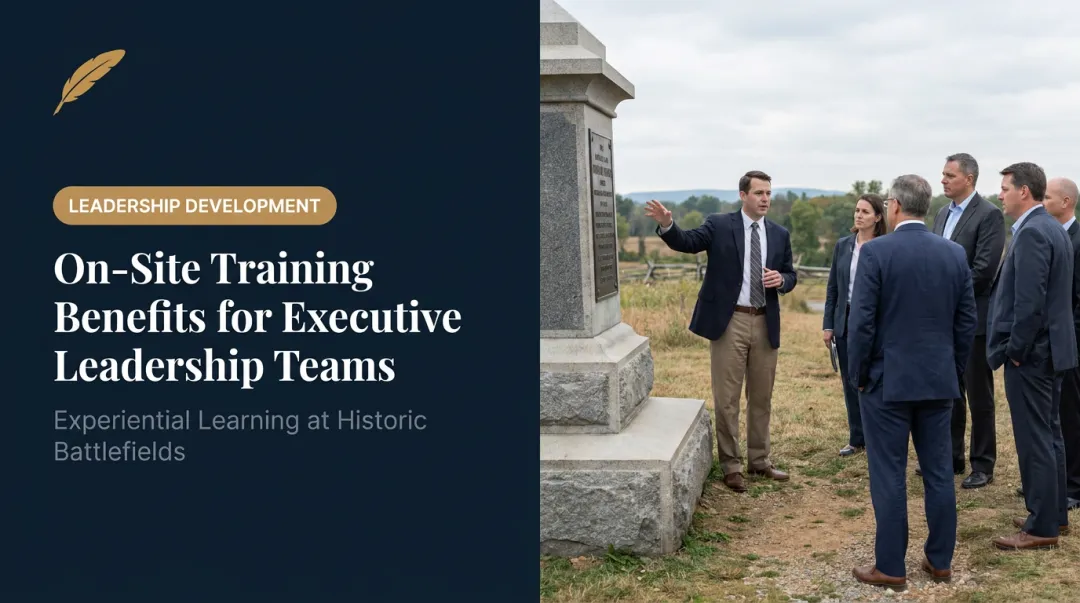
A common misconception: immersive automatically means VR goggles. It doesn't. Immersive simulation also includes AI-powered scenario practice, live facilitator-led exercises, and real-world experiential immersion, such as walking an actual historic battlefield and standing where a commander once had to decide, alone, with the clock running.
That last category isn't new. Real-world experiential immersion predates today's VR and AI tools by decades, and remains one of the most rigorously developed forms of simulation training available.
That track record matters because it clarifies what separates true immersive simulation from a simple role-play exercise or case-study discussion: genuine choice, consequence, and lived experience. A case study you discuss around a conference table teaches you what happened to someone else. A simulation makes you decide what happens next.
Why Executive Leadership Teams Need Immersive Simulation Training
Senior leaders face a different category of pressure than mid-level managers. Their decisions are high-stakes, ambiguous, and often public: a boardroom crisis, a product recall, a workforce reduction announced to the press within the hour. A standard workshop can't replicate that emotional weight, and cognitively, it doesn't need to try.
Deliberate Practice Applies at the Top, Too
Psychologist Anders Ericsson's deliberate practice framework requires effortful, repeated work on real weaknesses, with informative feedback and a task that pushes beyond what's already mastered.
That framework, later extended specifically to business managers and professionals, describes exactly what a well-designed simulation delivers: repeated high-pressure decisions, immediate coaching, and correction in the moment, not a one-time lecture that fades by Friday.
The Skills That Matter Most Are the Hardest to Teach Passively
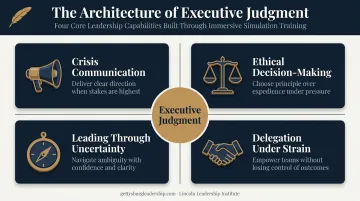
Immersive practice accelerates the capabilities that define the C-suite:
- Crisis communication: speaking clearly when the facts are incomplete
- Ethical decision-making: holding a line under pressure to compromise
- Leading through uncertainty: acting decisively without perfect information
- Delegation under strain: trusting the team when full oversight isn't possible
Development Investment Ties Directly to Retention
Deloitte's survey of nearly 7,700 Millennials across 29 countries found that among those planning to leave their organization within two years, 71% were dissatisfied with how their leadership skills were being developed, a 17-percentage-point gap compared to employees planning to stay five years or longer (Deloitte's 2016 Millennial Survey).
Investing visibly in leadership development functions as a retention signal for top talent.
Simulations also generate something satisfaction surveys can't: behavioral data. How a leader responds under time pressure, what they communicate first, and who they turn to for input all provide concrete evidence of behavior change.
Finally, there's the culture effect. When an entire executive team goes through a high-intensity shared experience together, they build trust and shared vocabulary in a way that individual, siloed e-learning modules simply can't replicate.
Types of Immersive Simulation Training
Not every immersive format fits every team. Here's how the three main categories compare.
| Format | Best For | Trade-offs |
|---|---|---|
| VR/AR-based simulation | Spatial and procedural practice with strong sensory immersion | Requires headset logistics, IT support, and higher upfront investment |
| AI-powered/live virtual simulation | Scalable, repeatable communication practice with real-time feedback | Lower infrastructure cost, though most published evidence comes from healthcare training rather than executive contexts |
| Real-world experiential immersion | Building strategic judgment, courage, and team leadership under real stakes | No screen or avatar; requires travel and on-site scheduling |
This is the model Lincoln Leadership Institute uses at Gettysburg, Normandy, and Pearl Harbor: no screen, no avatar, just executives standing on the ground where a decision actually happened, working through the same pressures that shaped it.
A Real-World Example: Battlefield-Based Leadership Simulation
The Lincoln Leadership Institute, based in Gettysburg, Pennsylvania, is a case example of experiential immersive simulation at scale. Operating for more than 25 years, it has worked with over 40,000 leaders across more than 25,000 Fortune 1000 and public-sector clients, including organizations like Pfizer, FedEx, GE, and the Department of Defense.
Executives walk actual historic battlefields (Gettysburg, Normandy, Pearl Harbor, the Alamo) and are placed at the decision points historical commanders faced. They work with incomplete information, real time pressure, and no do-over button.

The debriefs are where the transformation happens. Faculty translate historical decisions into modern leadership frameworks leaders can apply back at the office the following Monday.
That structure only works because of who leads it. The program's facilitators aren't generic trainers reading from a script:
- Retired military leaders, including a Navy Rear Admiral and a former Chief of Staff of US Army Special Operations Command
- A Navy SEAL with active service dating to 1988
- An Emmy-winning political journalist who's spent decades studying crisis communication
- Ph.D. historians who connect 19th-century decisions to 21st-century organizational challenges
Verifiable Credentials and Third-Party Recognition
Participants can also complete the Leadership Excellence Certificate Program, delivered in partnership with Purdue University Global. Graduates request a verified digital credential, checked against attendance records within a few business days and delivered by email, which they can display on LinkedIn, in email signatures, or on a resume.
The program has also drawn outside validation. ABC News called President Steven B. Wiley "the best speaker you've never heard of." USA TODAY, itself a client organization, described the training as "the most powerful performance training available."
How Much Does Immersive Simulation Training Cost?
Cost varies enormously by modality. Knowing what drives the price helps you compare quotes accurately.
VR-based training carries costs across three buckets: hardware (headsets and peripherals), custom scenario development, and ongoing IT support for deployment and updates.
PwC's study of more than 1,600 new managers found VR reached cost parity with classroom training around 375 learners, and with e-learning around 1,950 learners. VR generally makes financial sense at scale, not for a single leadership cohort.
AI-powered or live virtual platforms typically run on subscription or per-seat licensing, with far lower infrastructure overhead than VR since there's no hardware to procure or maintain.
Experiential, on-site executive programs are usually priced per multi-day cohort, covering:
- Venue and facilitation
- Travel and accommodations (participant travel to the location is typically separate)
- Expert faculty time
This is a premium investment. Weigh it against the value of better decision quality, stronger retention, and tighter executive team cohesion, not against a per-module VR license.
Organizations exploring Private Team Experiences or Enterprise Partnerships typically request a custom proposal rather than shopping off a rate card, since program length, faculty mix, and location all shift the total.
How to Choose the Right Immersive Simulation Program for Your Leadership Team
Start with objectives, not technology. Are you solving for crisis decision-making, communication under pressure, or team cohesion after a merger? The answer should determine the modality, not the other way around, so evaluate these three factors before comparing programs:
- Facilitator quality: Real-world, high-stakes experience matters more for debrief depth than technology sophistication. A retired general or a battlefield-tested journalist will draw out lessons a generic trainer simply can't.
- Format flexibility: Options range from a one-day summit to a 2.5-day battlefield immersion to a multi-day international program to a virtual session. Match the format to your team's schedule and budget.
- Group structure: Smaller open-enrollment cohorts suit cross-industry exposure; private team or enterprise formats suit organizations wanting a fully customized, shared experience.
There's no universal best answer; the right program matches your team's specific leadership gap to the modality built to close it.
Frequently Asked Questions
What is immersive training?
Immersive training is practice-based learning that places participants inside realistic scenarios, using VR, AI, or real-world experiential methods, to build skills through active decision-making rather than passive instruction.
What is an example of simulation training?
One example is an AI-powered virtual conversation tool that lets employees practice a difficult discussion with real-time feedback. Another is an executive team walking an actual battlefield and working through a historic commander's decision under time pressure.
How much does VR training cost?
VR training costs vary by hardware, content development, and scale, typically reaching parity with classroom costs only past several hundred learners. Cohort-based executive programs price per multi-day group instead, based on faculty, venue, and logistics rather than per-learner fees.
Is immersive simulation training effective for senior executives?
Yes. Presence research shows realistic simulations trigger genuine behavioral and physiological responses, and deliberate-practice research confirms that repeated, feedback-driven practice builds real judgment. Both are particularly valuable for composure under pressure.
How long does an executive leadership simulation program typically take?
Formats vary from one-day summits to 2.5-day battlefield immersions to multi-day international programs, plus virtual sessions for teams that can't travel. The right length depends on your objectives and schedule constraints.
What's the difference between immersive simulation training and traditional leadership workshops?
Traditional workshops rely on lectures and case-study discussion, where participants hear about decisions someone else made. Immersive simulation puts leaders inside the decision itself, with real consequences and a structured debrief that turns the experience into a transferable skill.