That's the tension facing HR and L&D leaders this year. Generic, one-size-fits-all activities rarely move the needle on real trust or performance. They fill an hour, generate a few laughs, and fade by the following Monday.
This guide breaks down the main categories of corporate team building activities for 2026, how they differ, and how to match the right one to your team's actual goals — not just the trendiest option on a vendor's list.
Key Takeaways
- Team building spans a spectrum, from five-minute icebreakers to multi-day leadership immersions
- Match format to team size, delivery mode, budget, and the depth of change you need
- Global employee engagement sits at just 20%—intentional team investment is a business priority, not a perk
- Pair activities with structured debriefs so behavior change actually sticks
What Are Corporate Team Building Activities and Why Do They Matter in 2026?
Corporate team building activities are structured group experiences designed to strengthen communication, trust, and collaboration outside of normal work tasks. That's the simple definition. The more important shift is what these activities are now expected to accomplish.
For years, team building lived in the "nice-to-have perk" column, a budget line that got cut first when things got tight. That's changing. Organizations are increasingly treating it as a retention and performance lever, favoring smaller, purpose-driven gatherings and leadership-focused formats over massive, generic company picnics.
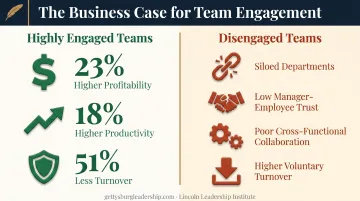
Highly engaged teams show 23% higher profitability, up to 18% higher productivity, and 51% less turnover, according to Gallup's 2026 employee engagement strategies report. Skip intentional team development, and the typical results look predictable:
- Siloed departments that don't communicate across functions
- Low trust between managers and their direct reports
- Poor cross-functional collaboration on shared projects
- Higher voluntary turnover among your best people
None of that shows up overnight. It builds slowly, one missed connection at a time, which is why waiting for a crisis to invest in team development costs more than acting early.
Types of Corporate Team Building Activities for 2026
Team building isn't one-size-fits-all. The right format depends on your goals, your team's size, and how much depth of change you're actually seeking. Activities generally fall on a spectrum: lightweight morale boosters on one end, intensive transformation-focused experiences on the other.
| Activity Type | Time Commitment | Best For | Depth of Impact |
|---|---|---|---|
| Icebreakers | 15–60 minutes | New hires, meeting kickoffs | Surface-level rapport |
| Problem-Solving Challenges | Half-day to full day | Collaboration, delegation skills | Moderate, needs debrief |
| Virtual/Hybrid Experiences | 1–3 hours | Distributed, remote-first teams | Moderate, format-dependent |
| Leadership Immersions | 1–5 days | Executives, high-potential leaders | Deep, lasting behavior change |
Icebreaker and Communication-Building Activities
These are short, low-stakes exercises (two truths and a lie, lunch-and-learns, personality assessments) built to help colleagues connect on a personal and professional level fast.
- Setup: minimal, often under 30 minutes
- Best suited for: onboarding new hires or kicking off meetings among teams that don't know each other well
- Strengths: low cost, easy to repeat frequently, builds psychological safety over time
- Limitations: impact fades quickly without repetition, and it does little to address deeper leadership or collaboration gaps
The catch: not everyone loves them. In a 2025 Leadership IQ survey of 6,821 workers, nearly half of respondents said forced-fun activities like icebreakers left them feeling uncomfortable or inauthentic. Use them, but don't over-rely on them as your only tool.
Problem-Solving and Competitive Challenge Activities
Escape rooms, scavenger hunts, office olympics, mini hackathons — these structured challenges push teams to collaborate under mild pressure. Unlike icebreakers, they're physically or mentally engaging enough to reveal real teamwork and leadership dynamics in action.
- Best suited for: teams that need sharper collaboration, delegation, or creative problem-solving skills
- Strengths: memorable, competitive energy boosts engagement, and natural leaders tend to surface
- Limitations: can unintentionally exclude less competitive or less physically able employees; needs a debrief afterward to translate insights back to daily work
A well-documented example: Microsoft's OneWeek Hackathon, studied across five internal teams, found that newly formed groups built role-based coordination on the fly and walked away with broader internal networks and sharper technical skills.
Virtual and Hybrid Team Building Experiences
Virtual trivia, online escape rooms, and hybrid hackathons exist to give remote and in-office employees equal footing. Rather than relying on in-room chemistry, these formats depend on digital tools and strong facilitation to create parity across distributed participants.
- Best suited for: distributed, remote-first, or hybrid organizations spanning multiple time zones
- Strengths: highly scalable, accessible, and cost-effective for large or dispersed teams
- Limitations: harder to replicate spontaneous, in-person bonding; passive remote attendees need active facilitation to stay engaged
Gallup's remote work data is a useful reality check here: fully remote employees report 31% engagement but only 36% thriving, and they also report more anger, sadness, and loneliness than their in-office peers. Virtual formats can help close some of that gap, but they're not a complete fix on their own.
Experiential Leadership Immersion Programs
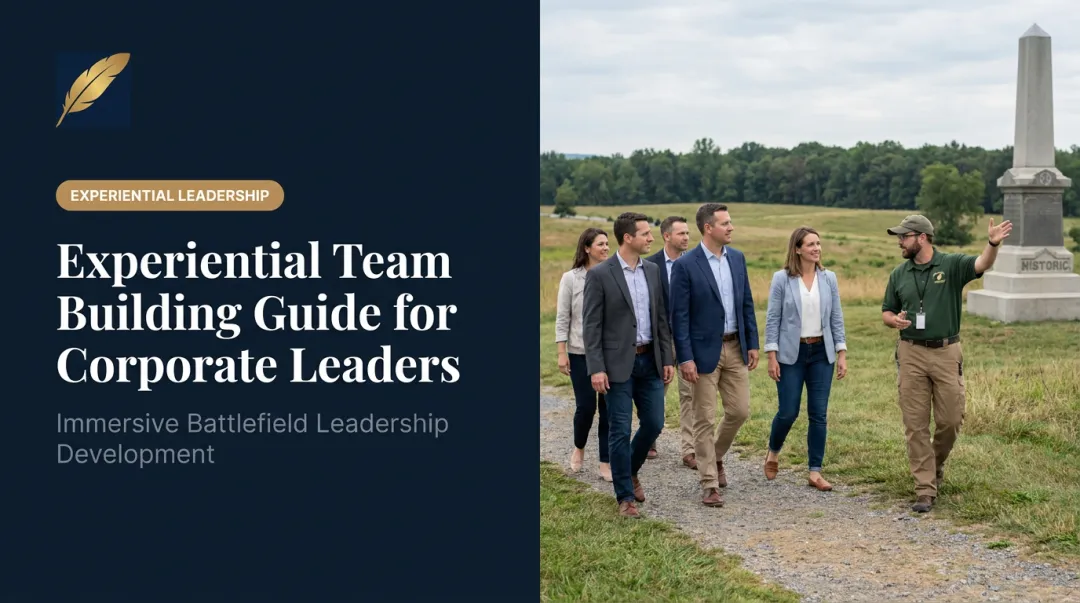
Multi-day immersive programs sit at the deep end of the spectrum. They take teams out of the office and into real historic environments to practice leadership and decision-making under pressure. This is where Gettysburg Leadership operates.
Rather than games or icebreakers, these programs place participants on the ground where consequential decisions were made. Sites include Gettysburg, Normandy, Pearl Harbor, the Alamo, and Virginia International Raceway.
Faculty includes retired generals, a Navy SEAL since 1988, a retired Navy Rear Admiral, Ph.D. historians, and Licensed Battlefield Guides who connect historical decisions directly to modern organizational challenges.
- Best suited for: executive teams, high-potential leaders, and organizations after lasting culture change rather than a one-time morale boost
- Strengths: lasting behavior change backed by 25+ years of battlefield-based leadership development
- Trade-offs: requires a bigger time and budget commitment than a single-day activity, so it fits annual or milestone events better than weekly touchpoints
Programs have reached more than 40,000 leaders across 25,000+ Fortune 1000 and public sector clients, including Pfizer, FedEx, GE, and the Department of Defense. USA TODAY has called it "the most powerful performance training available."
Formats range from one-day summits to a 2.5-day flagship Gettysburg Leadership Journey to full international programs at Normandy. Enrollment scales from open-enrollment cohorts of 3–5 leaders to enterprise partnerships for 20 or more.
How to Choose the Right Team Building Activity for Your Team
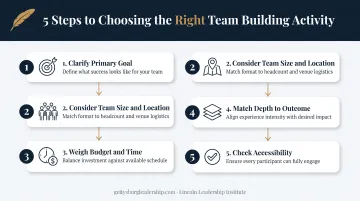
The "best" activity is the one that matches your specific goals and constraints, not whatever's trending on LinkedIn this quarter. Work through these factors before you book anything:
- Clarify your primary goal. Are you breaking the ice, sharpening problem-solving, boosting morale, or building deep leadership capability? Each goal points toward a different format.
- Consider your team's size, location, and format. A 10-person in-office team has very different options than a 200-person hybrid workforce spread across three time zones.
- Weigh your budget and time. Options range from a free one-hour activity to a multi-day offsite investment.
- Match depth to desired outcome. Light-touch fun works for morale; a structured program is what drives lasting behavioral change.
- Check accessibility. Make sure the activity works for all abilities, backgrounds, and comfort levels — not just the most extroverted people in the room.
SHRM's 2026 guidance aligns with this approach. Start with the team's actual objective and match the activity type to the specific capability gap, rather than leading with budget or a trending format.
Common Mistakes to Avoid When Planning Team Building
Even well-intentioned team building efforts fall flat when a few predictable mistakes creep in.
- Chasing trends over needs. Picking an activity because it's popular, not because it addresses your team's actual gaps.
- Skipping the debrief. This is the biggest miss. A meta-analysis of 46 studies found properly conducted debriefs improved effectiveness by 20–25%. Without one, a fun event stays fun—not lasting insight.
- Treating it as a one-off. An annual retreat alone won't fix year-round communication issues. Pair smaller, frequent touchpoints with larger events.
- Ignoring accessibility. Defaulting to physically demanding or highly extroverted formats excludes people and undermines the trust you're trying to build.
Conclusion
The most effective organizations in 2026 aren't treating team building as optional. Given where engagement numbers currently sit, it's a strategic investment with a real business case behind it.
Activities range widely in depth and purpose. A five-minute icebreaker at the start of a meeting and full leadership immersions like those run by Gettysburg Leadership at historic sites across the country both have a place. Neither approach is wrong. They just serve different goals.
Choosing intentionally, matching the format to what your team actually needs, is what separates memorable team building from forgettable filler.
Frequently Asked Questions
What are good corporate team building activities?
Good activities depend entirely on your goals. Options range from quick icebreakers and competitive problem-solving challenges to volunteering days and immersive leadership experiences, each covered in detail above.
What are some good team building activities to do at a team meeting?
Quick, low-lift options work best here: two truths and a lie, one-word check-ins, or a short trivia round. These fit comfortably within a standard meeting window without derailing the agenda.
How often should companies organize team building activities in 2026?
Most organizations benefit from a mix: lighter monthly touchpoints like check-ins or short activities, paired with one or two larger, more structured events per year for deeper impact.
What are the best team building activities for remote or hybrid teams?
Virtual trivia, online escape rooms, and hybrid hackathons work well because they're built to give remote employees the same participation level as in-office staff.
How is experiential leadership training different from typical team building activities?
Gettysburg Leadership programs use real historical high-stakes environments and faculty including retired generals and Navy SEALs to build lasting leadership skills, rather than a short-term morale boost.
How do you measure the ROI of a team building event?
Combine post-event surveys with follow-up pulse checks weeks later, then track whether engagement, retention, or productivity metrics shift over time. Isolating the program's effect from other factors takes deliberate measurement, not just a feedback form.