Many leadership teams struggle with this exact pattern: a offsite that felt energizing in the room but produced zero measurable shift in how decisions get made. The agenda was full. The flip charts were photographed. The follow-up never happened.
What separates a forgettable retreat from one that genuinely moves the needle on leadership behavior and business results? It usually comes down to design choices made weeks before anyone boards a plane.
This guide walks through the common pitfalls, six offsite formats that actually change how leaders operate, agenda design principles, and the follow-through system that makes the impact stick.
Key Takeaways
- Leadership impact comes from offsites built around one hard decision, not packed status updates
- Experiential formats reveal how leaders behave under pressure better than lectures or icebreakers
- Impact only lasts when offsites end in written commitments, named owners, and follow-through cadence
- The right environment and facilitation partner matter as much as the content itself
Why Most Executive Offsites Fail to Drive Real Impact
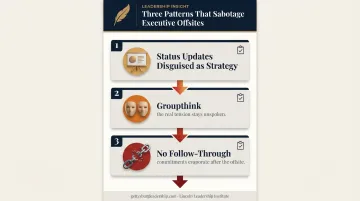
Walk into a typical executive offsite and you'll see the same structure: back-to-back 30-minute department updates, each leader presenting slides that could have been emailed. Nobody disagrees. Nobody's surprised. Everyone nods.
That's the first failure pattern. The agenda mistakes information-sharing for strategic work.
The second pattern is quieter and more damaging: groupthink. Every executive team has one real tension sitting under the surface, whether it's a resourcing conflict, a strategy disagreement, or a leader who isn't performing. Politeness keeps it unspoken. The group leaves "inspired," but the actual problem never got named, let alone solved.
The third pattern is the one that erases whatever progress the first two didn't already block: no follow-through. Harvard Business Review's guidance on offsite design recommends allocating 45 minutes to two hours per topic. It also calls for structured post-event check-ins, since commitments made in a conference room tend to evaporate once people return to their inboxes.
Common symptoms worth checking for:
- Agenda items that are status updates disguised as strategy discussions
- No pre-work, so half the room arrives cold
- Decisions made verbally but never written down or assigned an owner
- Zero scheduled check-in before the next offsite, a year later
Executive Offsite Ideas That Drive Real Leadership Impact
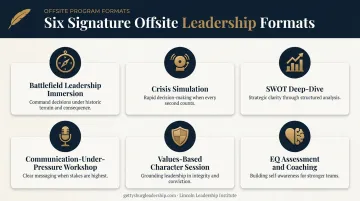
Once you've named the failure patterns, the fix calls for a different format, not a better icebreaker. These six approaches share one trait: each forces leaders to show how they really think and decide, exposing the gap between intention and performance.
Idea 1: Historic Battlefield Leadership Immersion
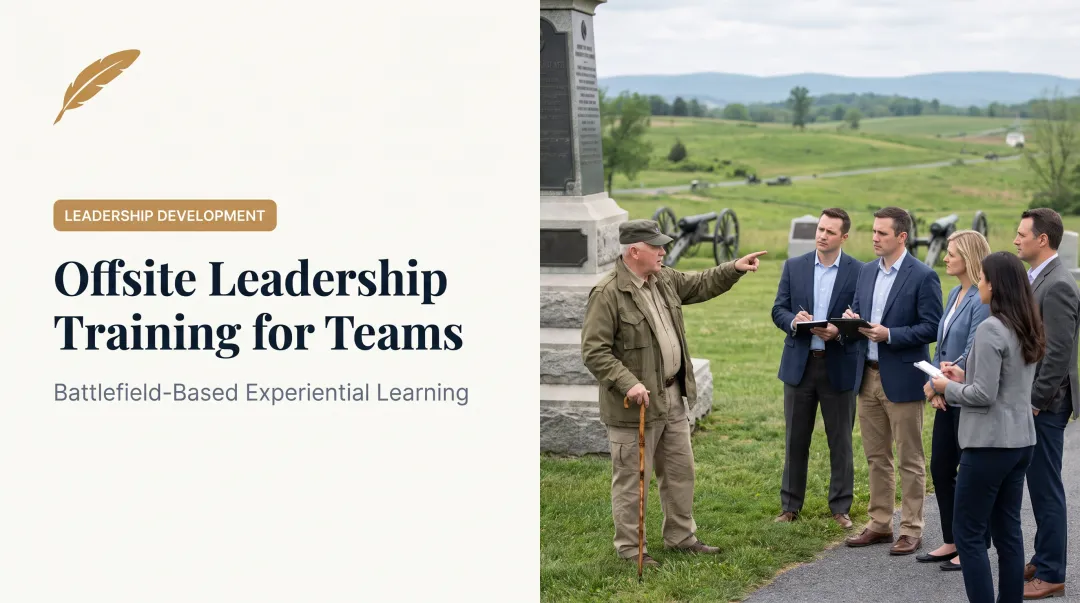
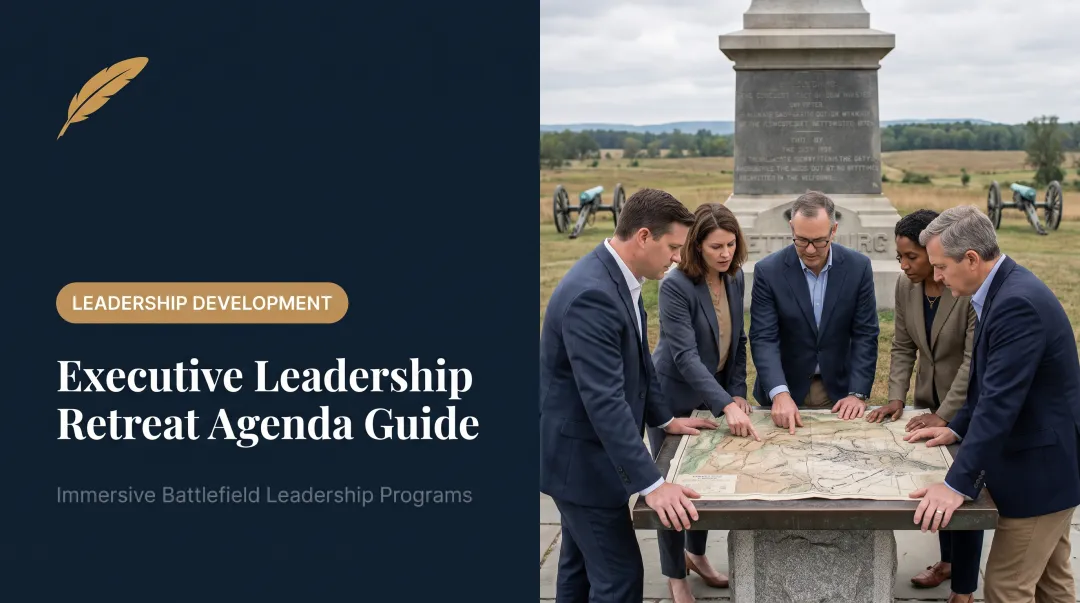
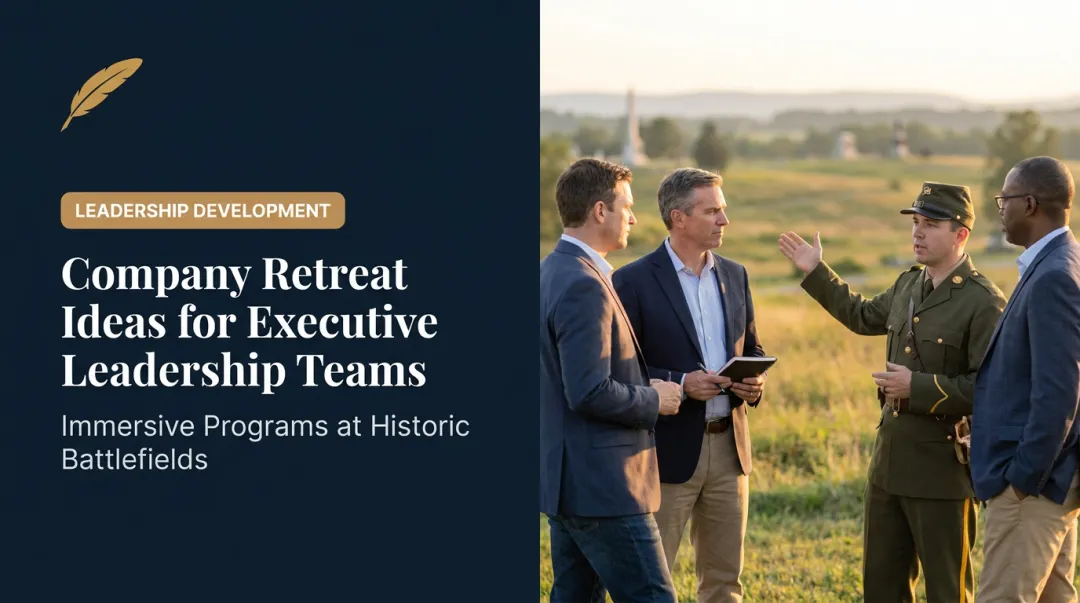
Put a leadership team on the very ground where a historic, high-stakes decision unfolded, and something shifts that a hotel conference room can't replicate. At Gettysburg, Normandy, Pearl Harbor, or the Alamo, licensed guides and historians walk executives through the terrain and the decisions made there, then draw direct lines to boardroom pressure.
The Lincoln Leadership Institute has run this exact model for more than 25 years, pairing licensed battlefield guides with historians and retired military leaders across all four sites. Its flagship Gettysburg Leadership Journey runs 2.5 days and includes individual coaching, accommodations, and post-program resources, all built around one question: how do leaders make consequential calls with incomplete information?
Idea 2: High-Stakes Facilitated Simulation or Crisis Exercise
Skip the personality quiz. A live, facilitated crisis simulation reveals exactly how a team makes decisions when the stakes feel real.
Research backs the format. A 2019 meta-analysis of 89 treatment-control studies found experiential instruction produced a moderate learning advantage over traditional lecture-based training (Cohen's d = 0.43) (Burch et al., 2019). Faculty who've led actual crisis operations, such as retired Navy SEAL Command Master Chief Dave Cooper or Colonel (Ret.) Mark Erwin, former Chief of Staff of US Army Special Operations Command, debrief these exercises through the lens of real mission-critical decision-making rather than theory.
Idea 3: SWOT and Strategic Plan Deep-Dive Session
Some offsites need less immersion and more structure. A results-oriented format anchors the entire session around three documents:
- A candid SWOT analysis, updated with input from every executive in the room
- The one-page strategic plan — mission, vision, and current-year objectives
- Prior-quarter goal accountability, reviewing what was committed to last time and what actually happened
This format works because it makes accountability unavoidable. Nobody can quietly skip the goal they missed when it's on the page in front of the whole team.
Idea 4: Communication-Under-Pressure Workshop
Most offsites never touch how executives communicate when the pressure is real, live, and public. That's a gap. Faculty with real-world broadcast journalism and crisis-communication backgrounds, like Dennis Owens, a 30-plus-year TV veteran and 15-time Emmy winner, bring firsthand experience of communication failures playing out in real time and teach executives how to stay credible under scrutiny.
Idea 5: Values-Based Leadership and Character-Building Session
Generic icebreakers build rapport. Historical case studies build character. Sessions grounded in figures like Joshua Chamberlain at Gettysburg or Lincoln's wartime decision-making push executives toward resilience and moral courage rather than surface-level trust exercises.
Idea 6: Executive Emotional Intelligence Assessment and Coaching
A validated EQ assessment, such as EQ-i 2.0 or EQ360, gives leaders data-backed self-awareness they can act on immediately. Dr. Jared Peatman, certified to administer both tools, folds results directly into individual coaching conversations during the offsite itself.
How to Structure Your Offsite Agenda for Maximum Impact
Content ideas only work inside the right structure. Before building an agenda, name one outcome: the single question or decision this offsite must answer. Everything else gets cut or shortened.
From there:
- Cut agenda topics in half. If you planned ten, you can handle five.
- Cap presentations at roughly 20% of total time. The rest goes to discussion and debate.
- Send pre-work one to two weeks in advance (a SWOT worksheet, prior goals, the strategic plan, relevant data) so nobody arrives cold.
- Build in unstructured "serendipity" time. Walks, informal meals, and shared physical activities are where real alignment often happens, outside the structured agenda entirely.
Sample two-day agenda:
| Time Block | Day 1 | Day 2 |
|---|---|---|
| Morning | Surface the real issue; review pre-work | Pressure-test yesterday's decisions |
| Midday | Facilitated experience or simulation | Assign owners and deadlines |
| Afternoon | Debate and decide | Document commitments |
| Evening | Serendipity time (walk, informal meal) | Close and depart |
Choosing the Right Environment: Venue and Location Considerations
Setting matters more than most planners assume, though the effect depends on what kind of thinking you're trying to produce. A 2023 review of 33 studies on physical environments and creativity found that specific attributes and spatial types influence different types of creative output (Lee & Park, 2023). The venue needs to match the work, not just look impressive.
That distinction matters when comparing venue types:
- Conventional retreat centers or resorts offer comfort and familiarity but rarely produce a shared vocabulary the team carries back to the office.
- Immersive, historically significant locations create a narrative the whole team experienced together. "Remember what we decided at the overlook" carries differently than "remember slide 14." Lincoln Leadership Institute's programs at Gettysburg, Normandy, and Pearl Harbor build on this principle, turning the actual terrain into the classroom.
Before booking either type, vet the practical logistics:
- Group size capacity: Confirm the venue comfortably fits your full team, not just the minimum headcount.
- Travel accessibility: Weigh the added time and expense of getting everyone there.
- Dedicated event coordination: Look for an on-site coordinator who manages logistics, freeing leaders to focus on the work instead of the schedule.
Turning Offsite Insights into Lasting Leadership Impact
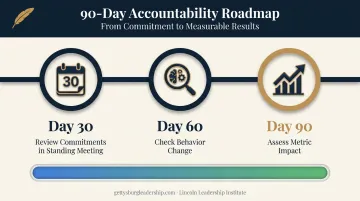
The offsite itself is the easy part. What happens in the following 90 days determines whether it mattered.
Start with a single documented action plan — a one-pager shared with the broader organization. This prevents speculation and builds trust with the people who weren't in the room.
From there, build a 30/60/90-day cadence:
- 30 days: Review commitments in a standing leadership meeting
- 60 days: Check behavior change against what was decided
- 90 days: Assess whether the decision actually moved the metric it was meant to move
Metrics matter too. Three are worth tracking post-offsite:
- Behavior change in subsequent meetings
- Decision-making speed
- Talent retention signals
This isn't anecdotal. DDI's 2023 Global Leadership Forecast, which surveyed nearly 13,700 leaders, found that 54% of organizations with effective leadership development at every level ranked in their industry's top financial-performance decile, compared with just 20% among those without.
Two more habits extend the return:
- Run an offsite post-mortem. Capture what worked and refine the next session before memories fade.
- Pair the offsite with an ongoing credentialed program. A partnership like Lincoln Leadership Institute's accredited certificate with Purdue University Global extends the impact well past two days and gives participants a lasting, verifiable credential.
Frequently Asked Questions
What is a leadership offsite?
A leadership offsite is a dedicated, off-location gathering of senior leaders focused on strategic decisions, alignment, and development, rather than routine business operations. It's built around a specific purpose, not a change of scenery alone.
What is a strategic offsite?
A strategic offsite centers specifically on long-term planning, market positioning, and major business decisions. This distinguishes it from team-building or operational-review sessions, which serve a different purpose.
What does offsite mean in business?
"Offsite" refers to any work-related meeting or event held away from the normal office environment, typically to encourage focus and fresh perspective. The term applies broadly, from team retreats to executive strategy sessions.
How long should an executive offsite be?
One to two days is typical, with a day and a half often ideal. This gives leaders time to surface an issue, sleep on it, and pressure-test decisions the next morning with clearer heads.
How do you measure the ROI of an executive offsite?
Track follow-through on commitments and behavior change in subsequent meetings, then examine downstream performance and retention data over time. Without these checkpoints, ROI stays anecdotal rather than measurable.
What makes an offsite different from a typical team retreat?
Executive offsites are strategic and decision-focused, limited to senior leaders. Team retreats focus on culture and morale, typically involving larger groups with less strategic depth.